

The infrastructure landscape of Bihar’s capital is poised for a generational shift following the finalization of the Patna Ring Road’s master plan. With the recent central approval of the Dighwara-Sarai alignment, the project has cleared its most significant planning hurdle, completing the blueprint for a 150-kilometer access-controlled corridor. Estimated at a staggering ₹16,000 crore, this ambitious project is designed to bypass the congested urban core of Patna, linking the southern and northern banks of the Ganga and fundamentally altering the economic geography of the region.
The Big Picture: A 150-Kilometer Lifeline for Bihar
The Patna Ring Road is not merely a local transit project; it is a strategic national highway initiative (primarily under the NH-131G designation) aimed at integrating the disparate growth centers around the state capital. The corridor is designed as a six-lane, access-controlled expressway that will facilitate the seamless movement of heavy goods and passenger traffic between North and South Bihar.
The project’s finalization comes at a time when Patna is grappling with severe urban sprawl and traffic bottlenecks. By providing a peripheral route, the Ring Road will allow long-distance commuters and commercial vehicles traveling between districts like Saran, Vaishali, and Bhojpur to bypass the city center entirely. This is expected to reduce travel times by up to 60% for cross-regional transit and significantly lower the carbon footprint of the city’s transportation sector.
Chronology of Development: From Conception to Final Approval
The journey of the Patna Ring Road has been one of incremental milestones, involving complex coordination between the State Government of Bihar and the Union Ministry of Road Transport and Highways (MoRTH).
- March 2021: The project gained significant momentum with the "appointed date" for the Kanhauli-Ramnagar section, marking the official start of construction on one of the project’s longest terrestrial stretches.
- June 2025: A major breakthrough occurred when the Bihar Chief Minister’s Office inaugurated the first phase of the Kachhi Dargah-Bidupur project. This 4.57 km section, connecting Kachhi Dargah to Raghopur Diara, provided the first tangible evidence of the project’s utility.
- March 2026: The Bihar government formally approved the northern Dighwara-Sarai alignment. Recognizing its strategic importance, state officials immediately moved the proposal for central clearance, directing the preparation of a Detailed Project Report (DPR).
- June 2026: The Central Government granted its final approval for the Dighwara-Sarai stretch, designating it as the eighth and final alignment of the Ring Road. This approval effectively closed the loop on the 150 km circuit.
- July 2026: Land acquisition activities intensified. The Central Government issued a Section 3D notification for the acquisition of land in the Patna district, specifically focusing on the stretch from Km 0 to Km 8.484, impacting villages such as Kanhauli and Painal.
- August 2026: Parliamentary data revealed the status of the Sherpur-Dighwara package, recording a physical progress of 20.60% and setting a revised completion target for early 2029.
Supporting Data: Breaking Down the Packages
The Patna Ring Road is being executed through a series of independent yet interconnected road and bridge packages. This modular approach allows for simultaneous construction across different terrains.
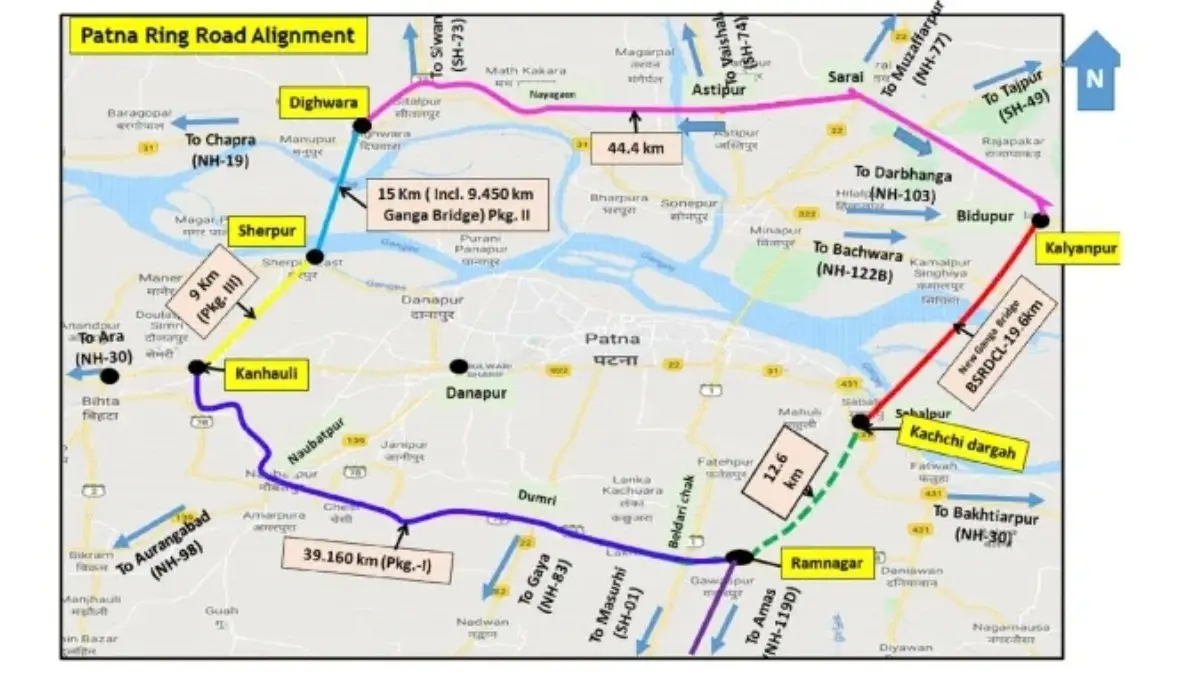
1. The Kanhauli-Ramnagar Section
- Length: 39.16 km
- Specifications: Six-lane package of NH-131G.
- Cost: Initially pegged at approximately ₹913.15 crore.
- Role: This section serves as the western and southern anchor of the ring, connecting the industrial outskirts of Patna.
2. The Kachhi Dargah-Bidupur Bridge
- Length: 19.76 km (including a 9.76 km main bridge over the Ganga).
- Status: Work in progress. As of May 31, 2026, the Bihar State Road Development Corporation (BSRDC) listed this as a priority site.
- Strategic Value: Once fully operational, it will be one of India’s longest river bridges, providing a vital link to Vaishali and reducing the burden on the aging Mahatma Gandhi Setu.
3. The Sherpur-Dighwara Package
- Length: 14.52 km
- Investment: Awarded at a cost of ₹3,012.27 crore.
- Progress: 20.60% as of August 2026.
- Revised Completion Date: March 31, 2029.
- Feature: This includes a massive six-lane Ganga crossing that connects the western part of Patna to the Saran district.
4. The Ramnagar-Kachhi Dargah Corridor
- Length: 14.5 km
- Type: Six-lane greenfield corridor.
- Purpose: It bridges the gap between the southern alignment and the major bridge projects, ensuring a continuous flow of traffic toward the eastern exits of the city.
Official Responses and Strategic Vision
Government officials have emphasized that the Patna Ring Road is more than just a road; it is an "economic corridor." During a review of National Highway projects in early 2026, Bihar state officials highlighted the synergy between the Ring Road and other mega-projects.
The Sonepur Connection: A key talking point in official circles has been the proposed greenfield airport at Sonepur. The Dighwara-Sarai alignment was specifically discussed in the context of providing high-speed road access to this future aviation hub. By linking the airport to the Ring Road, the government aims to create a multi-modal logistics park in the Saran-Vaishali belt.
De-congesting the Capital: The Ministry of Road Transport and Highways (MoRTH) has maintained that the Ring Road is essential for the "urban renewal" of Patna. In parliamentary submissions, the Ministry noted that the project would divert nearly 40,000 to 50,000 Passenger Car Units (PCUs) away from the city’s internal roads daily, thereby improving the quality of life for residents.
Implications for Real Estate and Regional Economy
The finalization of the Ring Road alignment has sent ripples through the Bihar real estate market. Historically, infrastructure projects of this scale in India—such as the Delhi Peripheral Expressways or the Hyderabad Outer Ring Road—have led to exponential growth in peripheral land values.
Emerging Real Estate Hotspots:
- The Sonepur-Dighwara Belt: With the final alignment now set and the link to the proposed airport confirmed, this area is seeing a surge in interest for industrial warehousing and residential townships.
- Kanhauli and Sherpur: These areas are becoming the new western gateways to Patna. The proximity to the six-lane NH-131G makes them ideal for commercial development.
- Bidupur and Sarai: Located on the northern side of the Ganga, these areas are transitioning from agricultural zones to suburban residential hubs for professionals working in Patna who seek more affordable housing and better connectivity.
Industrial and Logistics Growth:
The access-controlled nature of the corridor makes it a magnet for logistics companies. With the Ring Road connecting major national highways, Patna is expected to become a central distribution hub for the entire Northeast India region. The Bihar government has already hinted at planning industrial clusters along the Vaishali and Saran sections of the road.
The Road Ahead: Challenges and Completion Timelines
Despite the optimism surrounding the final alignment approval, the project faces the typical challenges associated with large-scale Indian infrastructure.
Land Acquisition: While the Section 3D notifications have been issued for several stretches, the process of compensation and possession remains a sensitive issue. The July 2026 notification for Kanhauli and Painal villages is a step forward, but the government must ensure a smooth transition to avoid legal delays that have plagued previous projects.
Technical Complexity: Building two massive six-lane bridges over the Ganga (at Kachhi Dargah and Sherpur) involves significant engineering hurdles, especially considering the river’s flow and the monsoon seasons which limit the construction window each year.
Timeline Adherence: The revision of the Sherpur-Dighwara completion date from 2027 to 2029 suggests that the full integration of the Ring Road may take another three to four years. The Dighwara-Sarai section, being the last to receive approval, will now enter the DPR and tendering phase, meaning it will likely be the final piece of the puzzle to fall into place.
Conclusion
The approval of the Dighwara-Sarai alignment marks the end of the "planning era" for the Patna Ring Road and the beginning of an intensive "execution era." At a cost of ₹16,000 crore, the project represents one of the largest single infrastructure investments in Bihar’s history.
By the time the full 150-kilometer loop is operational in the late 2020s, it will have redefined Patna’s urban boundaries. From fostering a new real estate boom in the periphery to enabling the success of the Sonepur greenfield airport, the Ring Road is destined to be the backbone of Bihar’s economic resurgence. For the residents of Patna, it promises a future where the city is no longer a bottleneck, but a gateway to the rest of the country.
