

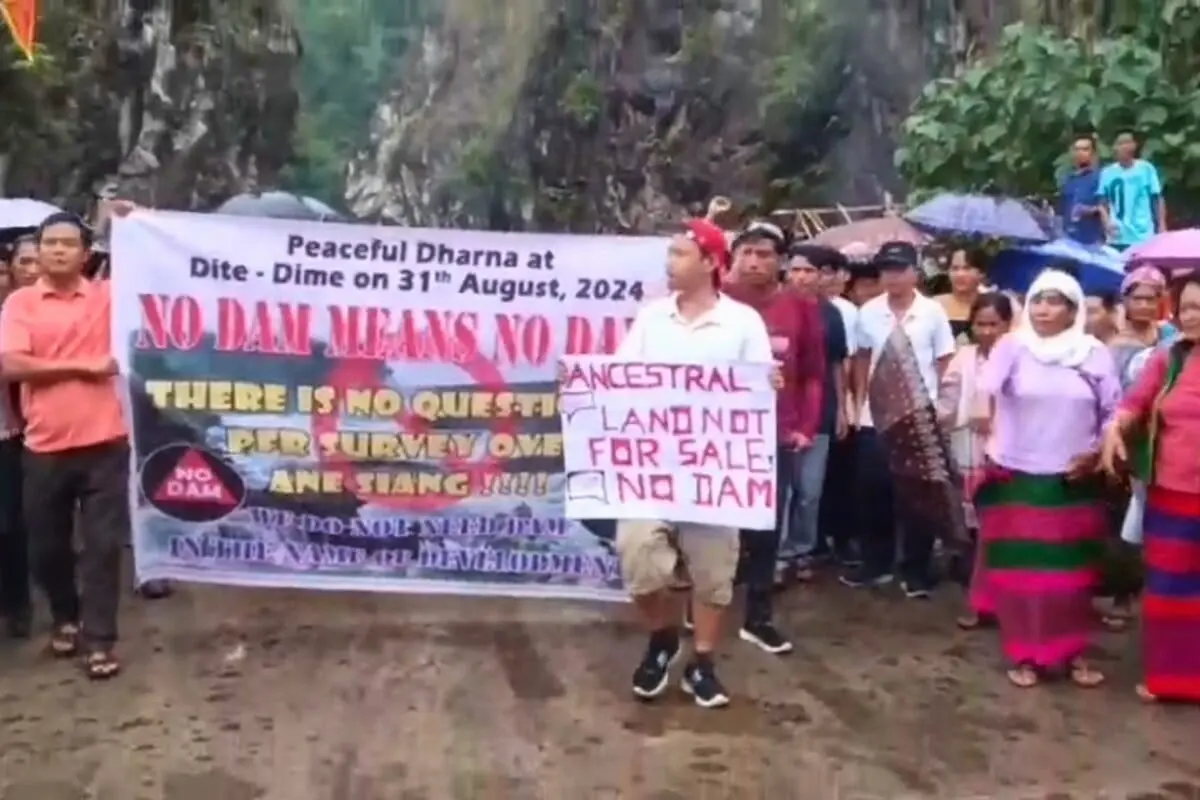
YINGKIONG, ARUNACHAL PRADESH — The serene landscapes of the Siang Valley, where the mighty Brahmaputra enters India from Tibet, have become a theater of intense civil unrest and state intervention. In a significant escalation of the long-standing conflict between the state government and indigenous communities, the Upper Siang district administration has imposed restrictive orders and invoked stringent anti-terror laws to quell protests against the proposed Siang Upper Multipurpose Project (SUMP).
What began as a localized movement to protect ancestral lands has evolved into a high-stakes standoff involving allegations of foreign interference, police lathi charges, and a fundamental debate over the cost of India’s renewable energy ambitions.
Main Facts: A Massive Project and a Massive Resistance
The Siang Upper Multipurpose Project (SUMP) is no ordinary infrastructure undertaking. With a planned capacity of 11,000 megawatts (MW), it is envisioned as India’s largest hydropower project. Spearheaded by the National Hydroelectric Power Corporation (NHPC), the dam is intended to serve three primary purposes: generating massive amounts of electricity for the national grid, providing flood control for the downstream regions of Assam and Bangladesh, and acting as a strategic "water buffer" to counter Chinese dam-building activities on the upper reaches of the Yarlung Tsangpo (as the Siang is known in Tibet).
However, the scale of the project necessitates a massive environmental and social footprint. Current estimates suggest that the reservoir created by the dam would submerge approximately 27 villages. Perhaps most significantly, the submergence zone includes Yingkiong, the administrative headquarters of the Upper Siang district. For the indigenous Adi people and other local communities, the project represents an existential threat to their culture, history, and livelihoods.
The recent flare-up in tensions was triggered by the state’s efforts to move forward with the Pre-Feasibility Report (PFR). The PFR is a critical technical stage required to determine the viability of specific dam sites before a Detailed Project Report (DPR) can be finalized. Local residents, organized under various banners, have vowed to prevent NHPC officials and surveyors from entering the region, leading to a breakdown in law and order.
Chronology: From Peaceful Dissent to Violent Confrontation
The timeline of the current crisis reveals a rapid deterioration of the relationship between the state and its citizens:
- Late September 2024: Tensions began to simmer following a high-profile visit by Arunachal Pradesh Chief Minister Pema Khandu to the district. The visit was intended to build consensus for the project, but it instead galvanized the opposition.
- October 4, 2024: Protests turned violent. Demonstrators reportedly set fire to government vehicles and stormed the residence of a local Member of the Legislative Assembly (MLA). In response, police forces deployed lathi charges to disperse the crowds, resulting in several injuries.
- October 9, 2024: In a move that shocked civil society, four prominent protesters were detained under the Arunachal Pradesh Unlawful Activities (Prevention) Act, 2014 (UAPA). The use of such a stringent law, typically reserved for cases of national security and terrorism, signaled a "zero-tolerance" approach by the state.
- October 11, 2024: The Upper Siang district administration officially issued an order under Section 144 of the CrPC (now Section 163 of the Bharatiya Nagarik Suraksha Sanhita), prohibiting the assembly of five or more people. The order cited the need to maintain public tranquility amid "intensifying protests."
- October 13, 2024: A coalition of civil society groups—the Adi Banne Kebang United, the Siang Indigenous Farmers Forum (SIFF) Youth Wing, and the SUMP Affected Area Youth Association (SAAYA)—submitted a formal memorandum to the District Collector. The document demanded the immediate release of detainees and the withdrawal of security forces.
Supporting Data: Socio-Environmental and Geopolitical Stakes
The resistance to SUMP is rooted in several layers of complex data and historical grievances.
1. Displacement and Cultural Loss
The submergence of 27 villages is not merely a logistical challenge; it is a cultural one. The Adi tribe, the primary inhabitants of the Siang Valley, share a deep spiritual connection with the river. Yingkiong, the town at risk of being lost to the reservoir, serves as the economic and educational hub for thousands of people. Critics argue that the government has yet to provide a credible rehabilitation and resettlement (R&R) plan that accounts for the loss of ancestral burial grounds and sacred sites.
2. The Geopolitical "Race to the Bottom"
The Indian government views SUMP as a strategic necessity. China has announced plans for a "super dam" on the Great Bend of the Brahmaputra, just across the border. New Delhi fears that China could use water as a weapon—either by diverting the flow during lean seasons or releasing massive amounts of water during the monsoon to cause downstream flooding. Proponents of SUMP argue that a large reservoir on the Indian side is the only way to establish "prior user rights" under international law and provide a physical buffer against Chinese hydrological manipulation.
3. The PFR and Technical Uncertainty
The current protests are specifically targeting the Pre-Feasibility Report (PFR). The NHPC needs to conduct topographical surveys and geological drilling to ensure the Himalayan rock formations can support a structure of this magnitude. However, the region is highly seismic (Zone V), and activists point to previous disasters in the Himalayas—such as the 2023 Teesta dam breach in Sikkim—as evidence that mega-dams in this terrain are inherently dangerous.
Official Responses: Peacekeeping vs. Legal Enforcement
The state government and district administration have maintained a dual stance: expressing a desire for "peaceful dialogue" while simultaneously tightening the legal noose around protest leaders.

Ashok Tajo, the District Collector of Upper Siang, has defended the recent administrative actions as necessary for maintaining order. In a statement regarding the detainees, Tajo clarified that the path to their release lies through the state government. “The detainees will have to submit their representations to the state government challenging the detention order of the District Magistrate for release from detention,” he stated, indicating that the matter is now a high-level legal issue rather than a local police concern.
Perhaps the most controversial aspect of the government’s response is the allegation of "foreign funding." The Central Bureau of Investigation (CBI) recently served a notice to Bhanu Tatak, a legal advisor to the Siang Indigenous Farmers Forum (SIFF). The notice alleges a violation of the Foreign Contribution (Regulation) Act (FCRA), claiming Tatak received ₹17 lakh (₹1.7 million) without proper registration.
State officials have hinted that the intensity and sophistication of the anti-dam movement suggest "external influences" aimed at sabotaging India’s strategic infrastructure. These allegations have been vehemently denied by the protesters, who claim their movement is a grassroots effort funded by local donations and driven by the fear of losing their homes.
The Civil Society Stance: A Call for Democratic Agitation
The memorandum submitted on October 13 by the Adi Banne Kebang United and associated youth wings outlines a clear set of demands that the government must meet to restore normalcy:
- Unconditional Release: The immediate release of the four protesters held under UAPA.
- Demilitarization: The withdrawal of Central Armed Police Forces (CAPF) from the Siang and Upper Siang districts.
- Cessation of Studies: An immediate halt to the PFR and all other studies being conducted by NHPC.
- Legal Immunity: The quashing of all legal proceedings and FIRs against those involved in the anti-dam movement.
Goto Apang, the convenor of SAAYA, expressed deep skepticism regarding the government’s approach. “We’ve been approached by the authorities seeking advice on how to restore peace to the area. By the steps they’re taking now, like detaining people, can peace be restored?” Apang asked. He warned that if the demands are not met, the youth and the public would be "compelled to escalate democratic agitation," for which the state would be held solely responsible.
Implications: A Crossroads for Northeast India
The standoff in Upper Siang has implications that resonate far beyond the borders of Arunachal Pradesh.
1. The Shrinking Space for Dissent
The use of UAPA and FCRA investigations against environmental and land-rights activists is a growing trend in India. In the case of SUMP, it suggests that the state views opposition to major infrastructure as a threat to national security. This sets a precedent that could affect other indigenous movements across the Northeast, where land and resource rights are frequently in conflict with national development goals.
2. The Future of Hydropower
Arunachal Pradesh is often called the "Powerhouse of India." The central government has signed dozens of Memorandums of Understanding (MoUs) for hydropower projects in the state. However, the resistance in Siang shows that "top-down" project implementation is increasingly untenable. If the 11,000 MW SUMP project fails or remains stalled, it could force a radical rethinking of India’s energy strategy in the Himalayas.
3. Geopolitical Vulnerability
While the government argues that the dam is needed to counter China, the internal instability caused by the project may actually weaken India’s position. A disgruntled and alienated border population is a significant security risk. The challenge for New Delhi is to find a way to secure its hydrological interests without losing the trust of the very people who live on the front lines of the border.
As the prohibitory orders remain in place and the detainees remain in custody, the Siang Valley remains on a knife-edge. The coming weeks will determine whether the government chooses the path of further securitization or returns to the negotiating table to address the fundamental fears of the Adi people. For now, the "Mighty Siang" continues to flow through a landscape of uncertainty, its future as contested as the land it carves.
