The Indian automotive landscape in late 2026 continues to be a battlefield of technological adoption and brand loyalty. Toyota Kirloskar Motor (TKM), a perennial heavyweight in the Utility Vehicle (UV) and Multi-Purpose Vehicle (MPV) segments, has reported its sales figures for September 2026, revealing a complex narrative of strategic realignment, model transitions, and intensified competition. While certain segments of the portfolio, particularly those born of strategic alliances, are witnessing exponential growth, the brand is navigating a temporary contraction in its core volume drivers as it prepares for a significant product refresh cycle.
Executive Summary: The September Performance Matrix
In September 2026, Toyota Kirloskar Motor recorded total domestic sales of 25,027 units. This figure represents a 7.61% year-on-year (YoY) decline compared to the 27,089 units sold in September 2025. The sequential data further highlights a cooling period, with volumes falling by 11.91% from the 28,410 units dispatched in August 2026.
This performance dip has had a notable impact on the industry leaderboard. For the first time in recent quarters, Kia India has surpassed Toyota in monthly volumes, pushing TKM to the number six position in the national rankings. However, a deeper dive into the data suggests that this is not a symptom of waning brand equity, but rather a calculated "clearing of the decks" ahead of major facelift launches and a shift in consumer preference toward specific utility niches.
Chronology of Performance: From Q3 2025 to September 2026
To understand the September dip, one must look at the broader quarterly context. Toyota’s Q3 2026 (July–September) performance saw a total of 83,953 units delivered. This is a marginal decline of 1.87% compared to the 85,550 units recorded in the same period in 2025.
The trajectory throughout 2026 has been one of high-volume stability followed by a sharp correction in September. August 2026 served as a high-water mark for the year, but the subsequent drop in September can be largely attributed to the massive reduction in Glanza volumes and a strategic slowdown in Innova Hycross dispatches as the company prepares for the facelifted version’s arrival in December.
Supporting Data: A Model-by-Model Breakdown
The "mixed bag" performance of Toyota in September is best understood through the lens of individual model contributions.

1. The Volume Drivers: Hyryder and the Innova Duo
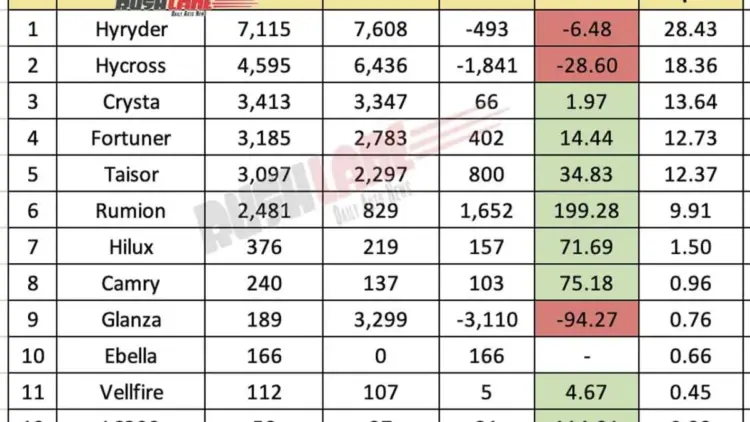
The Toyota Urban Cruiser Hyryder remains the undisputed backbone of the company’s current portfolio. In September 2026, it registered 7,115 units, accounting for a substantial 28.43% of the company’s total monthly sales. Despite its dominance, the Hyryder saw a slight cooling in Q3 2026, with 22,536 units sold—an 11.70% decline from the previous year’s Q3.
The Innova brand remains a formidable force, though its internal split is telling. The Innova Hycross (the premium hybrid offering) saw 4,595 units sold in September, a 28.60% drop from the 6,436 units sold in September 2025. Conversely, the venerable Innova Crysta (the diesel workhorse) showed resilience, growing 1.97% to 3,413 units. Combined, the two Innova models contributed 8,008 units, representing 32% of Toyota’s monthly volume.
2. The Growth Stars: Rumion and Taisor
The most significant gains for Toyota came from its alliance-sourced products. The Toyota Rumion (based on the Maruti Ertiga) nearly tripled its performance, recording 2,481 units compared to just 829 units in September 2025—a staggering 199.28% increase. In Q3 2026, the Rumion grew by 409.78%, proving that Toyota’s entry into the mid-tier MPV segment has finally gained massive traction.
Similarly, the Toyota Taisor (based on the Maruti Fronx) registered 3,097 units, a 34.83% YoY growth. Crucially, the Taisor was the only high-volume model to show growth on both a yearly and a monthly (8.17% MoM) basis, signaling its rising popularity among urban crossover buyers.
3. The Glanza Anomaly
The most dramatic figure in the September report is the Glanza’s performance. Sales plummeted to just 189 units, down from 3,299 units in September 2025—a 94.27% decline. This is not indicative of a product failure; rather, it reflects the transition period for the newly launched facelifted Glanza. Inventory management during a facelift transition often results in a "billing holiday" where old stock is cleared and new stock is yet to reach peak dispatch levels.
4. Premium and Lifestyle Segments
Toyota’s premium "heavy hitters" continue to command their niches:

- Fortuner: Sold 3,185 units, growing 14.44% YoY, maintaining its iron grip on the full-size SUV segment.
- Hilux: The lifestyle pickup saw a 71.69% YoY increase with 376 units.
- Camry: The luxury hybrid sedan grew by 75.18% YoY to 240 units.
- Vellfire & LC300: The ultra-luxury offerings remained stable or grew, with the Land Cruiser 300 doubling its tally from 27 units last year to 58 units this month.
Official Context and Market Factors
While Toyota Kirloskar Motor has not issued a defensive statement regarding the slip to the number six position, internal sources and market analysts point toward a "calculated inventory correction."
Industry experts suggest that Toyota is currently prioritizing the streamlining of its production lines for the upcoming Innova Hycross Facelift. Spied testing recently, the facelifted Hycross is expected to feature a revised interior with a larger hidden touchscreen and updated ADAS (Advanced Driver Assistance Systems) suites. By slowing down dispatches of the current model, Toyota avoids the "inventory pile-up" that often plagues manufacturers before a major update.
Furthermore, the surge in Rumion and Taisor sales highlights the success of the "Toyota-Suzuki" global partnership. These models allow Toyota to capture the sub-15 lakh price bracket, where they previously lacked presence, while their core engineering (the TNGA platform and Hybrid tech) maintains the premium end of the market.
Strategic Implications: The Battle for the Top 5
The rise of Kia India to the number five spot is a significant milestone in the Indian automotive hierarchy. Kia’s aggressive focus on the "Seltos" and "Sonet" refreshes, combined with their expansion into the EV6 and EV9 space, has allowed them to capture the momentum that Toyota momentarily relinquished during its transition phase.
However, for Toyota, the implications are more nuanced:
1. The Hybrid vs. EV Debate
Toyota remains the primary champion of Strong Hybrid Electric Vehicle (SHEV) technology in India. While other manufacturers are pivoting hard toward Battery Electric Vehicles (BEVs), Toyota’s growth in the Hyryder and Hycross segments (despite the temporary September dip) suggests that the Indian consumer still views hybrids as the most practical "bridge" to green mobility.

2. The "Premiumization" of the Portfolio
The data shows that while Glanza (the most affordable Toyota) fell, the Fortuner and Camry grew. This indicates that Toyota’s brand identity is shifting further toward the premium end of the spectrum. The company is becoming less of a "mass-market" player and more of a "premium-utility" specialist.
3. The Facelift Catalyst
The upcoming launch of the facelifted Hycross in December 2026 is expected to be the catalyst that returns Toyota to the number five—or even number four—spot. Historically, Toyota’s "refresh" cycles result in a massive backlog of bookings, often extending wait times to several months.
Conclusion: A Resilient Outlook
September 2026 was a month of consolidation for Toyota Kirloskar Motor. The headline decline of 7.61% masks the underlying strength of the brand’s newer entrants like the Taisor and Rumion, as well as the continued dominance of the Fortuner. The massive drop in Glanza and the cooling of Hycross sales are textbook examples of a manufacturer preparing for a product offensive.
As the industry heads into the final quarter of the 2026 calendar year, all eyes will be on the launch of the facelifted Innova Hycross. If Toyota can resolve supply chain constraints and capitalize on the festive season momentum, the "temporary" loss of the number five spot to Kia may be short-lived. For now, Toyota remains a master of the long game, sacrificing short-term monthly rankings to ensure long-term portfolio health and technological leadership in the hybrid space.