The Indian automotive landscape in 2026 continues to be a theater of intense competition, shifting consumer preferences, and strategic recalibrations. At the heart of this evolution is Toyota Kirloskar Motor (TKM), a manufacturer that has long enjoyed a reputation for reliability, premium positioning, and a dominant hold over the Multi-Purpose Vehicle (MPV) and premium SUV segments. However, the sales data for September 2026 reveals a complex narrative—one of localized triumphs shadowed by a broader volume contraction and a significant shift in market rankings.
As the industry moves toward the final quarter of the year, Toyota’s performance serves as a barometer for the premium and hybrid segments. With a total of 25,027 units sold in September 2026, the company faced a dual challenge: a year-on-year (YoY) decline and a month-on-month (MoM) slump. Perhaps most notably, this period marked a shift in the hierarchy of Indian car manufacturers, with Kia India overtaking Toyota to claim the fifth position in the national sales rankings.
Main Facts: A Quantitative Overview of September 2026
The headline figures for Toyota in September 2026 indicate a period of consolidation and transition. The total sales volume of 25,027 units represents a 7.61% decline compared to the 27,089 units recorded in September 2025. The sequential data is even more stark; compared to August 2026’s 28,410 units, Toyota’s volumes fell by 11.91%.
This downturn contributed to a softened third quarter (Q3 2026). For the period of July to September, Toyota recorded total sales of 83,953 units. While this is a formidable number, it represents a 1.87% dip from the 85,550 units achieved in the same quarter of the previous year.
Despite the overall decline, several models within the Toyota stable demonstrated remarkable resilience. The Toyota Urban Cruiser Hyryder maintained its status as the brand’s primary volume driver, while the Rumion and Taisor—products of the strategic partnership with Maruti Suzuki—showed explosive growth. Conversely, the significant drop in Glanza volumes and a cooling of Innova Hycross sales were the primary anchors weighing down the overall performance.

Chronology of Market Dynamics: From August Peaks to September Adjustments
To understand the September dip, one must look at the preceding months. August 2026 was a period of high inventory loading in anticipation of the early festive season. However, as September progressed, several factors converged to alter the trajectory.
- Late August/Early September: Toyota maintained high production levels, but consumer sentiment began to pivot toward upcoming refreshes. News of the facelifted Innova Hycross being spied on public roads began to circulate, leading some prospective buyers to defer their purchases.
- Mid-September: The launch of the facelifted Glanza occurred. This created a classic "transition gap" where the outgoing model’s inventory was depleted, but the new model’s billing had not yet reached full velocity. This explains the catastrophic 94.27% drop in Glanza sales for the month.
- Late September: Competitive pressure from Kia, particularly with refreshed versions of the Seltos and Carens, began to eat into the market share of the Hyryder and Innova. By the close of the month, Kia’s aggressive retail strategy allowed them to leapfrog Toyota in the monthly standings.
Supporting Data: A Model-by-Model Breakdown
The Leaders: Hyryder and the Innova Legacy
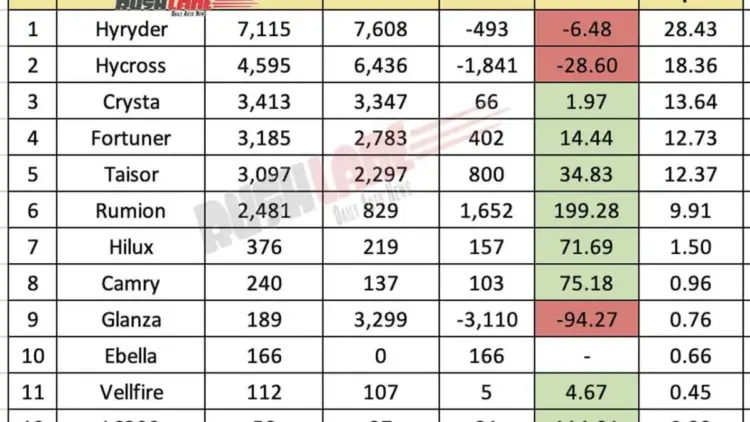
The Toyota Hyryder remains the cornerstone of TKM’s modern strategy. In September 2026, it registered 7,115 units, accounting for a significant 28.43% of the company’s total monthly volume. While it remains a favorite in the mid-size SUV segment due to its strong-hybrid powertrain options, it faced stiff competition from both internal combustion and electric rivals.
The Innova brand, split between the high-tech Hycross and the venerable Crysta, continues to be Toyota’s "bread and butter."
- Innova Hycross: Recorded 4,595 units, a 28.60% decline from the 6,436 units sold in September 2025.
- Innova Crysta: Registered 3,413 units, showing a marginal growth of 1.97%.
The combined Innova tally of 8,008 units represents 32% of Toyota’s sales, proving that even in a "down" month, the Innova remains the de facto choice for Indian families and fleet operators.
The Growth Drivers: Rumion, Taisor, and Fortuner
If the Hycross and Glanza were the laggards, the Rumion and Taisor were the stars of the show.
- Toyota Rumion: This MPV saw its sales nearly triple, jumping from 829 units in September 2025 to 2,481 units in September 2026—a staggering 199.28% increase. This represents the largest absolute annual gain in the lineup.
- Toyota Taisor: The compact SUV-coupe recorded 3,097 units, a 34.83% YoY increase and an 8.17% sequential growth. It was the only high-volume Toyota model to grow on both YoY and MoM metrics in September.
- Toyota Fortuner: Despite the entry of new premium competitors, the Fortuner grew 14.44% YoY with 3,185 units, reaffirming its iron grip on the full-size SUV segment.
The Specialized Segments: Niche and Luxury
Toyota’s niche offerings showed surprising vitality:

- Hilux: 376 units (up 71.69% YoY).
- Camry: 240 units (up 75.18% YoY).
- Vellfire: 112 units (up 4.67% YoY).
- Land Cruiser 300: 58 units, more than doubling its 27-unit performance from the previous year.
Official Responses and Strategic Pivot
While Toyota Kirloskar Motor has not issued a reactionary statement specifically regarding the loss of the No. 5 spot to Kia, the company’s internal strategy is clearly visible through its product lifecycle management.
Industry analysts suggest that Toyota is currently prioritizing "value over volume." By focusing on high-margin vehicles like the Fortuner, Vellfire, and the strong-hybrid variants of the Hycross, Toyota is maintaining a healthy bottom line even if the unit numbers fluctuate. Furthermore, the massive drop in Glanza sales (down to 189 units from 3,299) is being viewed by the company as a "planned vacuum." The launch of the facelifted Glanza, equipped with Advanced Driver Assistance Systems (ADAS) and ventilated seats, is expected to reclaim lost ground in the premium hatchback segment by Q4 2026.
Regarding the Innova Hycross, internal sources suggest that the production line is being optimized for the upcoming facelift expected in December. This refresh is rumored to include a revamped interior and a larger touchscreen interface, addressing some of the minor critiques of the current model.
Implications for the Future: What Lies Ahead?
The September 2026 sales breakup carries several significant implications for Toyota and the wider Indian automotive industry.
1. The Battle for the Top 5
Kia’s ascent to the No. 5 position is a wake-up call. Kia has leveraged a younger brand image and a faster feature-update cycle. Toyota, conversely, relies on a "slow and steady" approach. To reclaim its position, Toyota will likely need to accelerate the introduction of its own battery electric vehicles (BEVs) or further enhance the tech-suite in its mass-market models like the Hyryder.

2. The Success of the Partnership Strategy
The performance of the Rumion and Taisor validates Toyota’s partnership with Maruti Suzuki. These models allow Toyota to participate in high-volume segments without the massive R&D costs of developing ground-up platforms for every sub-segment. The fact that the Rumion and Taisor provided the "cushion" for the Glanza and Hycross decline suggests that Toyota’s multi-pronged product strategy is working as a safety net.
3. The Resilience of Hybrid Technology
Despite the overall volume dip, the demand for Hyryder and Hycross hybrids remains steady. As the Indian government continues to debate GST rationalization for hybrids, Toyota’s early-mover advantage in this space remains its most significant competitive moat. If tax breaks for hybrids are realized in the 2027 budget, Toyota could see an unprecedented surge in demand.
4. Q4 Outlook and the Festive Season
With the facelifted Glanza now hitting showrooms and the facelifted Hycross slated for a December debut, Toyota is positioning itself for a strong finish to the year. The company is betting that the "newness" of these models will coincide with the peak festive buying period in India, potentially reversing the negative YoY trends seen in September.
Conclusion
Toyota’s September 2026 performance is a classic example of a "transitional" month. While the headline decline and the loss of market rank to Kia may seem concerning at first glance, a deeper dive into the data reveals a brand in the middle of a strategic refresh. The explosive growth of the Rumion and the steady dominance of the Fortuner provide a solid foundation, while the temporary dip in Glanza and Hycross volumes appears to be a calculated byproduct of model lifecycle transitions.
As the automotive world looks toward 2027, Toyota’s ability to balance its legacy of reliability with the modern demands of technology and hybridization will determine whether it can reclaim its top-five status or if it will remain a specialized player in the premium and MPV niches. For now, all eyes are on the December launch of the Hycross facelift, a vehicle that could very well define Toyota’s trajectory for the next fiscal year.