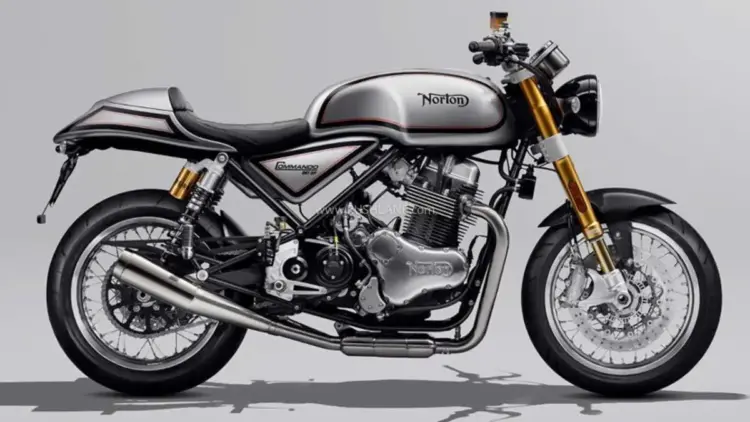
The global motorcycling landscape is witnessing a seismic shift as heritage brands pivot toward the highly lucrative mid-capacity segment. In a move that signals a bold new chapter for British motorcycling, Norton Motorcycles—now under the stewardship of India’s TVS Motor Company—is preparing to venture into the mass-market premium space. At the heart of this strategy is a newly developed 450cc single-cylinder platform, internally codenamed the "H-Series."
This initiative represents the second phase of TVS Motor’s ambitious revival plan for Norton. While the first phase focused on stabilizing the brand’s reputation and launching high-end, multi-cylinder machines like the Manx and Atlas ranges, the H-Series is designed to bring the Norton badge to a broader global audience. With a debut slated for EICMA 2026 in Milan, this development marks a critical juncture where British design meets Indian industrial prowess.
Main Facts: The H-Series and Norton’s Global Ambitions
The upcoming Norton 450cc range is not merely a single motorcycle but a modular platform designed to spawn a variety of genres. The move mirrors successful strategies employed by other partnerships, such as Bajaj-Triumph and Hero-Harley Davidson, which have sought to democratize iconic brands without stripping away their premium allure.
Technical Specifications and Performance
While official technical sheets remain under wraps, preliminary reports and industry intelligence suggest that the H-Series will feature a state-of-the-art 450cc single-cylinder engine. Unlike the air-cooled simplicity of traditional singles, this power unit is expected to be liquid-cooled, featuring a Double Overhead Camshaft (DOHC) setup to ensure it meets stringent Euro 5+ and upcoming global emission norms.
- Power Output: The engine is projected to produce between 40 bhp and 45 bhp.
- Torque: Peak torque is estimated to sit in the 40–45 Nm range, providing a punchy low-to-mid-range performance ideal for both urban commuting and spirited weekend rides.
- Transmission: A 6-speed gearbox, likely equipped with a slip-and-assist clutch, will be standard.
- Body Styles: The rollout will commence with a "Roadster," followed by an Adventure (ADV) variant, a Scrambler, and potentially a Cafe Racer or Bobber to honor Norton’s stylistic roots.
Manufacturing and Export Strategy
In a strategic move to optimize costs while maintaining high quality-control standards, the H-Series will be manufactured at TVS Motor’s world-class facility in Hosur, India. This plant already serves as the manufacturing hub for BMW Motorrad’s sub-500cc range (the G 310 series), proving TVS’s capability to meet international luxury standards. These India-made Nortons are destined for global markets, including Europe, North America, and Southeast Asia, alongside a significant push into the Indian domestic market.
Chronology: From Acquisition to the H-Series
To understand the significance of the 450cc project, one must look at the timeline of Norton’s evolution under TVS ownership.
- April 2020: TVS Motor Company acquires Norton Motorcycles in an all-cash deal worth approximately £16 million. The brand was then in a state of financial and administrative distress.
- 2021–2022: TVS invests heavily in a new state-of-the-art headquarters in Solihull, England. The focus is on re-engineering the flagship V4SS and Commando 961 models to fix quality issues inherited from the previous administration.
- 2023–2024: The "First Phase" of the product offensive begins. Norton showcases the new generation of the Atlas (650cc twin) and the Manx series. These bikes serve as the "halo" products to re-establish the brand’s premium credentials.
- Late 2024: Internal development of the "H-Series" 450cc platform accelerates as TVS identifies a gap in the sub-500cc premium segment.
- January – March 2027: Norton is scheduled to officially re-enter the Indian market, initially with its higher-displacement imported or CKD (Completely Knocked Down) models like the Atlas and Manx.
- EICMA 2026 (November): The global debut of the first H-Series 450cc Roadster is set for the Milan Motorcycle Show.
- H2 2027: Commercial launch and global deliveries of the 450cc range are expected to commence.
Supporting Data: The Mid-Capacity Market Surge
The decision to develop a 450cc single-cylinder engine is backed by significant market data. The "mid-size" segment (250cc to 750cc) is currently the fastest-growing slice of the global motorcycle market.
- The Royal Enfield Factor: In India and abroad, Royal Enfield’s 450cc "Sherpa" engine (found in the Himalayan 450 and Guerrilla 450) has set a benchmark for performance singles. Norton’s 450cc platform is positioned as a direct "Premium+" competitor to these models.
- The Export Opportunity: European and American markets are seeing a resurgence in "A2-license" compliant motorcycles. A 40-45 bhp Norton fits perfectly into this regulatory bracket, making it an attractive entry point for younger riders in developed economies.
- Cost Efficiency: By utilizing the H-Series platform across multiple genres (Roadster, ADV, Scrambler), Norton can achieve economies of scale. Industry analysts suggest that sharing R&D costs between TVS and Norton for this platform could reduce production costs by up to 30% compared to a solo UK-based development.
Trademark Insights
Norton has recently filed for several trademarks that provide clues to the H-Series nomenclature. Names like Norton Electra, Norton Combat, Rover, Inter, and Avalon have been secured. Historically, "Electra" and "Combat" were variants of the classic Commando, suggesting that the 450cc range will lean heavily into the brand’s heritage to differentiate itself from the "appliance-like" feel of some modern competitors.
Official Responses and Strategic Vision
While TVS Motor executives have remained tight-lipped about specific torque curves or pricing, the overarching corporate sentiment has been one of "restoration with modernization."

Sudarshan Venu, Managing Director of TVS Motor Company, has previously emphasized that Norton will remain a "global brand" and that TVS will provide the necessary "industrial backbone" to ensure its success. The strategy is clear: Norton provides the soul, design, and brand equity, while TVS provides the engineering precision, supply chain, and manufacturing scale.
The shift toward a 450cc single-cylinder engine is a pragmatic response to the "volume vs. value" debate. By producing a high-quality, high-volume single-cylinder bike, Norton can generate the cash flow required to fund its more exotic projects, such as electric super-bikes and liter-class performance machines.
Implications: A New Era for Norton and the Industry
The introduction of the H-Series has far-reaching implications for Norton, TVS, and the motorcycle industry at large.
1. Brand Dilution vs. Brand Expansion
The primary challenge for Norton will be maintaining its "ultra-premium" image while selling a mass-produced 450cc motorcycle. To mitigate this, Norton is expected to use high-end components—such as Brembo brakes, Ohlins or high-spec Showa suspension, and advanced electronics (cornering ABS, traction control)—to ensure the 450cc range feels a cut above the standard offerings from Royal Enfield or Honda.
2. Competitive Disruption
The Norton 450cc Roadster will enter a crowded arena. It will face off against:
- Triumph Speed 400: The current gold standard for finish and value.
- Royal Enfield Guerrilla 450: The torque-heavy, characterful challenger.
- KTM 390 Duke: The tech-loaded performance leader.
Norton’s edge will likely be its "Britishness"—a blend of timeless aesthetics and a more sophisticated, "gentlemanly" performance profile compared to the aggressive KTM or the rugged Royal Enfield.
3. The GST and Displacement Dynamics in India
In the Indian domestic market, motorcycles above 350cc attract higher tax brackets. There is speculation that TVS might consider a "sleeved-down" 350cc version of the H-Series for India to compete more aggressively on price, though current reports suggest Norton will stick to the 450cc displacement to maintain its performance edge and global uniformity.
4. Technological Spillover
The development of a high-performance 450cc single will undoubtedly benefit TVS’s own product line. We may see derivatives of this engine technology appearing in future TVS Apache models, creating a virtuous cycle of engineering excellence between the parent company and the subsidiary.
Conclusion
The Norton H-Series 450cc platform is more than just a new motorcycle; it is a litmus test for the "India-owned, British-designed" business model. If successful, it will prove that legacy brands can be revitalized without losing their identity, provided they are backed by the right industrial partner.
As the world looks toward EICMA 2026, the anticipation builds for a Norton that is not just a museum piece or a billionaire’s toy, but a machine that can be seen, heard, and ridden on every street corner. For the first time in decades, Norton is not just looking back at its glorious past—it is racing toward a high-volume, high-performance future.