
The esteemed Master of Business Administration (MBA) degree, long considered a golden ticket to career advancement, is undergoing a significant transformation. As economic tides shift and technological advancements, particularly Artificial Intelligence (AI), reshape the corporate world, the traditional value proposition of an MBA is being re-evaluated. This in-depth analysis delves into the current realities of MBA programs, focusing on financial returns, the performance of newer institutions, the impact of AI on entry-level roles, and the global trends, offering a clear-eyed perspective for prospective students and stakeholders alike.
The Shifting Sands of MBA Value: A Question of Numbers and Institutions
The initial premise is stark: an MBA is still a worthwhile investment, but for a more discerning group, at fewer institutions, and for reasons that have evolved from just five years ago. While top-tier Indian Institutes of Management (IIMs) continue to offer rapid returns on investment, with median graduates recouping their fees in under a year, a different narrative is unfolding at several newer IIMs. Here, escalating fees are increasingly outpacing stagnant or declining median salaries, raising questions about the financial prudence of these programs.
Compounding this challenge is the silent but significant impact of Artificial Intelligence (AI). AI is steadily encroaching upon the entry-level corporate roles that historically served as the crucial first rung on the career ladder for MBA graduates. For aspiring candidates preparing for competitive entrance exams like the CAT, the immense financial outlay – ranging from ₹20 to ₹27 lakh and a two-year commitment – prompts a crucial question: is this investment truly justifiable? While parents might hesitate to vocalize these concerns, coaching institutes may offer an overly optimistic outlook, and the curated successes on platforms like LinkedIn often mask the complexities, this article aims to provide an unvarnished assessment. We will examine the financial metrics, the performance of newer IIMs, the tangible effects of AI on entry-level employment, the global MBA landscape, and project future trends for the degree through 2031, free from any sales pitch, relying solely on empirical data and insightful analysis.
The Financial Equation: Payback Periods Dictated by Institute Prestige
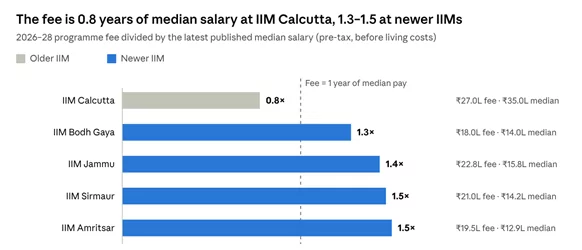
The financial viability of an MBA program in India is now intrinsically linked to the reputation and placement record of the institution. At the apex of the Indian management education system, the numbers remain compelling. For instance, IIM Calcutta, with fees approximating ₹27 lakh for the 2026-28 batch, reported a median salary of ₹35 lakh for its 2026 graduates. This signifies a remarkably swift return on investment, with the fee being recouped in less than a year.
However, this optimistic picture dims considerably when examining several newer IIMs. For these institutions, the tuition fees often exceed the typical graduate’s annual salary, leading to payback periods stretching well beyond a year. It is crucial to acknowledge that these reported figures often present a flattering view. They typically do not account for essential factors such as income tax, the substantial living expenses incurred over two years, and, perhaps most critically, the forgone salary an individual would have earned had they not pursued the MBA. For an individual earning ₹10 lakh per annum prior to commencing their MBA, the opportunity cost of two years of lost earnings, in addition to the program fees, can easily amount to another ₹20 lakh. When these crucial elements are factored in, the payback period at newer IIMs can extend from approximately 1.5 years to over three years, contingent on the candidate’s pre-MBA salary and their reliance on educational loans.
Despite these financial realities, pursuing an MBA from a newer IIM is not inherently a poor decision. A median salary ranging from ₹14 to ₹16 lakh still represents a significant career advancement for fresh graduates or those transitioning from roles earning ₹5 to ₹7 lakh. Nevertheless, the decision to enroll should be guided by a sober assessment of the median salary figures and one’s personal financial projections, rather than solely by the headline-grabbing highest salary packages.
Newer IIMs: Unpacking the Nuances Beyond Placement Reports
The question of an MBA’s worth becomes particularly pertinent and complex when considering the newer IIMs. An analysis of National Institutional Ranking Framework (NIRF) data by Careers360 reveals a concerning trend: across nine of these newer institutions, six reported a decline in median salaries for their 2025 graduating cohort compared to earlier batches.
These drops are not negligible. IIM Bodh Gaya, for example, witnessed a significant decrease in its median salary, falling from ₹15.5 lakh to ₹12.12 lakh over two graduating batches – a reduction of approximately 22%. Similarly, IIM Amritsar experienced a dip of about 19% in its median salary, settling at ₹12.9 lakh. While this trend is not universal, and some newer IIMs have shown positive movement – IIM Sirmaur’s median salary increased by around 12.6% to ₹14.2 lakh, and IIM Jammu saw a slight rise to ₹15.8 lakh – the overall picture suggests a challenging environment for these institutions.
Beyond the published numbers, the omissions in placement reports often carry more weight than their inclusions. For the 2024-26 batch, IIM Amritsar, while advertising a highest Cost to Company (CTC) of ₹43 lakh, conspicuously omitted average or median salary figures. IIM Sirmaur’s latest summary provided an average salary but lacked a median. IIM Bodh Gaya, to its credit, reports on an audited "MEP" (Modified Earnings Potential) basis, which is a commendable practice, but these figures are not directly comparable to schools that do not adhere to similar auditing standards. Therefore, before placing complete trust in any institutional brochure, prospective students should rigorously scrutinize placement data by asking critical questions about the reporting methodology, the distinction between average and median salaries, the inclusion of all graduates in the reported figures, and the existence of independent audits. Our comprehensive tracker of IIM placement reports aims to provide a consolidated view of median salaries, batch sizes, and audit statuses for every IIM that makes this data publicly available.
AI’s Impact on Entry-Level Roles: The Evidence Speaks
The burgeoning presence of AI in the workplace has ignited a debate about its potential to displace jobs. While wholesale job destruction is not yet evident, the evidence strongly suggests that AI is indeed thinning out the junior ranks of the corporate hierarchy – precisely the segment where most fresh MBA graduates traditionally find their initial employment.
A landmark study by Stanford’s Digital Economy Lab, which analyzed payroll data from millions of US workers, provides compelling insights. It found that 22-to-25-year-olds employed in occupations most susceptible to AI experienced a relative decline in employment of 13% since late 2022. In contrast, older workers in similar roles maintained or even increased their employment levels. An update to this research in August 2026 indicated that this disparity had widened to 19%, yet it still did not point to an economy-wide wave of job displacement.
Two key takeaways from this research are particularly relevant for MBA aspirants. Firstly, roles where AI serves to augment human capabilities, rather than entirely replace tasks, have shown stable or growing employment. Secondly, the employment gap narrows significantly when educational attainment is considered. In simpler terms, the repetitive and codified tasks often associated with junior analyst roles are vulnerable to AI, whereas roles demanding judgment, client interaction, and the strategic direction of AI remain more resilient.
This sentiment is echoed by employers globally. A 2026 survey conducted by the Graduate Management Admission Council (GMAC) involving 621 recruiters across 39 countries revealed that approximately one in three employers plan to replace some entry-level roles with AI. Concurrently, 53% of these recruiters identified proficiency in using AI tools as the most crucial skill for the next five years.
In India, the impact is beginning to manifest. Naukri’s JobSpeak index for September 2026 indicated a modest 2% increase in overall white-collar hiring, with fresher hiring up by just 1%. However, roles related to AI/ML saw a substantial surge of 20%. Within the IT sector, the demand for AI talent was most pronounced among individuals with 8 to 16 years of experience. This suggests that companies are actively seeking specialized expertise and experience, while exhibiting caution regarding generalist fresh graduates.
The consulting sector, a primary recruiter for many top IIMs, offers a clear illustration of this shift. McKinsey, after a period of contraction, has signaled a 12% increase in hiring for 2026 and has integrated AI components into its final-round interviews in the US. Similarly, Boston Consulting Group (BCG) has been strategically tilting its hiring towards AI and technology specialists, prioritizing them over generalist MBA graduates. While these firms are resuming recruitment, the profile of the candidates they seek has undeniably evolved.
The honest assessment for prospective MBA students is that AI renders a generic MBA less valuable while amplifying the worth of a specialized and differentiated one. A career path focused on an MBA followed by a generic analyst role, one that could be partially automated by a sophisticated AI model, has a significantly shorter shelf life than it did even in 2022.
The Global MBA Arena: Demand Persists, But Preferences are Shifting
Globally, the demand for MBA graduates remains robust, although the landscape is increasingly characterized by a preference for fewer, more prestigious institutions and a growing interest in programs located outside North America. GMAC’s latest survey indicates a 2% rise in MBA applications for the 2025-26 cycle, building upon a record 13% increase the previous year. Full-time, two-year programs, in particular, saw a 4% growth in applications.
This growth, however, is not evenly distributed. Among the most selective 25% of MBA programs, 52% reported an increase in applications, whereas only 28% of the least selective programs experienced similar growth. This trend highlights a flight to quality, with top-tier business schools attracting a larger share of applicants. Conversely, several US business schools have recently paused or discontinued their full-time MBA programs, including the Bauer College at the University of Houston in 2025, and previously, institutions in Illinois and Iowa. These schools have pivoted towards online, part-time, or one-year formats.
Even elite institutions have faced challenges. Harvard Business School reported that 23% of its job-seeking Class of 2024 had not secured an offer three months post-graduation, a figure more than double the historical average. The Class of 2025 showed a recovery, with 90% having offers at the three-month mark and nearly 94% by November, with Stanford GSB also reporting similar placement rates. Salary outcomes, however, remained stable throughout this period.
Despite these fluctuations, the salary premium associated with an MBA degree persists. GMAC’s 2026 recruiter survey projects a median starting salary of US$120,000 for new MBA hires in the United States, compared to US$107,500 for experienced professionals recruited directly from industry. Employers continue to value the MBA, but they are becoming more selective about the institutions they recruit from and the AI-related competencies of the graduates.
Prognostications for the MBA: A Look Towards 2031
Based on the discernible trends, we offer five predictions for the evolution of the MBA degree between 2026 and 2031:
- Hyper-Specialization: MBA programs will increasingly offer specialized tracks in emerging fields like AI ethics, sustainable finance, digital transformation, and global supply chain resilience. This will cater to the demand for specific skill sets rather than general management knowledge.
- AI Integration as Core Curriculum: AI literacy and the application of AI tools in business strategy, marketing, finance, and operations will become a fundamental component of all MBA curricula, not just elective offerings.
- Rise of Hybrid and Modular Formats: While full-time, two-year programs at top institutions will remain prestigious, there will be a significant expansion of one-year programs, hybrid models, and modular executive MBAs catering to experienced professionals seeking targeted upskilling.
- Increased Emphasis on Soft Skills and Leadership: As AI handles more analytical tasks, the demand for uniquely human skills – critical thinking, complex problem-solving, emotional intelligence, negotiation, and ethical leadership – will surge, becoming a central focus of MBA pedagogy.
- Global Diversification of Top Programs: While North American and European schools will retain their prominence, business schools in Asia, particularly India and Southeast Asia, and other emerging markets will gain further traction, driven by their understanding of local economies and growing global influence.
The Decisive Question: Is an MBA Right for You?
The MBA is no longer a monolithic product; its value proposition is nuanced and context-dependent. Consequently, there is no single, universal answer to whether pursuing an MBA is the right choice. The decision hinges on individual circumstances, aspirations, and a clear-eyed assessment of personal goals. We present a framework to help you navigate this crucial decision:
| Your Situation | Our Honest Take | What to Check First |
|---|---|---|
| 99+ percentile range, aiming for IIM A/B/C/L/K or equivalent | Still one of the most valuable degrees in India. The financial payback is rapid, and the network effects are significant and enduring. | Clearly define the specific roles and industries you wish to target post-MBA to ensure the two years of study are optimally utilized. |
| Two-plus years of work experience and a clear career switch in mind | A strong case for an MBA. The degree is fundamentally designed for career transitions, and AI poses less of a threat to experienced professionals. | Evaluate if a one-year program could achieve your career transition goals more efficiently and cost-effectively. |
| Fresher with conversions primarily from newer IIMs or tier-2 schools | Exercise extreme caution. With fees in the range of ₹18-23 lakh and median salaries hovering around ₹12-16 lakh, the payback period is prolonged. Fresher roles are most AI-exposed. | Scrutinize the institution’s independently audited median placement figures and their track record specifically for fresher placements. |
| Pursuing the degree because "everyone in my batch is" or to escape a disliked job | It’s advisable to reconsider. A year of focused professional development, acquiring AI-specific skills, or seeking an internal role change within your current company might be more beneficial. | Identify precisely what you are unable to achieve in your current trajectory without the MBA qualification. |
| Planning a substantial loan for a non-IIM, non-top-20 program | Proceed with extreme caution. This is where the return on investment (ROI) narrative most frequently falters. | Compare the projected loan EMIs against realistic, not aspirational, post-MBA salary expectations. |
Ultimately, the MBA landscape is evolving, demanding a more strategic and informed approach from prospective students. By understanding the data, recognizing institutional differences, and acknowledging the transformative power of AI, individuals can make a decision that aligns with their long-term career aspirations and financial realities. Connecting with current students and alumni can provide invaluable firsthand insights into the realities of various programs, further informing this critical choice.