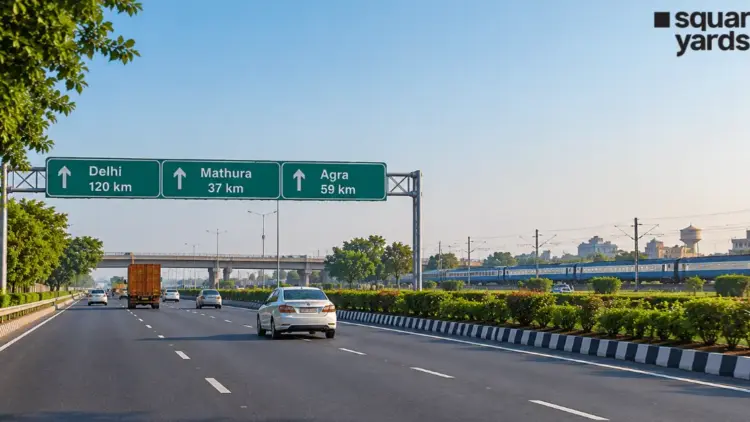
The Delhi-Agra highway, one of India’s most critical economic and tourism arteries, is poised for a transformative upgrade. On November 17, 2026, the government officially sanctioned a massive infrastructure package worth Rs 1,123.56 crore aimed at de-congesting the National Highway network connecting the National Capital Region (NCR) to the city of the Taj Mahal.
This ambitious project focuses on the enhancement of National Highway 44 (NH-44) and National Highway 19 (NH-19), stretching across the industrial heartlands of Haryana and the cultural hubs of Uttar Pradesh. By integrating advanced engineering solutions such as flyovers, underpasses, and railway overbridges, the project seeks to modernize a corridor that currently struggles under the weight of nearly 70,000 vehicles daily.
Core Project Facts and Financial Layout
The approved investment of Rs 1,123.56 crore represents a significant commitment to the "Gati Shakti" vision of integrated infrastructure development. Rather than constructing a brand-new expressway, the focus is on "brownfield" optimization—improving the existing highway network to ensure that current bottlenecks do not stifle regional growth.
The project encompasses a multi-state jurisdiction, covering:
- Haryana: The industrial and residential districts of Faridabad and Palwal.
- Uttar Pradesh: The tourism and commercial centers of Mathura and Agra.
The technical scope of the work is divided into eleven major structures designed to segregate local traffic from high-speed transit:
- Three Road Over Bridges (ROBs): Aimed at eliminating delays at railway level crossings.
- Four Flyovers: Designed to allow through-traffic to bypass high-density urban intersections.
- Four Vehicle Underpasses (VUPs): Facilitating safe movement for local residents and farmers across the highway without interrupting the main traffic flow.
Chronology: From Bottlenecks to Seamless Connectivity
The Delhi-Agra corridor has historically been a victim of its own success. As the primary link between the capital and the plains of Uttar Pradesh, the road has seen exponential growth in traffic over the last two decades.
The timeline leading up to the November 17, 2026, approval reflects a growing urgency to address the "missing links" in the corridor’s efficiency. For years, commuters and freight operators have complained of "phantom jams" at locations like Ballabhgarh and the intersections near Mathura. While the Yamuna Expressway provided an alternative route for light vehicles, the NH-44/19 remains the lifeline for heavy industry, logistics, and budget-conscious travelers.
The approval marks the transition from the planning phase to the execution phase. This development follows a series of feasibility studies conducted by the National Highways Authority of India (NHAI), which identified that the existing infrastructure was no longer sufficient to handle the 68,000 Passenger Car Units (PCUs) that traverse the route daily. The project is expected to enter the tendering phase in early 2027, with construction milestones set to roll out over the following 24 to 36 months.
Technical Breakdown: Engineering a Congestion-Free Future
The engineering philosophy behind this Rs 1,123 crore project is "grade separation." By moving traffic onto different levels, the project minimizes the "conflict points" that lead to accidents and delays.
The Role of Road Over Bridges (ROBs)
The Delhi-Agra route is intersected by several busy railway lines, including the North-Central Railway’s main trunk route. Currently, when a train passes, traffic on the highway can back up for kilometers. The three new ROBs will ensure that the flow of goods and people is decoupled from the railway schedule, providing a permanent solution to one of the most frustrating causes of delay on the NH-19.
Flyovers and Grade-Separated Intersections
Four new flyovers will be strategically placed at intersections where local arterial roads meet the national highway. In areas like Faridabad and Palwal, local traffic often cuts across the highway, forcing high-speed vehicles to slow down or stop. These flyovers will allow highway traffic to maintain a constant speed of 80-100 km/h while local commuters use the ground-level roundabouts and service lanes.
Vehicle Underpasses (VUPs)
Safety is a primary driver for the four VUPs. Pedestrians and slow-moving local vehicles often take risks crossing the eight-lane highway. The VUPs, particularly in locations like Mitraol and Mundkati Chowk, will provide a dedicated subterranean path for local movement, significantly reducing the "black spots" where accidents are currently frequent.
Supporting Data: Analyzing the 68,000 PCU Traffic Load
To understand the scale of this project, one must look at the data. The corridor handles approximately 68,000 Passenger Car Units (PCUs) every day. A PCU is a metric used in transportation engineering to assess traffic flow; for instance, a heavy truck might count as 3 PCUs, while a motorcycle counts as 0.5.
The traffic composition on this route is uniquely diverse:
- Industrial Freight: Serving the manufacturing clusters of Faridabad and the logistics hubs of Palwal.
- Interstate Logistics: Heavy carriers moving goods from the ports of Western India toward Delhi and the North.
- Tourism: Thousands of private cars and luxury buses heading to Mathura, Vrindavan, and Agra.
- Daily Commuters: A growing population of professionals living in Palwal or Faridabad and working in Delhi or Noida.
The data suggests that without this Rs 1,123.56 crore intervention, the travel time between Delhi and Agra via the NH-19 would have increased by 40% over the next five years due to saturation.
Official Responses and Strategic Vision
While official statements from the Ministry of Road Transport and Highways (MoRTH) emphasize the technical merits, government sources also highlight the broader economic impact.
"The Delhi-Agra corridor is not just a road; it is an economic conveyor belt," stated a senior official involved in the project planning. "By investing over Rs 1,100 crore, we are reducing the cost of logistics. Every minute saved for a truck on this highway translates into lower fuel consumption and faster turnaround times for industries in Haryana and UP."
The government also views this project as a crucial component of the "Tourism Circuit" development. By making the drive to Mathura and Agra smoother, the project supports the Ministry of Tourism’s efforts to increase the "stay-time" of international visitors by making travel between heritage sites less exhausting.
Regional Implications: A District-by-District Analysis
The impact of this infrastructure package will be felt differently across the four primary districts it touches.
Faridabad and Palwal: The Industrial Backbone
In Faridabad, the project addresses the "urban-industrial choke." As the city has expanded, the highway has effectively become an internal city road in sections like Ballabhgarh. The new flyovers will help separate local school and office commuters from the heavy industrial trucks moving toward the KMP (Western Peripheral) Expressway.
In Palwal, the focus is on transit efficiency. As a burgeoning hub for plotted developments and warehouses, Palwal requires seamless access points. The underpasses at Mitraol and Mundkati Chowk are specifically designed to help the rural and semi-urban population navigate the highway safely, fostering better integration of the district’s eastern and western halves.
Mathura and Agra: The Tourism Gateway
For Mathura, the religious capital of the region, the upgrade is a boon for the "weekend tourism" economy. The current congestion at the entry points to the city often deters travelers from Delhi-NCR. Smoother roads mean more frequent visits and higher revenue for local hospitality businesses.
In Agra, the project complements the existing inner ring road and the Lucknow-Agra Expressway. By improving the "old" Delhi-Agra road (NH-19), the government is ensuring that the traditional commercial areas of Agra—which are not directly served by the Yamuna Expressway—remain competitive and accessible.
Socio-Economic and Real Estate Impact
The announcement has already sent ripples through the real estate markets of the region. Infrastructure is the single greatest driver of property value, and the Delhi-Agra corridor is no exception.
- Residential Growth in Palwal: With improved connectivity, Palwal is increasingly seen as a viable "affordable" alternative to the saturated markets of Gurgaon and Faridabad. The reduction in travel time to Delhi makes daily commuting a realistic prospect for middle-income families.
- Warehousing and Logistics: The stretch between Ballabhgarh and Palwal is expected to see a surge in demand for Grade-A warehousing. Logistics firms favor locations where "entry and exit" from the national highway are seamless.
- Hospitality in Mathura: Real estate experts predict an uptick in the development of hotels and resorts along the highway stretch in Mathura, as the ease of travel encourages more "day-trippers" to convert into "overnight stayers."
- Industrial Appreciation: In Faridabad’s industrial sectors, the easing of bottlenecks means better supply chain efficiency, which inherently increases the value of industrial land and factory units.
Conclusion: A Corridor Reimagined
The Rs 1,123.56 crore approval for the Delhi-Agra road corridor is more than just a construction project; it is a strategic recalibration of one of India’s most vital transport links. By addressing the specific pain points of railway crossings, busy intersections, and local-versus-express traffic conflicts, the project promises to deliver a safer, faster, and more reliable journey.
As the 68,000 daily vehicles find a smoother path through the four districts of Haryana and Uttar Pradesh, the ripple effects will be felt in the form of reduced carbon emissions, lower logistics costs, and a significant boost to the regional economy. For the millions who travel this historic route, the "road to Agra" is finally catching up with the demands of the 21st century.