“When the flood took everything from me, it took more than my home and livelihood; it took away the place I once had in society. People look at us differently now. The relationships and respect we once had are no longer the same. I am not a beggar, and I was never born into a life like this.”
These are the words of Bijay Pradhan, a 36-year-old resident of Teesta Bazaar in Kalimpong, West Bengal. His testimony serves as a haunting prologue to a larger tragedy of administrative inertia and environmental catastrophe. Before October 2023, Pradhan’s family enjoyed a life of modest independence, supported by agriculture and livestock. Today, three years after a Glacial Lake Outburst Flood (GLOF) tore through the Teesta River valley, he is a daily-wage laborer living in a makeshift relief camp.
Pradhan’s story is not unique. It is the shared reality of hundreds of families across the Darjeeling and Kalimpong hills who remain trapped in a cycle of displacement, waiting for a permanent rehabilitation that seems perpetually out of reach.

The Core Facts: A Landscape Transformed by Sediment and Silence
The disaster began on the night of October 3, 2023, when the South Lhonak Lake in upstream Sikkim suffered a catastrophic breach. The resulting GLOF sent a wall of water and debris downstream, impacting an estimated 80,000 people. While the immediate loss of life was devastating, the long-term environmental and social consequences have proven equally catastrophic.
According to a 2025 study published in the journal Science, the flood swept an staggering 270 million cubic meters of sediment downstream. This massive influx of debris fundamentally altered the morphology of the Teesta River. In the Kalimpong reach, a central government committee found that the riverbed rose by an average of six to 14 meters.
This rise in the riverbed has created a "new normal" where the river flows significantly closer to human settlements. Areas that were once considered safe are now within the immediate flood zone. In Teesta Bazaar, a marketplace that has served as a regional hub for decades, the river—which once required a several-minute walk to reach—now laps just a minute away from the doorsteps of surviving homes.
Chronology of a Crisis: From Outburst to Perpetual Inundation
The 2023 GLOF was not a singular event but the beginning of a multi-year ordeal for the region.

- October 2023: The South Lhonak Lake breach occurs. Thousands are displaced in Sikkim and West Bengal. Preliminary assessments in Kalimpong estimate 550 houses damaged across Teesta Bazaar, Tarkhola, Rangpo, and Melli.
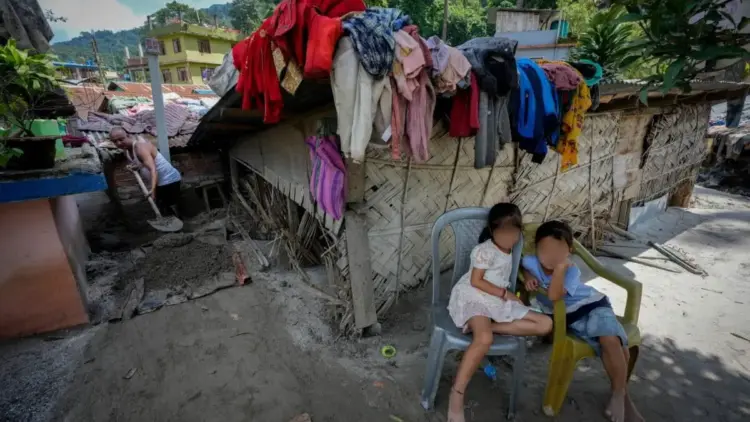
- Late 2023: Displaced families are moved into "temporary" relief camps, such as the Haat Ghar building in Teesta Bazaar and forest land at Labar Bhotay.
- Monsoon 2024: Consecutive flash floods occur as the swollen, sediment-filled river overflows its banks with minimal rainfall.
- July 2025: Frustrated by inaccuracies in initial damage assessments, the Gorkhaland Territorial Administration (GTA) and the Kalimpong district administration order a fresh survey of affected properties.
- Monsoon 2025: The region experiences another round of inundation. The "temporary" shelters begin to deteriorate under the strain of repeated weather events.
- September 2026: Residents of Teesta Bazaar and Melli mark nearly three years of displacement. A re-survey concludes that 116 houses need to be built, but the project remains stalled, awaiting financial sanction from the West Bengal state government.
Supporting Data: The Science of Vulnerability
The vulnerability of the Teesta basin is not merely a product of the 2023 GLOF; it is the result of decades of environmental degradation. Research indicates that the terrain has become increasingly landslide-prone due to intensive road construction, settlement expansion, and agricultural practices.
Since the 1970s, the construction of multiple dams and barrages along the Teesta’s length has altered its natural course and sediment-carrying capacity. A GIS-based study of the river’s channel morphology found that while the channel width has decreased in some areas due to human encroachment, the depth has also decreased due to siltation, making the river more prone to "bursting" its banks during the monsoon.
The human cost of this scientific reality is visible in the relief camps. At Haat Ghar, ten families live in an unfinished building where plastic sheets and bamboo serve as walls. In Labar Bhotay, 32 families live in forest land beside National Highway 10. These dwellings are plagued by leaks, rats, and snakes. Because the land belongs to the forest department, residents are prohibited from building permanent structures, leaving them in a state of constant anxiety over potential eviction.
Administrative Friction and the Politics of Disaster
The recovery process has been marred by what local experts call the "politics of disaster management." A stark disparity exists between the rehabilitation efforts in Sikkim and those in West Bengal.

Sikkim, the epicenter of the initial breach, moved relatively quickly to implement formal housing programs. The state sanctioned 4,100 houses—2,100 for homeowners under the Sikkim Punarvaas Awaas Yojana and 2,000 for tenants. Additionally, the Sikkim government distributed over ₹67 lakhs in rental assistance to displaced persons.
In contrast, West Bengal has yet to officially declare the 2023 GLOF a "disaster." This administrative distinction has had profound financial implications. Without a disaster declaration, the scale of federal and state relief funds remains limited. While West Bengal Chief Minister Mamata Banerjee’s government launched the "Arjun Vahini"—a specialized disaster response squad—and distributed some land titles (pattas) and cash compensation of ₹3 lakhs to families affected by the 2024 and 2025 floods, many victims of the original 2023 GLOF claim they have been excluded from these benefits.
"Politics plays a significant role in disaster management in the Himalaya," says Praful Rao, founder of ‘Save The Hills.’ "The disagreements between the Trinamool-led GTA and the BJP-led central government influence how funds are deployed. Meanwhile, the people on the ground are the ones who suffer."
The compensation rates themselves have been a point of contention. Under current state policy, a "completely damaged" house receives ₹75,000, while a "partially damaged" house receives a mere ₹5,000. In a region where construction costs are high due to the difficult terrain, these sums are viewed by residents as insulting.

Early Warning Systems: A Failure of Technology and Trust
One of the most tragic aspects of the 2023 flood was the failure of the Early Warning System (EWS). Just three weeks before the South Lhonak breach, a high-level team led by the National Disaster Management Authority (NDMA) had installed weather stations at the lake. However, the specific sensors designed to detect a sudden drop in water level—the primary indicator of a breach—had not yet been installed. The project was reportedly running a year behind schedule.
Furthermore, a "warning fatigue" had set in among the local population. For over a decade, residents had heard rumors of dam breaches that never materialized. "I took it casually," admits Mehtab Allam, a rafting driver from Melli. "We had heard warnings so many times before that when the sirens actually sounded, many of us didn’t believe it until the water was at our doors."
Implications: The High Cost of Inaction
The Teesta crisis highlights a broader challenge for Himalayan disaster governance. Eklavya Sharma, former director of ICIMOD, emphasizes that "rivers do not follow administrative boundaries." The lack of a transboundary monitoring and data-sharing protocol between Sikkim and West Bengal—and eventually Bangladesh—ensures that downstream communities will always be at a disadvantage.
Experts argue that disaster mitigation in the mountains is inherently more expensive than in the plains. The same budget that could protect thousands in the lowlands may only reach a few hundred in the hills due to the cost of infrastructure and logistics. However, the cost of inaction is even higher. Each monsoon that passes without the riverbed being dredged or permanent embankments being built increases the risk of another catastrophe.

For the residents of Kalimpong, the implication is a loss of the future. Small business owners like Kopila, who lost her campsite and car in the flood, are now drowning in debt while running tiny canteens to survive. The social fabric of the region is fraying as independent families are forced into the indignity of long-term aid dependency.
Conclusion: Waiting for a Permanent Solution
As the third anniversary of the Teesta GLOF approaches, the landscape remains a graveyard of half-buried houses and broken promises. The river, now higher and more volatile, remains a constant neighbor to those who have nowhere else to go.
The "window for prevention" is closing. Mitigation work must happen during the winter dry season, yet residents report that government attention only arrives when the monsoon clouds gather. For Bijay Pradhan and the hundreds of others living in the "temporary" camps of Teesta Bazaar, hope is a dwindling resource.
“I have not lost my hope,” Pradhan insists, though his eyes tell a different story. “I am still waiting for a permanent solution that will allow my family to rebuild our lives again. We are not asking for charity; we are asking for the security we once had.”

Until the administrative deadlock between the state and central governments is broken, and until scientific river management takes precedence over political maneuvering, the people of the Teesta valley will remain a community in waiting—living in the shadow of a river that has already taken their past and continues to threaten their future.