Date: November 22, 2026
By: Editorial Bureau
Introduction: A New Blueprint for Urban Living
In a move poised to fundamentally reshape the urban landscape of northern India, the Haryana government has greenlit an ambitious infrastructure overhaul aimed at developing "Smart Roads" across all 87 Urban Local Bodies (ULBs) in the state. This initiative, far-reaching in its scope, seeks to transcend traditional road-building by integrating advanced drainage, pedestrian-centric design, and sustainable green corridors into the state’s arterial networks.
As Haryana continues to position itself as a premier industrial and residential hub, the government’s focus has shifted from mere connectivity to "urban livability." The announcement comes at a critical juncture for the state’s real estate sector, which has seen a divergence in performance between established hubs like Gurugram and emerging markets like Faridabad and Sonipat. By standardizing high-quality infrastructure across all municipalities, the state aims to decentralize growth and enhance the investment appeal of its Tier-2 and Tier-3 cities.
Main Facts: The Anatomy of a Smart Road
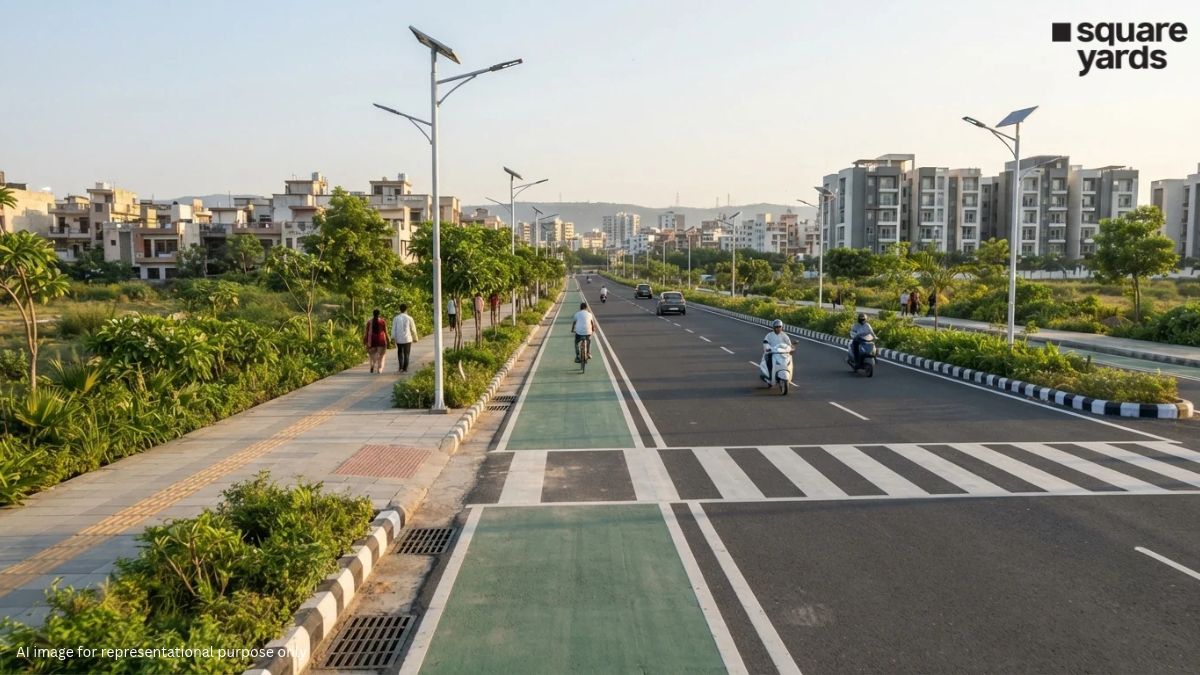
The "Smart Road" project is not merely a resurfacing exercise but a multi-dimensional engineering framework. According to the directives issued by the Chief Minister’s office, the project focuses on six core pillars:
- Integrated Drainage Systems: Addressing the perennial issue of urban waterlogging, these roads will feature scientifically designed, covered drainage networks.
- Pedestrian and Non-Motorized Transport (NMT): Dedicated, encroachment-free pathways and cycle tracks are being prioritized to reduce reliance on fossil-fuel-based transport for short distances.
- Smart Lighting and Safety: The installation of energy-efficient LED street lighting and strategically placed surveillance infrastructure to enhance public safety, particularly for women and children.
- Environmental Integration: The inclusion of green spaces and "vertical landscaping" where possible to mitigate the urban heat island effect.
- Utility Ducting: Pre-installed underground ducts for fiber optics and electrical lines to prevent the frequent digging of roads by various utility providers.
- Universal Accessibility: Design standards that ensure roads and sidewalks are accessible to senior citizens and persons with disabilities (PwDs).
Chronology: From Vision to Execution
The rollout of this massive infrastructure project has been structured into phases to ensure fiscal responsibility and logistical feasibility.
- Pre-2026 Planning: The state identified the need for a uniform urban standard following inconsistent infrastructure quality across different districts, which led to lopsided real estate growth.
- Early 2026: Pilot projects were initiated in select municipal corporations to test the "Smart Road" design templates.
- November 19, 2026: Chief Minister Nayab Singh Saini (or the incumbent CM) conducted a high-level comprehensive review of the Urban Local Bodies department. During this meeting, the mandate was expanded to include all 87 ULBs.
- Current Status (Late November 2026):
- Active Construction: Work is currently underway in 11 Urban Local Bodies, where ground-breaking has already occurred.
- Approval Pipeline: 10 ULBs have submitted their Detailed Project Reports (DPRs) and are currently in the final stages of technical and financial approval.
- Administrative Queue: 23 additional ULBs are awaiting administrative sanction, representing the next wave of development.
- Projected Horizon: The government aims to have the majority of these projects under construction by the mid-2027 fiscal cycle, with a focus on completing high-traffic corridors first.
Supporting Data: Real Estate Trends and Market Sentiment
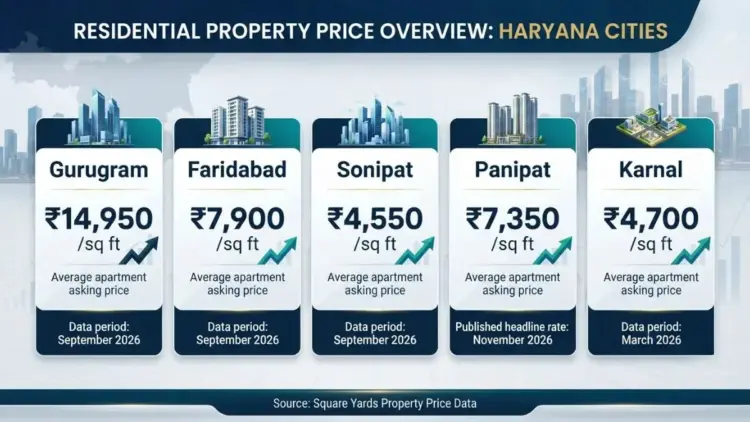
To understand the potential impact of these smart roads, one must look at the current state of Haryana’s residential property market. Data provided by Square Yards reveals a complex tapestry of asking prices and growth trajectories across the state’s major urban centers as of late 2026.
The Gurugram Paradox
Gurugram remains the crown jewel of Haryana real estate, yet it shows signs of price stabilization. In September 2026, the average asking price for an apartment stood at Rs 14,950 per sq. ft. (psf), a marginal decline of approximately 1% from the Rs 15,100 psf recorded in December 2025.
However, a granular look at the data shows extreme internal variance:
- Golf Course Road: Continues to command premium rates at Rs 23,550 psf.
- Sohna and Manesar: Offer more accessible entry points at Rs 11,150 psf.
The Smart Road initiative is particularly vital for Gurugram’s secondary hubs (like Sohna), where improved internal connectivity could bridge the price gap with the city center.
The Faridabad Surge
Faridabad has emerged as the state’s dark horse in 2026. Apartment asking prices jumped from Rs 6,750 psf in December 2025 to Rs 7,900 psf by September 2026—a significant 17% increase in just nine months.
- Faridabad North: Leads with Rs 9,350 psf.
- Neharpar (Greater Faridabad): Phase 1 and 2 are averaging Rs 7,400 and Rs 6,500 psf respectively.
The introduction of Smart Roads in Neharpar could be the catalyst needed to sustain this double-digit growth, as the area has historically struggled with drainage and street lighting.
Sonipat’s Volatility and Resilience
Sonipat offers a case study in market sensitivity. Prices fluctuated throughout 2026, peaking at Rs 5,000 psf in March before dipping to Rs 4,350 in June, and finally stabilizing at Rs 4,550 psf in September. This represents a modest year-to-date growth of 2.2%. For Sonipat, infrastructure is the primary lever for price stability; the Smart Road project could provide the "institutional grade" feel that buyers migrating from Delhi seek.
Tier-3 Markets: Karnal and Panipat
In Karnal, prices saw a slight contraction, ending September 2026 at Rs 4,700 psf, down 2.2% from the start of the year. Panipat has shown similar volatility. These markets are highly sensitive to "livability" factors. The government’s plan to bring high-end road infrastructure to these cities is seen as an attempt to make them viable alternatives to the NCR (National Capital Region).
Official Responses and Government Vision
State officials have emphasized that this project is not just about civil engineering but about economic competitiveness. A senior official from the Directorate of Urban Local Bodies stated, "The objective is to ensure that a citizen living in Rohtak or Hisar enjoys the same quality of road infrastructure as someone in Gurugram. Smart roads are the backbone of a smart city. By integrating drainage and lighting into the initial design, we are reducing long-term maintenance costs and improving the safety profile of our cities."
The Chief Minister’s review on November 19 also highlighted the need for "Green Spaces" alongside these corridors. The government is reportedly looking at a Public-Private Partnership (PPP) model for the maintenance of the green belts and cycle tracks, ensuring that the infrastructure does not fall into disrepair after completion.
Implications: Will Infrastructure Drive Valuations?
The correlation between infrastructure and real estate value is well-documented, but experts suggest a nuanced outlook for Haryana.
1. The "Ease of Living" Premium
Property markets are shifting from speculative investment to end-user demand. Modern homebuyers are increasingly prioritizing "last-mile livability"—the ability to walk safely to a local market, the absence of waterlogging during monsoons, and well-lit streets. Cities that successfully implement the Smart Road program are likely to see a higher "absorption rate" of residential inventory.
2. Commercial Vitality
Smart roads with dedicated parking bays and better pedestrian access naturally boost local commerce. This, in turn, increases the value of commercial real estate and ground-floor retail spaces along these corridors.
3. The Implementation Risk
While the announcement is a positive signal, the market remains cautious. Historically, infrastructure projects in India have faced delays in the "administrative approval" stage. With 23 ULBs currently awaiting approval, the speed at which the government moves from "paper to pavement" will determine the actual impact on property prices.
4. Narrowing the Urban-Rural Divide
By targeting all 87 ULBs, the Haryana government is making a strategic bet on regional equalization. If a buyer can find Gurugram-level infrastructure in Karnal at one-third of the price, the "commutable city" model could gain traction, potentially leading to a capital appreciation boom in currently undervalued districts.
Conclusion: What Homebuyers and Investors Should Watch
As Haryana embarks on this ambitious journey, the real estate market is likely to enter a "wait and watch" phase. For prospective homebuyers, the focus should be on the specific localities within the 87 ULBs that are slated for the first phase of development.
The Square Yards data highlights a crucial reality: infrastructure alone does not guarantee a price hike, but it does create a floor for valuations. In a market like Gurugram, smart roads are a necessity to maintain current premiums; in Faridabad and Sonipat, they are a catalyst for future growth.
The success of the Smart Road initiative will ultimately be measured not by the kilometers of asphalt laid, but by the resolution of age-old urban grievances—waterlogged streets, dark alleys, and unsafe pathways. If the Haryana government delivers on its November 19 vision, the state’s real estate market may be on the verge of its most sustainable growth cycle yet.