
New Delhi: As the Common Admission Test (CAT) 2026 draws closer, a significant drop in registration numbers has sparked a wave of discussion and speculation across aspirant circles. With approximately 2.84 lakh candidates registering, a decrease of about 11,000 from the previous year, the prevailing sentiment on social media and student forums is that this reduction will inevitably lead to lower cutoffs and a more accessible path to prestigious Indian Institutes of Management (IIMs). However, a deeper analysis of historical data and the mechanics of percentile calculation suggests this optimistic outlook may be premature and potentially misleading.
While the headline figures might appear encouraging to some, a meticulous examination of past trends reveals that the number of registrations is a far less influential factor in determining an aspirant’s percentile than the perceived difficulty and structure of the examination itself. The core principle of percentile remains unchanged: it reflects a candidate’s standing relative to others who actually appeared for the exam. Therefore, a smaller pool of registered candidates does not automatically translate into a higher percentile for individuals. The true determinant of success lies in mastering the intricacies of the CAT paper, a variable that has historically demonstrated far greater volatility and impact on score-to-percentile conversion than the number of test-takers.
This article aims to dissect the claims surrounding the dip in CAT 2026 registrations, presenting a data-driven perspective that moves beyond the prevalent hype and panic. By analyzing seven years of registration data, five years of score-versus-percentile conversions, and the fundamental principles of IIM shortlisting, we will provide a comprehensive understanding of what the numbers truly signify for aspirants preparing for this crucial examination.
The Registration Numbers: A Trend Under Scrutiny
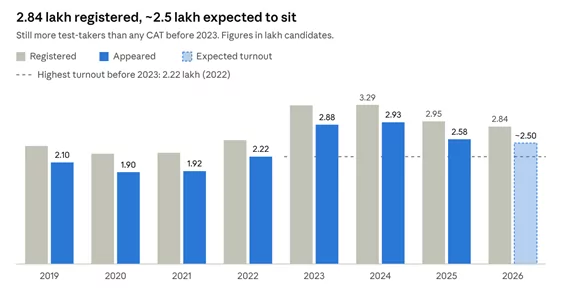
The current discourse is largely centered around the decrease in CAT 2026 registrations to approximately 2.84 lakh, marking a decline of 3.7% from the 2.95 lakh who registered in the preceding year. This marks the second consecutive year of falling registrations since the peak observed in 2024, which saw 3.29 lakh aspirants. This downward trend, amplified across various online platforms, has fueled the narrative of reduced competition.
However, a broader historical perspective reveals a more nuanced picture. The surge in registrations witnessed in 2023-24 appears to have been an outlier rather than the establishment of a new normal. Even with the current reduction, the pool of CAT 2026 registrants remains larger than the numbers recorded in years prior to 2023, a period during which many candidates successfully secured admissions into IIMs with competitive percentiles. This historical context suggests that the current registration figures, while lower than recent peaks, do not represent an unprecedented decline that would fundamentally alter the competitive landscape.
Beyond Registration: The Critical Factor of Actual Test-Takers
The figures often circulated on social media platforms focus solely on the number of registered candidates. However, a crucial distinction must be made between those who register and those who actually appear for the examination. Historically, the number of candidates who sit for the CAT exam has consistently been between 11% and 17% lower than the number of registrations since 2019.
Last year, for instance, out of 2.95 lakh registered candidates, only approximately 2.58 lakh appeared for the exam. Projecting this trend, the expected turnout for CAT 2026 is likely to be around 2.5 lakh. This discrepancy is attributable to several factors. A significant portion of registered candidates might be those who signed up "just to see" or who secure alternative admission offers from other institutions or campus placements before the exam date. Final-year students who receive early job offers or working professionals whose appraisal cycles clash with the exam preparation are also likely to be among those who do not appear. These individuals, while having paid the registration fee, were never truly in direct contention for the top percentiles.
Therefore, while the headline number of registrations has decreased by 11,000, the actual number of serious contenders has likely seen a reduction of a few thousand more. It is vital to keep this distinction in mind, as it directly impacts the calculation of percentiles and will be revisited later in the analysis.

Percentile: A Measure of Relative Performance, Not Absolute Numbers
The fundamental definition of a percentile remains constant, regardless of the total number of candidates. A 99th percentile signifies that a candidate has outperformed 99% of the individuals who actually took the examination. Consequently, if the number of test-takers decreases, the absolute number of candidates falling within a specific percentile band also shrinks proportionally.
For example, with approximately 2.58 lakh candidates appearing in the previous year, the 99th percentile corresponded to the top roughly 2,580 candidates. For CAT 2026, with an expected turnout of around 2.5 lakh, this figure would be approximately 2,500. This implies that the pool of candidates above and below a certain percentile shrinks in tandem with the overall candidate pool.
The misconception perpetuated by some online discussions is that a smaller pool automatically grants a higher percentile. This is inaccurate. A reduced number of participants does not intrinsically elevate an individual’s percentile. Instead, it results in a less crowded percentile band. The actual marks required to achieve a particular percentile, however, are governed by an entirely different set of factors, primarily the nature of the examination itself.
The Decisive Factor: Examination Difficulty Trumps Candidate Numbers
The true determinant of the marks required to achieve a specific percentile, particularly the highly coveted 99th percentile, is the difficulty level of the CAT paper. Historical data over the past five years clearly illustrates this point. The marks needed for the 99th percentile have fluctuated significantly, ranging from 76 to 98 marks. Crucially, this variation shows little correlation with the number of candidates who appeared for the exam.
A stark example can be observed between CAT 2023 and CAT 2024. Despite a minimal change in the number of test-takers, the score required for the 99th percentile surged by 19 marks. This dramatic shift was directly attributable to the comparatively easier nature of the CAT 2024 paper. Conversely, between 2021 and 2022, even with an increase of 30,000 test-takers, the 99th percentile score actually declined by 14 marks.
This data unequivocally demonstrates that the difficulty of the CAT paper, and how effectively the entire cohort navigates it, plays a far more significant role in shaping percentile scores than the sheer number of registrations. An 11,000-candidate reduction in registrations will not influence the percentile conversion as profoundly as a single challenging section, such as the Data Interpretation and Logical Reasoning (DILR) section, being particularly difficult. Aspirants are therefore advised to focus their energies on understanding and mastering the nuances of each section, rather than banking on a decrease in competition.
Where a Smaller Pool Offers a Modest Advantage: The Lower Percentile Bands
While the impact on top percentiles is minimal, there is a legitimate argument to be made about how a smaller candidate pool might offer a slight advantage in the lower percentile bands, particularly concerning IIM shortlisting. IIMs typically aim to fill a fixed number of seats. When the number of candidates appearing for the exam decreases, and assuming the number of interview calls remains relatively constant, IIMs may need to dip deeper into the percentile list to fill their quotas.
To illustrate this point, consider the following hypothetical scenarios for two illustrative shortlist sizes:
| If an institute calls… | ~2.93 lakh appear (2024) | ~2.58 lakh appear (2025) | ~2.5 lakh appear (2026, expected) |
|---|---|---|---|
| 3,000 candidates (top-IIM-sized list) | 98.98 %ile | 98.84 %ile | 98.80 %ile |
| 15,000 candidates (mid-tier-sized list) | 94.88 %ile | 94.19 %ile | 94.00 %ile |
As observed, at the higher end (e.g., for a top IIM shortlist of 3,000 candidates), the required percentile shifts by approximately 0.2 percentile points. This is a marginal change, often within the range of what a single error in a ‘To the point’ question might cost. However, in the mid-tier percentile bands (e.g., 94-95%), the impact is more noticeable, with a shift of around 0.9 percentile points. This could offer a modest tailwind for candidates targeting calls from mid-tier IIMs.
It is crucial to acknowledge two significant caveats to this observation. Firstly, IIMs officially publish minimum percentile cutoffs as part of their admission policy. These published cutoffs generally do not fluctuate significantly based on the number of registrations or test-takers. Secondly, the shortlisting process for IIMs is a composite one. Factors such as Class 10, Class 12, graduation scores, work experience, and diversity points all contribute significantly to the final shortlist. Therefore, relying solely on a projected percentile shift due to a smaller pool might be imprudent without considering these other crucial components of the IIM admission criteria.
Identifying the Candidates Who Are Opting Out
While official data on the profile of candidates who do not register for CAT is unavailable, informed reasoning suggests that the individuals opting out are likely not those fiercely competing for the top percentiles. Several factors contribute to this trend:
- Robust Job Market for Graduates: A strong job market for fresh graduates may lead some to prioritize immediate employment over pursuing an MBA.
- Increasing IIM Fees: The substantial fee structure of flagship IIMs, now around ₹21 lakh, can be a deterrent for some aspirants.
- Crowded Entrance Exam Calendar: The proximity of other major MBA entrance exams like NMAT, SNAP, and XAT can lead aspirants to strategically choose which exams to focus on.
- Past Admissions Irregularities: Last season’s admissions process, marked by revoked offers, re-issued result lists, and general confusion, may have dissuaded some casual aspirants.
These pressures disproportionately affect the "undecided" aspirant – those who may not have a clear career roadmap or are easily swayed by external factors. Highly motivated and prepared candidates, those who have already invested significant time in mock tests, accuracy tracking, and slot strategy, are generally less deterred by fee hikes or a crowded exam schedule. Consequently, the CAT 2026 pool is likely to be comprised of a slightly more serious and committed cohort of candidates, not less. This realization should serve not as a cause for panic, but as a motivator to intensify preparation and avoid complacency.
Strategic Focus for the Remaining Preparation Period
Given that the registration numbers have a negligible impact on individual percentiles, the focus for the remaining 38 days of preparation should be on aspects that are directly controllable and demonstrably influential. The data unequivocally points towards prioritizing the following areas:
- Intensive Mock Test Analysis: Beyond merely taking mocks, dedicating significant time to dissecting performance is paramount. Identifying recurring error patterns, understanding the time allocation strategy for each section, and analyzing the difficulty level of questions are crucial.
- Sectional Accuracy Improvement: Focus on strengthening weak areas within each section. This involves targeted practice, understanding fundamental concepts, and developing effective problem-solving techniques.
- Speed and Accuracy Enhancement: The CAT is a timed examination. Improving both speed and accuracy in tackling questions is critical. This can be achieved through timed practice sessions and by learning to make quick, yet accurate, decisions.
- Understanding of Exam Structure: Familiarity with the exam pattern, question types, and scoring system is essential. This includes understanding the nuances of different sections and the marking scheme for each.
- Mental Preparedness and Stress Management: The CAT is a high-stakes exam. Developing effective strategies for managing exam day anxiety, maintaining focus, and staying calm under pressure is as important as academic preparation.
A More Productive Message to Share
Instead of succumbing to the speculative narrative of falling cutoffs, a more constructive approach is to share information that empowers fellow aspirants. The next time the "cutoffs will fall" message circulates, consider forwarding these key insights:
- Percentile is Relative: Your percentile is determined by your performance against those who actually appear for the exam, not just those who register.
- Paper Difficulty is Key: The marks required for a specific percentile are primarily dictated by the difficulty of the CAT paper, not the number of candidates.
- Actual Competition is Smaller: The number of serious contenders is consistently lower than the registered numbers due to dropouts.
- Top Percentiles Remain Unaffected: A slight decrease in registrations does not significantly alter the marks needed for the 99th percentile.
- Focus on Controllables: Your preparation, mock analysis, and sectional accuracy are the factors that will truly impact your score.
The CAT 2026 exam is scheduled for November 29th. With fewer aspirants, the same underlying anxiety, and the same challenging examination, the path to success remains paved with diligent preparation and strategic focus. The competition may be perceived as less fierce, but the ultimate goal of securing a seat in a top IIM remains as demanding as ever. The key lies in understanding the real dynamics at play and channeling your energy into what truly matters: your performance on the day of the exam.
Connect with alumni and students for insights. Join: CAT 2026 Exam Preparation, Discussion | PaGaLGuY