Introduction: The Enduring Question of MBA Worth
The pursuit of a Master of Business Administration (MBA) degree has long been a cornerstone of career advancement, promising lucrative salaries, prestigious roles, and accelerated professional growth. However, the traditional narrative surrounding the MBA’s unimpeachable value is undergoing a significant recalibration. In the current economic climate, marked by rising tuition fees, evolving job markets, and the disruptive influence of artificial intelligence (AI), the question of whether an MBA is still "worth it" has become more pertinent and complex than ever before. This article delves into the nuanced realities of the MBA landscape, examining its financial viability, the diverging fortunes of top-tier institutions versus newer ones, the tangible impact of AI on entry-level employment, the global trends shaping MBA demand, and offers a forward-looking perspective on the degree’s future trajectory.
The Financial Calculus: A Tale of Two Tiers
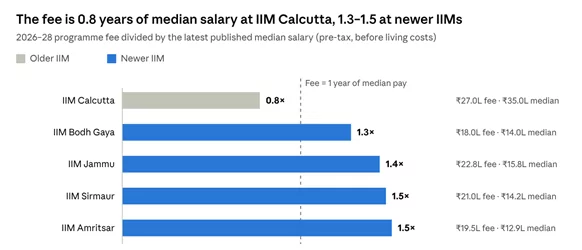
The financial return on investment (ROI) for an MBA is no longer a monolithic concept; it is profoundly influenced by the institution attended. At the apex of India’s premier Indian Institutes of Management (IIMs), the financial calculus remains compelling. For the 2026-28 batch at IIM Calcutta, the fee structure stands at approximately ₹27 lakh, a figure that graduates of the 2026 cohort saw recouped in median salaries of around ₹35 lakh, achieving a payback period of under a year. This swift financial recovery underscores the enduring appeal of the top IIMs, where the network, brand equity, and placement opportunities continue to command premium salaries that quickly offset the educational investment.
However, the picture is considerably different for many of the newer IIMs. Reports indicate a concerning trend of sliding median salaries at several of these institutions, even as their tuition fees continue to climb. This divergence creates a significant financial strain, stretching the payback period for graduates. A more comprehensive financial assessment reveals that the advertised median salaries often present an optimistic view. When factoring in the opportunity cost of two years of forgone salary – for someone earning ₹10 lakh annually pre-MBA, this amounts to ₹20 lakh – along with living expenses and taxes, the actual payback period at newer IIMs can extend to 1.5 to 3 years or more, depending on an individual’s pre-MBA earnings and loan obligations.
While a median salary of ₹14-16 lakh still represents a substantial step up for freshers or career switchers from roles earning ₹5-7 lakh, the decision to pursue an MBA at these institutions demands a rigorous, data-driven approach. Prospective students must look beyond headline-grabbing highest salary packages and focus on the median figures and their personal financial projections.
The Newer IIMs: Unpacking the Data Beyond the Headlines
The "is it worth it?" question becomes particularly acute when considering the newer IIMs. An analysis of National Institutional Ranking Framework (NIRF) data by Careers360 reveals a disquieting trend: six out of nine "baby IIMs" reported lower median salaries for their 2025 graduating batch compared to earlier cohorts. The decline is not insignificant; IIM Bodh Gaya witnessed a drop from ₹15.5 lakh to ₹12.12 lakh, a decrease of approximately 22% over two batches. Similarly, IIM Amritsar saw its median salary slip by about 19% to ₹12.9 lakh. While not a universal decline, with IIM Sirmaur showing a 12.6% increase to ₹14.2 lakh and IIM Jammu inching up to ₹15.8 lakh, the overall trend suggests a cooling job market for graduates from these institutions.
Crucially, placement reports often omit vital information that can paint a more realistic picture. For instance, the 2024-26 batch at IIM Amritsar highlighted a highest Cost To Company (CTC) of ₹43 lakh but provided no average or median salary data. IIM Sirmaur’s latest summary offered an average but not a median. IIM Bodh Gaya’s reporting on an audited "MEP" (Merit-based Earnings Projection) basis, while a sound practice, is not directly comparable to schools that do not adhere to the same methodology. Prospective students must critically evaluate placement reports, scrutinizing the availability of audited median salaries, the placement rate for the entire batch, and the consistency of reported figures year-on-year.
AI’s Shadow: Reshaping Entry-Level Roles
The advent of Artificial Intelligence (AI) is a significant disruptor, and its impact on the entry-level corporate ladder, a traditional stepping stone for MBA graduates, is undeniable. While AI is not causing wholesale job destruction, it is demonstrably thinning the ranks of junior-level positions, precisely the domain where many fresh MBA graduates find their initial employment.
Research from Stanford’s Digital Economy Lab, analyzing payroll data from millions of U.S. workers, found that 22-25-year-olds in occupations most exposed to AI experienced a 13% relative decline in employment since late 2022. This decline widened to 19% by August 2026, while older workers in similar roles saw stable or increased employment. Importantly, the study indicates that jobs where AI augments human capabilities, rather than replacing tasks, showed stable or rising employment. Furthermore, the employment gap narrowed when accounting for education levels. This suggests that the highly codified and repeatable tasks performed by junior analysts are most vulnerable, while roles requiring judgment, client interaction, and the ability to direct AI remain more resilient.
This sentiment is echoed by recruiters. A 2026 GMAC survey of 621 recruiters across 39 countries revealed that approximately one in three planned to replace some entry-level roles with AI. Conversely, 53% identified proficiency in using AI tools as the most critical skill for the next five years.
In India, the Naukri JobSpeak index for September 2026 illustrated this shift. While overall white-collar hiring saw a modest 2% increase and fresher hiring a mere 1%, AI/ML roles surged by 20%. Within the IT sector, demand for AI talent was most pronounced among professionals with 8-16 years of experience. This indicates a clear preference for specialists and experienced individuals, with companies exercising caution regarding generalist freshers.
The consulting sector, a major recruiter at top IIMs, exemplifies this trend. McKinsey, after a period of contraction, signaled a 12% hiring increase for 2026, incorporating an AI component into its final-round interviews in the U.S. Boston Consulting Group (BCG) is reportedly prioritizing hiring AI and tech specialists over generalist MBAs. While hiring is resuming, the profile of candidates sought has evolved.
The honest implication for MBA aspirants is that AI is diminishing the value of a "generic" MBA while amplifying the importance of a "differentiated" one. A career plan focused solely on obtaining an MBA to secure a generic analyst role, one that could be partially automated by a well-prompted AI model, has a significantly shorter shelf life than it did just a few years ago.
The Global MBA Landscape: Shifting Demand and Selective Growth
Globally, the demand for MBA degrees remains robust, though the landscape is consolidating. Prospective students are increasingly targeting fewer, higher-ranked institutions, with a noticeable shift in demand away from North America and towards other regions. GMAC’s latest survey indicates a 2% rise in MBA applications for the 2025-26 cycle, following a record 13% surge the previous year, with full-time, two-year programs experiencing a 4% growth.
This growth, however, is concentrated at the top. Among the most selective quarter of MBA programs, 52% reported an increase in applications, compared to just 28% among the least selective. This trend has led to the closure or pause of full-time MBA programs at several U.S. business schools, including Houston’s Bauer College in 2025, and earlier, at institutions in Illinois and Iowa, which have pivoted towards online, part-time, or one-year formats.
Even elite institutions have experienced temporary setbacks. Harvard Business School reported that 23% of its job-seeking Class of 2024 had no job offers three months post-graduation, more than double the historical norm. The Class of 2025 demonstrated a recovery, with 90% securing offers within three months and close to 94% by November, mirroring Stanford GSB’s 90% placement rate. Crucially, salary levels have remained strong throughout these fluctuations.
The salary premium associated with an MBA persists. GMAC’s 2026 recruiter survey projects a median starting salary of $120,000 for new MBA hires in the U.S., compared to $107,500 for experienced hires recruited directly from industry. Employers continue to value the MBA, but their selection criteria are becoming more discerning, with a heightened emphasis on a graduate’s ability to leverage AI.
Looking Ahead: Five Predictions for the MBA (2026-2031)
Based on the prevailing trends, several key predictions can be made about the future of the MBA degree:
- Divergence in Value: The gap in perceived and actual value between top-tier MBA programs and those from less selective institutions will widen. The former will continue to command high fees and deliver strong ROI, while the latter will face increasing pressure to justify their costs.
- Rise of Specialization and AI Integration: MBA curricula will increasingly integrate specialized tracks focused on emerging fields like AI, data science, sustainability, and digital transformation. Programs will need to demonstrate how they equip graduates with the skills to navigate and lead in an AI-driven economy.
- Emphasis on Experiential Learning and Soft Skills: As AI automates routine tasks, the focus of MBA programs will shift further towards developing critical thinking, leadership, communication, and problem-solving skills – competencies that are inherently human and less susceptible to automation. Experiential learning, case studies, and real-world projects will become even more paramount.
- Growth in Hybrid and One-Year Formats: To cater to experienced professionals seeking accelerated career pivots and to manage costs, one-year and hybrid MBA programs are likely to gain further traction. These formats offer a more time- and cost-efficient route to acquiring valuable business acumen.
- Increased Scrutiny of Placement Data: Prospective students and employers will demand greater transparency and rigor in placement reporting. Audited median salaries, detailed breakdowns of job roles, and clear metrics on the impact of AI on entry-level hiring will become standard expectations.
The Personal Equation: Should YOU Pursue an MBA?
The MBA is no longer a one-size-fits-all proposition. The decision to pursue one requires a personalized assessment of individual circumstances and career aspirations. Here’s an honest take on different scenarios:
-
High-Achiever (99+ Percentile in CAT, Targeting Top IIMs A/B/C/L/K): This remains one of the most financially sound educational investments in India. The payback period is rapid, and the network’s value compounds over time. The key is to clearly define your post-MBA career goals to maximize the benefit of these two years.
-
Experienced Professional (2+ Years Work Experience, Clear Career Pivot): An MBA can be a powerful catalyst for a significant career switch, such as moving from engineering to product management or operations to strategy. AI poses less of a threat to experienced professionals. Consider whether a one-year program can achieve your objectives more efficiently and cost-effectively.
-
Fresher/Early Career (Targeting Newer IIMs or Tier-2 Schools): This is where careful consideration is paramount. With fees often approaching ₹18-23 lakh and median salaries hovering around ₹12-16 lakh, the payback period can be lengthy. Furthermore, fresher roles are the most exposed to AI automation. Thoroughly investigate the school’s audited median placement data and its track record with fresher placements.
-
"Everyone Else is Doing It" or Escaping a Disliked Job: If the primary motivation is peer pressure or a desire to escape a current role without a clear alternative plan, it might be prudent to pause. A year of focused skill development, acquiring AI-specific expertise, or seeking internal role changes within your current company might offer a more direct and less costly path to career progression.
-
Significant Loan for Non-IIM/Non-Top-20 Program: Exercise extreme caution. This is the scenario where the ROI narrative most frequently falters. Rigorously compare your projected loan EMIs against realistic post-MBA salary expectations, not the highest advertised figures.
Conclusion: A Strategic Investment in a Dynamic Future
The MBA degree is not obsolete, but its value proposition is evolving. In an era defined by rapid technological advancement and a discerning job market, the decision to invest in an MBA demands a strategic and data-informed approach. For those targeting elite institutions and possessing clear career objectives, the MBA remains a potent tool for career acceleration. However, for individuals considering less established programs or embarking on an MBA without a defined purpose, the financial and career implications require meticulous scrutiny. The future of the MBA lies not in its universality, but in its ability to adapt, specialize, and equip individuals with the critical, human-centric skills needed to thrive in an increasingly AI-powered world. Prospective students must ask not just "is it worth it?" but "worth it for me, and how will I leverage it in a changing world?"