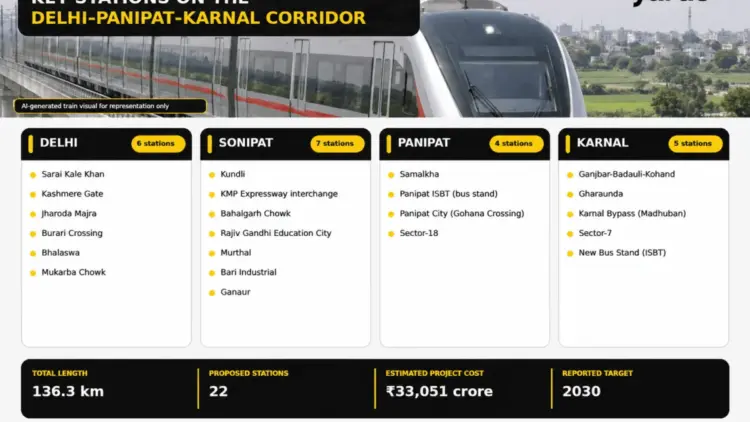
NEW DELHI – The infrastructure landscape of Northern India is on the precipice of a generational shift. As of late 2026, the proposed Delhi–Panipat–Karnal Namo Bharat (Regional Rapid Transit System – RRTS) corridor has transitioned from a visionary blueprint into a high-priority infrastructure project, bolstered by critical administrative approvals and the commencement of preliminary site works.
With an estimated investment of ₹33,051 crore, this 136.3-km high-speed rail artery is designed to redefine the relationship between the national capital and the industrial and agricultural heartlands of Haryana. By 2030, the project aims to compress the distance between Delhi’s Sarai Kale Khan and the historic city of Karnal into a mere 90-minute commute, effectively expanding the boundaries of the National Capital Region (NCR).
1. Main Facts: The Scope of the Namo Bharat Expansion
The Delhi–Panipat–Karnal corridor represents the second major phase of India’s ambitious RRTS network, following the pioneering Delhi–Ghaziabad–Meerut line. Developed by the National Capital Region Transport Corporation (NCRTC)—a joint venture between the Central Government and the participating states—the project is a technological marvel designed to operate at speeds of up to 160 km/h.
Key Project Parameters:
- Total Length: Approximately 136.3 kilometers.
- Alignment: Primarily follows the NH-44 (Delhi-Chandigarh Highway) corridor, utilizing an elevated and at-grade mix to minimize land acquisition hurdles.
- Primary Hubs: Connects Sarai Kale Khan in Delhi to Karnal in Haryana.
- Projected Travel Times: Approximately 60 minutes to Panipat and 90 minutes to Karnal.
- Estimated Capital Outlay: ₹33,051 crore.
- Rolling Stock: Modern, aerodynamic "Namo Bharat" trainsets equipped with Wi-Fi, premium seating, and regenerative braking systems.
The corridor is not merely a transit link; it is a logistical backbone. By integrating with the Delhi Metro, Indian Railways, and the Inter-State Bus Terminals (ISBTs), the RRTS ensures "multimodal integration," allowing a passenger from Karnal to reach any part of Delhi or the wider NCR with minimal friction.
2. Chronology: The Road to Approval and Beyond
The trajectory of the Delhi–Panipat–Karnal RRTS has been marked by rigorous fiscal planning and inter-agency coordination. The year 2026 has proven to be the most decisive period in the project’s lifecycle.
The Milestone Timeline:
-
March 2026: The Haryana Cabinet Mandate
The Haryana state government, under the leadership of the Chief Minister, officially greenlit the project. This was a watershed moment, as the Cabinet approved a state contribution of approximately ₹7,472 crore. Crucially, this approval also included the adoption of Transit-Oriented Development (TOD) policies, allowing for increased floor area ratios (FAR) and intensified commercial activity around the proposed stations. -
Mid-2026: Central Clearance
Following the state’s commitment, the project received Center-level clearance. This ensured that the remaining funding—split between the Union Government and potential multilateral lending agencies (such as the ADB or NDB)—was secured in principle. -
November 2026: NHAI Land-Use Permission
In a significant bureaucratic breakthrough, the National Highways Authority of India (NHAI) granted formal land-use permission. Since much of the corridor runs parallel to NH-44, this permission is essential for constructing piers (pillars), station boxes, and the massive undertaking of shifting high-tension power lines that currently line the highway.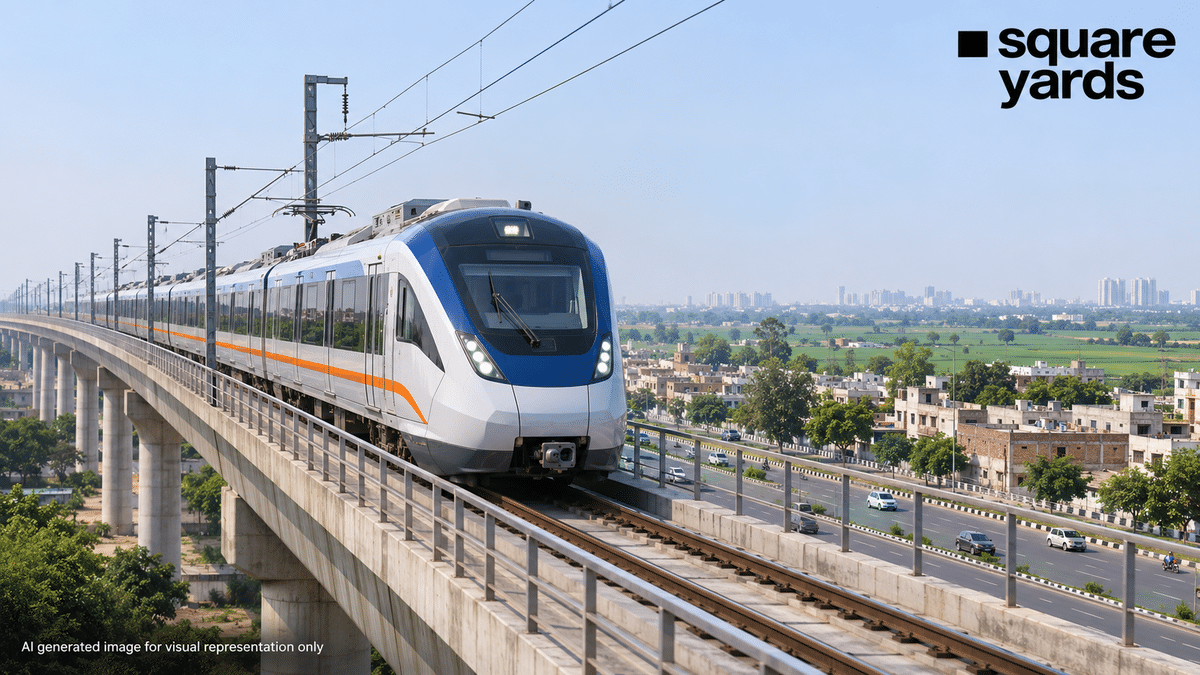
-
Current Status (Late 2026): Preparatory Works
While the main civil construction contracts are being finalized, preparatory work has begun. This includes utility shifting, geotechnical surveys, and the marking of station boundaries in areas like Kundli and Sonipat. -
The 2030 Horizon:
The NCRTC has set a target for completion by 2030. This timeline accounts for the complexities of building through densely populated urban clusters in Delhi and the logistical challenges of a 136-km linear construction site.
3. Supporting Data: Technical and Financial Breakdown
The scale of the Namo Bharat project is best understood through the data that underpins its construction and eventual operation. The following table provides a comprehensive snapshot of the current proposal:
| Project Detail | Current Proposal / Reported Status |
|---|---|
| Route Terminals | Sarai Kale Khan (Delhi) to Karnal (Haryana) |
| Total Distance | 136.3 km |
| Projected Speed | 160 km/h (Operating), 180 km/h (Design) |
| Total Stations | Up to 22 (Proposed) |
| Key Towns Covered | Narela, Kundli, Sonipat, Ganaur, Samalkha, Panipat, Karnal |
| Total Estimated Cost | ₹33,051 Crore |
| Haryana Government Share | ₹7,472 Crore |
| Target Completion | 2030 |
| Projected Daily Ridership | Estimated in the hundreds of thousands upon full maturation |
Financial Engineering:
The financing of the project follows a SPV (Special Purpose Vehicle) model. The equity is shared between the Government of India and the Government of Haryana, while a significant portion of the ₹33,051 crore will be raised through long-term soft loans from international financial institutions. The TOD (Transit-Oriented Development) model is expected to generate "value capture" revenue, which will help subsidize the operational costs through commercial leasing and specialized property taxes around station zones.
4. Official Responses: The Vision for a "Connected Haryana"
The Haryana government and the NCRTC have been vocal about the socio-economic philosophy driving this project. Official statements emphasize that the RRTS is not just a transport project, but an "economic catalyst."
The Haryana Government’s Stance:
State officials have highlighted that the corridor will decongest the saturated Delhi-NCR roads, particularly the overburdened NH-44. By providing a reliable, high-speed alternative to road travel, the state expects a significant reduction in carbon emissions and traffic accidents. The Cabinet’s focus on TOD provisions suggests a desire to turn station areas into "mini-smart cities" with high-density housing and commercial offices.
The NCRTC’s Operational Philosophy:
The NCRTC has maintained that the "Namo Bharat" service will prioritize passenger comfort and reliability. Officials have pointed out that the signaling system (ETCS Level 2) will be among the most advanced in the world, allowing for high-frequency train intervals. "Our goal is to make regional travel as seamless as a metro ride," an NCRTC representative noted during a recent briefing.
NHAI’s Role:
The NHAI’s cooperation is pivotal. By allowing the RRTS to utilize the highway’s right-of-way, the project avoids the protracted legal battles often associated with greenfield land acquisition. This synergy between highway and rail infrastructure is being hailed as a model for future national transit projects.

5. Implications: Real Estate, Economy, and Urban Migration
The arrival of the Namo Bharat corridor is expected to trigger a paradigm shift in the regional economy, with the real estate sector being the most immediate beneficiary.
Real Estate: The "Commuter Premium"
Historically, infrastructure projects of this magnitude lead to a "wait-and-watch" appreciation in property values. Areas that were once considered "peripheral" or "industrial" are now being re-evaluated as viable residential hubs for Delhi’s workforce.
According to data from Square Yards Research, the residential asking rates in key areas along the corridor provide a baseline for this potential growth:
| Area | Indicative Apartment Asking Rate | Data Period |
|---|---|---|
| Kundli | ~₹4,650 per sq. ft. | September 2026 |
| Sonipat | ~₹4,550 per sq. ft. | September 2026 |
| TDI City, Panipat | ~₹6,000 per sq. ft. | September 2026 |
| Karnal | ~₹4,700 per sq. ft. | March 2026 |
Note: These are asking rates and reflect market sentiment rather than finalized transaction spikes directly attributed to the RRTS.
Analysis of Regional Impact:
- The Rise of "Rurban" Living: Towns like Kundli and Sonipat, which sit on the border of Delhi, are likely to see the highest demand. If a commuter can reach Central Delhi in 20-30 minutes via RRTS, these areas become competitive alternatives to expensive neighborhoods in Rohini or Pitampura.
- Industrial Integration: Panipat, known as the "Textile City," and Sonipat, a burgeoning education and industrial hub, will benefit from easier access to specialized talent from Delhi. This "reverse commute" could see professionals living in the capital but working in Haryana’s industrial zones.
- Institutional Growth: With 22 stations planned, smaller towns like Ganaur and Samalkha will be integrated into the mainstream economy, potentially attracting hospitals, universities, and shopping malls that require large land parcels unavailable in Delhi.
6. Challenges and the Road Ahead
While the momentum is positive, the path to 2030 is not without hurdles. Large-scale infrastructure projects in India often face three primary challenges:
- Utility Shifting: The NH-44 corridor is densely packed with underground water mains, gas pipelines, and overhead high-tension wires. Moving these without disrupting the existing supply to millions of residents is a logistical nightmare.
- Multimodal Connectivity: The success of the RRTS depends on "last-mile connectivity." If commuters cannot easily get from a Namo Bharat station to their final destination via e-rickshaws, buses, or feeder cycles, the high-speed advantage is lost.
- Construction Management: Building an elevated corridor over one of India’s busiest highways (NH-44) requires surgical precision to ensure that daily traffic flow—consisting of thousands of trucks moving essential goods—is not choked.
Conclusion: A New Era for the NCR
The Delhi–Panipat–Karnal Namo Bharat corridor is more than just a train line; it is a statement of intent. It signals a shift away from a Delhi-centric growth model toward a more balanced, regional approach. By the time the first trains roll into Karnal in 2030, the geography of opportunity in Northern India will have been permanently altered.
For the homebuyer, it offers the promise of a better quality of life away from the capital’s congestion. For the investor, it offers a decade-long growth story. And for the daily commuter, it offers the most precious commodity of all: time. As preparatory works accelerate, the vision of a 90-minute journey from the heart of Delhi to the gates of Karnal moves one step closer to reality.