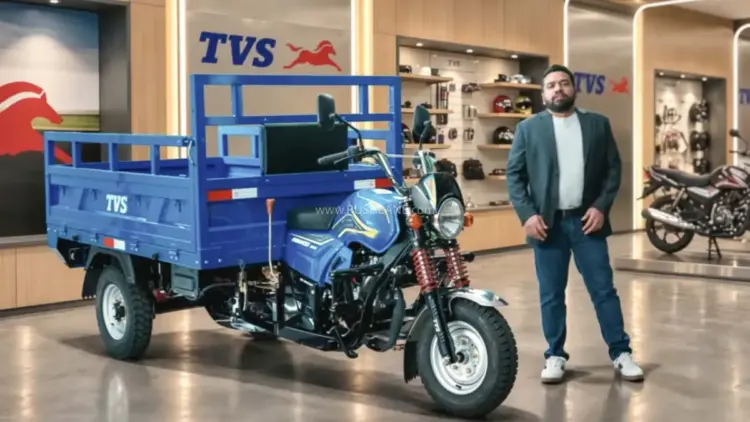
TVS Motor Company, a global leader in two-and three-wheeler manufacturing, has officially announced the world debut of the TVS Armado. This heavy-duty cargo tricycle represents a significant shift in the company’s commercial vehicle strategy, boasting a segment-redefining one-tonne payload capacity. Designed specifically to bridge the gap in first- and last-mile logistics, the Armado is set to become a cornerstone of TVS’s export strategy across Africa, Latin America, and the ASEAN regions.
The global logistics landscape is undergoing a rapid transformation, driven by the explosion of e-commerce and the increasing need for efficient, cost-effective transport solutions in emerging markets. In response, TVS Motor Company has introduced the Armado, a vehicle that combines the agility of a three-wheeler with the hauling capabilities of a small truck. By targeting entrepreneurs and fleet operators in high-growth regions, TVS aims to solidify its position as a dominant player in the international commercial mobility sector.
The Core Value Proposition: Redefining Three-Wheeler Utility
The TVS Armado is not merely an incremental update to existing cargo models; it is a ground-up solution for heavy-duty transport. The primary headline of the launch is the vehicle’s claimed payload capacity of up to one tonne (1,000 kg). In the world of three-wheeled cargo vehicles, this is a substantial figure that challenges the traditional boundaries of the segment.
For small business owners and logistics providers, the ability to transport a metric tonne on a vehicle with a small footprint offers a unique advantage. It allows for higher volume and weight per trip compared to standard delivery trikes, thereby reducing the "cost per ton-mile"—a critical metric for profitability in the delivery business. The Armado is positioned as an "unstoppable" workhorse, capable of navigating congested urban centers while carrying loads that previously required larger, more expensive four-wheeled mini-trucks.
Chronology of Development: A Global Validation Process
The path to the Armado’s debut was paved by extensive research and development. TVS Motor Company has a long-standing history of manufacturing three-wheelers, most notably the TVS King series, which has seen success in both passenger and light-cargo variants. However, the Armado represents a strategic pivot toward heavy-duty commercial applications.
During its development phase, the Armado underwent thousands of kilometers of rigorous validation testing. TVS engineers focused on the unique stresses placed on a vehicle carrying a full tonne of cargo. This involved testing in diverse climates and topographies—from the humid, high-traffic streets of Southeast Asia to the rugged, unpaved terrains often found in parts of Africa and Latin America.
The decision to launch globally before an Indian release suggests a calculated move to capture market share in regions where the demand for affordable, heavy-duty three-wheelers is currently outpacing supply. While TVS has not yet announced a specific timeline for an India launch, the global rollout serves as a massive real-world pilot for the vehicle’s long-term viability.
Engineering Excellence: A Deep Dive into Technical Specifications
The TVS Armado is built on a foundation of robust engineering, designed to withstand the "stop-start" nature of urban delivery while managing the physical strain of heavy loads.
The Powertrain: Efficiency Meets Durability
At the heart of the Armado is a 200 cc oil-cooled engine. This power unit is engineered to deliver 10.6 kW (approximately 14.2 bhp) at 7,500 rpm, with a peak torque of 15.5 Nm at 5,000 rpm. While these figures might seem modest compared to passenger cars, in the context of a tricycle, they are optimized for low-end grunt and mid-range pulling power.
The choice of oil cooling is a strategic one. Unlike air-cooled engines that can struggle with heat dissipation under heavy loads in stationary traffic, the oil-cooling system ensures that the engine maintains an optimal operating temperature. This is crucial for maintaining engine longevity and performance consistency during a full day of operation. The power is managed through a five-speed manual gearbox, providing the driver with the necessary gear ratios to tackle steep inclines even when the cargo bed is at maximum capacity.
Chassis and Suspension: Built for the Load
To support a one-tonne payload, TVS has equipped the Armado with a heavy-duty leaf-spring suspension system. This setup is the industry standard for load-bearing vehicles, offering the durability and resilience needed to prevent "bottoming out" under weight. Complementing this is a class-leading ground clearance of 230 mm. This high clearance is essential for navigating the varied road conditions of emerging markets, where potholes, speed bumps, and uneven surfaces are common.
Cargo Bed Versatility
The Armado features a two-meter-long cargo bed, providing ample volume for a variety of goods, from agricultural produce to construction materials and e-commerce parcels. A standout feature is the three-side access. The cargo bed’s gates can be lowered from the rear and both sides, allowing for rapid loading and unloading in tight spaces. This flexibility is a significant operational advantage for delivery drivers who may need to access specific parts of a load without rearranging the entire cargo.
Technology and Driver Ergonomics: Modernizing the Workspace
Recognizing that the Armado is a workplace for many, TVS has not neglected the driver’s experience. The vehicle features a fully digital LCD instrument cluster, providing clear and concise information on speed, fuel levels, and vehicle health. This modernization helps drivers monitor their vehicle more effectively, reducing the likelihood of unexpected downtime.
Furthermore, the inclusion of a USB charging port acknowledges the digital nature of modern logistics. Most delivery drivers today rely on smartphones for GPS navigation, order management, and communication with dispatchers. A built-in charging solution ensures that these essential tools remain powered throughout a long shift. To support these extended working hours, the Armado is equipped with a 16-liter fuel tank, minimizing the frequency of refueling stops and maximizing uptime.
Official Responses: TVS’s Strategic Vision
The launch of the Armado is a clear indicator of TVS Motor Company’s intent to expand its footprint in the global commercial vehicle market. Peyman Kargar, President of International Business at TVS Motor Company, emphasized the customer-centric approach taken during the vehicle’s development.
"The TVS Armado was developed around the specific needs of our customers and business owners," Kargar stated. "Our goal was to combine immense load-carrying capability with the durability and everyday practicality that the commercial sector demands. We believe this product will empower entrepreneurs and fleet operators to scale their businesses with confidence."
Kargar also highlighted that the product is backed by TVS’s extensive international sales and service network. This ensures that genuine spare parts and trained technicians are available in every market where the Armado is sold—a critical factor for commercial buyers who cannot afford prolonged vehicle downtime.
Global Market Implications: Economic Empowerment and Logistics Efficiency
The rollout of the TVS Armado has broader implications for the economies of Africa, Latin America, and ASEAN nations. These regions are characterized by a high density of Small and Medium Enterprises (SMEs) that form the backbone of the economy.
Economic Impact on SMEs
For many small-scale entrepreneurs, the cost of a full-sized commercial truck is prohibitive. The Armado provides a "middle-ground" solution. It offers nearly the same payload capacity as some four-wheeled mini-trucks but at a lower acquisition cost and with significantly lower operating expenses (fuel, maintenance, and insurance). By lowering the barrier to entry for high-capacity transport, TVS is effectively providing a tool for economic mobility.
Addressing the "Last-Mile" Challenge
The "last mile" is often the most expensive and complex part of the logistics chain. Large trucks are frequently barred from narrow city streets or face significant delays due to congestion. The Armado’s three-wheeled configuration allows it to maneuver through spaces that would be inaccessible to four-wheeled vehicles, all while carrying a significant volume of goods. This efficiency can lead to faster delivery times and lower consumer prices.
Competitive Landscape
The Armado enters a competitive field where brands like Bajaj Auto and Piaggio have long held sway. However, by pushing the payload capacity to the one-tonne mark, TVS is attempting to carve out a new sub-segment. Most existing cargo tricycles in these markets are rated for 500 kg to 750 kg. By offering a 1,000 kg capacity, TVS is positioning the Armado as the premium choice for heavy-duty requirements.
Future Outlook: The Road Ahead for the Armado
While the initial launch focuses on internal combustion engine (ICE) technology, the Armado platform represents a potential springboard for future innovations. As global markets shift toward sustainability, the modular nature of the Armado’s chassis could theoretically support an electric powertrain (EV) in the future, aligning with TVS’s broader commitment to green mobility.
Furthermore, the industry is closely watching for an India launch. Given the massive size of the Indian logistics sector and the government’s push for "Make in India" and enhanced rural connectivity, a one-tonne cargo tricycle could find significant traction in the domestic market.
In conclusion, the TVS Armado is more than just a new vehicle; it is a strategic instrument designed to facilitate global commerce. By blending heavy-duty engineering with the practical needs of the modern delivery driver, TVS Motor Company has introduced a vehicle that is well-poised to become a ubiquitous sight in the growing economies of the world. As the Armado begins its rollout, it carries with it the potential to redefine the efficiency and profitability of the global first- and last-mile transport industry.