

Chennai, Tamil Nadu – In a seismic shift that has redrawn the political map of Tamil Nadu, actor-politician Vijay’s nascent party, the Tamilaga Vettri Kazhagam (TVK), is poised to form the government, marking the end of a five-and-a-half-decade-long dominance by the Dravidian majors, the Dravida Munnetra Kazhagam (DMK) and the All India Anna Dravida Munnetra Kazhagam (AIADMK). With crucial support from the Congress and smaller allies like the Viduthalai Chiruthaigal Katchi (VCK), the Communist Party of India (CPI), and the Communist Party of India (Marxist) (CPI(M)), the TVK has not only secured a mandate for change but has also demonstrated an unprecedented ability to carve out a significant space in the state’s fiercely contested political landscape.
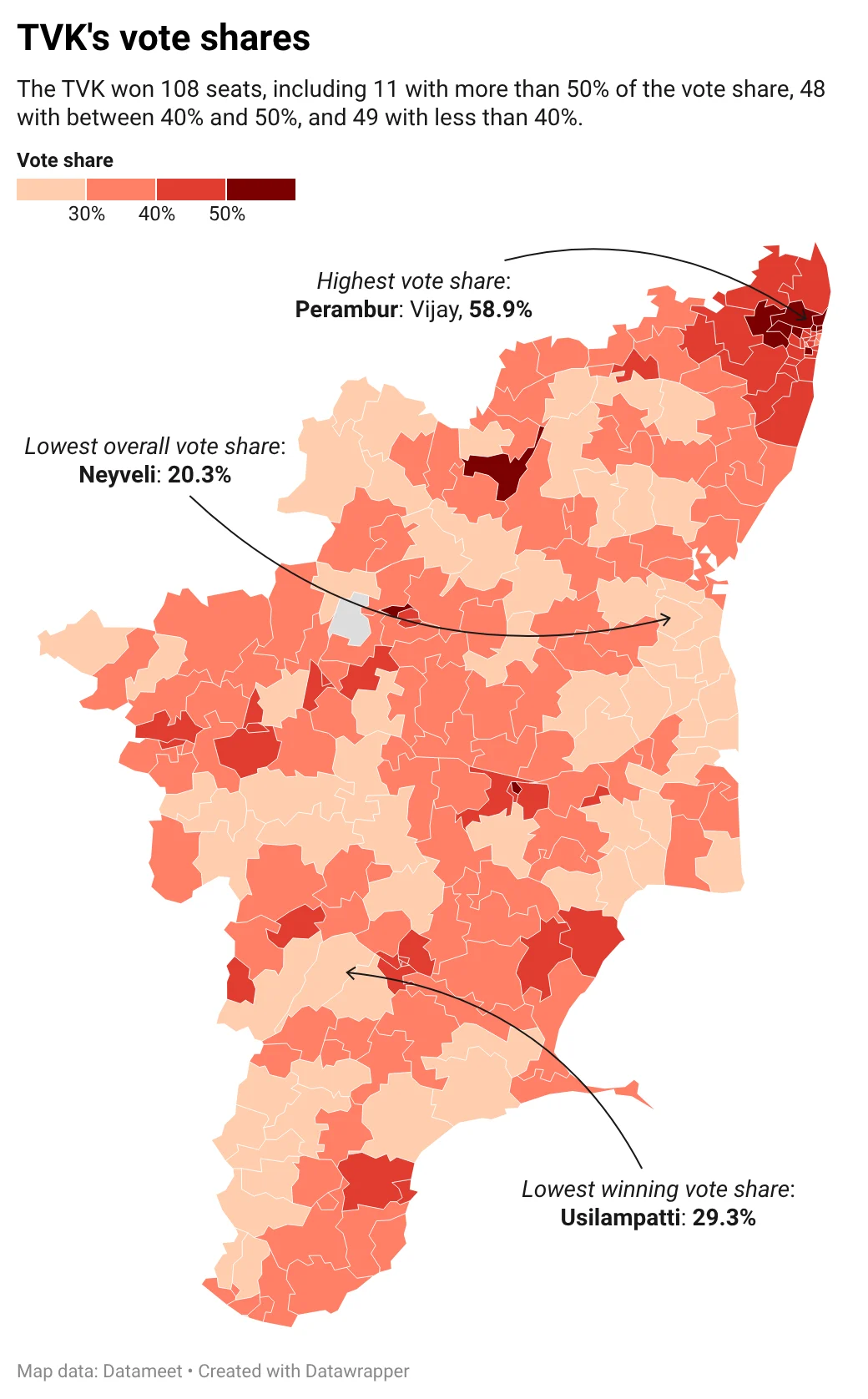
The electoral results reveal a remarkable debut for the TVK, which managed to secure 108 of the total 234 assembly seats. This performance is not merely a victory but a profound disruption, as the party directly ousted the entrenched Dravidian parties in an astounding 91 constituencies. Furthermore, the TVK played the role of a potent ‘spoilsport’ in 51 other seats, where its candidates, despite not winning, garnered more votes than the eventual winner’s margin, effectively altering outcomes for both the DMK and AIADMK. Vijay’s ascension to the Chief Minister’s office will usher in the first non-DMK and non-AIADMK government in Tamil Nadu since 1967, signaling a monumental turning point in the state’s political narrative.
The Dawn of a New Era: Vijay’s Historic Ascent
The victory of the Tamilaga Vettri Kazhagam is more than just an electoral win; it is a cultural phenomenon translated into political power. For decades, Tamil Nadu politics has been characterized by the alternating reigns of the DMK and AIADMK, each built on distinct ideological foundations and led by charismatic figures. Vijay, a superstar of Tamil cinema, has now successfully leveraged his immense popularity and a carefully crafted political message to break this deeply entrenched duopoly. His entry into politics, initially met with skepticism by some, has culminated in a mandate that reflects a profound desire among the electorate for fresh leadership and alternative governance.
The TVK’s ability to garner support from national and regional parties like the Congress, VCK, CPI, and CPI(M) underscores its strategic acumen and broad appeal. While the Congress, a traditional ally in national politics, often plays a supporting role in Tamil Nadu, its decision to back the TVK highlights the emerging consensus around Vijay’s leadership. This coalition, comprising diverse ideological partners, will be critical in providing stability to the new government and translating electoral promises into tangible policy outcomes.
Breaking the Dravidian Duopoly
The significance of TVK’s win cannot be overstated in the context of Tamil Nadu’s political history. Since the late C.N. Annadurai led the DMK to power in 1967, the state has been governed exclusively by either the DMK or the AIADMK. This half-century-plus era of Dravidian dominance has shaped the state’s socio-political fabric, its welfare schemes, and its distinct regional identity. Vijay’s TVK has now shattered this long-standing pattern, demonstrating that a new political force, rooted in popular appeal and a fresh agenda, can successfully challenge and overcome established power structures.
The TVK’s performance stands out even when compared to other successful debuts by actor-politicians in Tamil Nadu. While M.G. Ramachandran (MGR), another cinematic icon, led the AIADMK to victory in 1977 by winning 130 seats after breaking away from the DMK, the TVK’s achievement is remarkable in its own right. MGR’s victory came after a split from an existing major party, inheriting a significant support base. Vijay’s TVK, in contrast, started from scratch, without the benefit of a ready-made party infrastructure or a pre-existing political cadre. Its vote share of 34.9% this year is notably higher than the AIADMK’s 30.4% in 1977, which occurred during the state’s earliest three-cornered contest involving the Congress. This higher vote share, despite a lower seat count than MGR’s debut, indicates a broader base of support for the TVK across the state.
A Timeline of Triumph: TVK’s Journey to Power
Vijay’s political journey has been a gradual, calculated progression, distinct from the sudden plunges often seen with other celebrity entrants.
From Fan Clubs to Political Force
For over two decades, Vijay cultivated a massive and highly organized fan base through his fan clubs, the ‘Vijay Makkal Iyakkam’ (VMI). These clubs, initially focused on welfare activities and social service, served as a de facto political training ground and grassroots network. From distributing relief during natural calamities to organizing blood donation camps, the VMI instilled a sense of purpose and collective action among its members. While Vijay had previously lent his support to certain political parties or candidates, his direct political ambitions remained largely speculative until recent years. The strategic deployment of VMI members in local body elections, where they contested independently and achieved some success, offered a clear precursor to the formation of a full-fledged political party. This extensive groundwork provided the TVK with an immediate and dedicated cadre, a crucial advantage for a debutant party.
Campaigning on a Wave of Change
The official launch of the Tamilaga Vettri Kazhagam (TVK) was met with considerable anticipation. Vijay’s campaign strategy was meticulously planned, focusing on themes of good governance, anti-corruption, youth empowerment, and a departure from the perceived dynastic politics of the established parties. He positioned himself as a fresh alternative, free from the baggage of past alliances and controversies. His public rallies drew massive crowds, reminiscent of the superstar-driven campaigns of MGR and J. Jayalalithaa. Vijay’s rhetoric resonated particularly with younger voters and first-time electors, who constituted a significant demographic seeking change.
The TVK’s manifesto promised a range of welfare measures, economic reforms, and social justice initiatives, carefully crafted to appeal to a broad spectrum of the electorate. Crucially, the party avoided making overt ideological commitments that could alienate potential supporters, instead focusing on pragmatic solutions to everyday problems. The campaign effectively utilized social media, leveraging Vijay’s immense digital presence to disseminate messages and mobilize support, especially among the tech-savvy youth. This combination of traditional mass rallies and modern digital outreach proved highly effective in converting his cinematic popularity into political capital.
Dissecting the Mandate: A Deep Dive into Election Analytics
The electoral data provides a granular understanding of how the TVK achieved its historic victory and fundamentally altered the competitive dynamics of Tamil Nadu politics.
Unprecedented Debut: Beyond MGR’s Shadow
While MGR’s AIADMK secured more seats (130) in its 1977 debut, TVK’s 34.9% vote share this year is a testament to its widespread acceptance across the state, surpassing AIADMK’s 30.4% in 1977. This difference is significant because vote share reflects a broader mandate and deeper penetration across constituencies, even in losing seats. It indicates that the TVK was a formidable contender everywhere, not just in specific pockets. This robust vote share underscores the party’s potential for long-term growth and its capacity to sustain its influence in future elections.
The Vote Share Revolution
The TVK successfully cornered more than a third of the state-wide vote share, at 34.9%. This impressive figure drastically impacted the fortunes of the established parties. The DMK, despite its historical legacy, was reduced to 24.2% of the vote, marking its fourth-lowest vote share in party history. The AIADMK fared even worse, plummeting to its lowest-ever vote share of 21.21%. These figures highlight a profound erosion of support for the traditional Dravidian parties, with a significant portion of their erstwhile voters shifting allegiance to the TVK. This reallocation of votes indicates a clear desire for an alternative beyond the decades-old political binary.
Strategic Wins and Decisive Margins
Though only 11 of TVK’s 108 seats were won with more than 50% of the vote share, the party’s average winning margin stood at 22,631 votes. This is comfortably above the state-wide average winning margin of 16,784 votes and just shy of the 2021 polls’ average of 23,946 votes. This indicates that while TVK might not have achieved outright majority support in most of its winning constituencies, its victories were often substantial, reflecting a clear preference over its rivals.
A deeper analysis reveals the TVK’s strategic penetration into traditional strongholds. A remarkable 23 of the TVK’s wins occurred in seats where the DMK had secured at least 50% of the vote share in the 2021 elections, indicating a direct assault on the ruling party’s bastions. Similarly, the TVK managed to flip 3 seats where the AIADMK had garnered more than half the vote in 2021. This ability to dismantle the established majorities of its rivals speaks volumes about the TVK’s effective ground game and the resonance of its message.
The Spoilsport Effect: TVK’s Disruptive Influence
The TVK’s impact extended beyond its direct wins, significantly altering outcomes in other constituencies. In a further indication of the party’s pervasive influence, the number of seats where the winner secured less than 40% of the vote share surged from just 13 in 2021 to 150 this year. This proliferation of multi-cornered contests underscores the fragmentation of the vote and the TVK’s role in introducing a formidable third dimension. Of these 150 seats, the TVK won 49, followed by the DMK with 48, and the AIADMK with 35. This suggests that in many constituencies, the TVK’s presence was a deciding factor, even if it didn’t win.
Among these 150 seats, 39 witnessed extremely close triangular contests, where the vote-share gap between the winner and the third-place finisher was less than 5 percentage points. A prime example is Palani, where the AIADMK won with 32.1% of the vote, the TVK came second with 31.8%, and the CPI(M) third with 31.4%. A mere 0.7 percentage points separated the top three, illustrating how minor shifts could have drastically altered the outcome. In these fiercely contested seats, the TVK demonstrated its competitive edge, winning 12, while the DMK and AIADMK each secured 11.
Beyond these, the TVK’s "spoilsport" role was evident in 51 seats where, despite finishing in third place, its vote tally exceeded the winning margin. This directly impacted both major Dravidian parties, costing the DMK in 23 such seats and the AIADMK in 19. This data point highlights how the TVK acted as a significant disruptor, siphoning off crucial votes that would otherwise have gone to one of the traditional contenders, thereby influencing the final results in a substantial number of constituencies.
Reshaping the Electoral Map: Shifting Allegiances
The election witnessed a significant reshuffling of political loyalties, with 163 seats changing hands between parties compared to the 2021 elections. The TVK was the primary beneficiary of this churn:
- It wrested 26 seats from the AIADMK, representing 39% of all seats the AIADMK won in 2021.
- It captured 65 seats from the DMK, accounting for a staggering 49% of all seats won by the DMK in 2021.
- The TVK also secured 11 seats that had been won by the Congress in 2021.
In contrast, the incumbent DMK managed to retain only 40 of its 133 seats from 2021 and wrested 15 seats from the AIADMK. The AIADMK, similarly, retained just 22 of its 66 seats from 2021 but managed to flip 22 from the DMK. This unprecedented level of churn underscores the deep anti-incumbency sentiment and the electorate’s readiness to embrace a new political alternative, with the TVK emerging as the clear winner in this realignment.
In terms of head-to-head contests, there were 49 seats that saw bipolar fights – where the winner and runner-up were within 5 percentage points of each other, and the third-place finisher was more than 5 percentage points behind the runner-up. The DMK was the most successful in these direct confrontations, winning 21 such seats, followed by the TVK with 17, and the AIADMK lagging at 6. While 24 of these bipolar fights were between the DMK and TVK, 7 were between the AIADMK and TVK, and 9 were between the traditional rivals DMK and AIADMK.
However, the most telling indicator of the TVK’s dominant performance lies in the number of seats where the winning candidate secured a lead of at least 10 percentage points over the runner-up. Out of 66 such seats, the TVK won an overwhelming 47, demonstrating its capacity for decisive victories. The AIADMK and DMK trailed far behind with 11 and 6 such seats, respectively. While AIADMK chief Edappadi K. Palaniswami secured the largest margin in his Edappadi seat (57.7% of the vote, more than 38 percentage points ahead of the runner-up), the TVK managed to win 14 seats with a vote-share gap of at least 20 percentage points, the highest among all parties. This statistic powerfully illustrates the strength and breadth of the TVK’s mandate.
Voices from the Arena: Reactions and Repercussions
The election results have elicited a range of reactions from across the political spectrum, each offering insights into the evolving landscape of Tamil Nadu.
Vijay and the TVK: A Vision for Tamil Nadu
Following the declaration of results and the confirmation of sufficient support to form the government, Vijay addressed the media and his jubilant supporters. "This victory is not mine alone, but a testament to the people’s unwavering faith in change and a rejection of stagnant politics," he declared, his voice hoarse with emotion. "The Tamilaga Vettri Kazhagam pledges to deliver transparent, accountable, and people-centric governance. Our focus will be on economic revival, job creation for our youth, strengthening social welfare programs, and ensuring environmental sustainability. We understand the weight of expectations, and we are committed to fulfilling every promise made to the people of Tamil Nadu."
TVK spokespersons echoed Vijay’s sentiments, emphasizing the party’s commitment to inclusive development and a corruption-free administration. "Our leader has always believed in serving the people, and this mandate empowers us to do so on a larger scale," stated a senior TVK leader. "We will work tirelessly to address the pressing issues faced by our state, from water scarcity to industrial growth, with a fresh perspective and unwavering dedication."
The Dravidian Majors: Introspection and Resilience
The DMK and AIADMK, reeling from the unexpected setback, have begun a period of introspection. DMK President and outgoing Chief Minister issued a statement acknowledging the people’s verdict. "We respect the democratic process and the choice of the electorate," he said. "While this is a challenging moment for our party, we will analyze the results thoroughly, understand where we fell short, and rededicate ourselves to serving the people as a strong opposition. The principles of Dravidian ideology remain central to Tamil Nadu’s identity, and we will continue to uphold them."
AIADMK chief Edappadi K. Palaniswami expressed disappointment but vowed to rebuild the party. "The results are not what we anticipated, but the AIADMK has faced challenges before and emerged stronger," he asserted. "We will work unitedly to regain the trust of the people and ensure that the voices of the opposition are heard. We will hold the new government accountable for its promises." Both parties are expected to undertake significant organizational overhauls and strategic reassessments in the coming months to counter the TVK’s ascendance.
Coalition Partners: A Foundation of Support
Leaders of the Congress, VCK, CPI, and CPI(M) reaffirmed their support for the TVK government. "The Congress party extends its full support to Chief Minister Vijay and the Tamilaga Vettri Kazhagam," stated the state Congress chief. "This alliance reflects a shared commitment to progressive governance and democratic values. We look forward to contributing to the stability and success of the new administration."
VCK leader Thol. Thirumavalavan hailed the victory as a testament to the power of unity. "This coalition represents a diverse set of voices and aspirations," he commented. "Our collective aim is to ensure social justice, equality, and inclusive growth for all sections of society. We believe Vijay’s leadership will usher in a new era of politics that truly serves the common man." The support from these parties is crucial for TVK to maintain its majority and navigate the complexities of governance.
Expert Analysis: The New Political Landscape
Political analysts are unanimous in describing the election as a watershed moment for Tamil Nadu. "This election marks the definitive end of the Dravidian duopoly that has defined Tamil Nadu politics for over five decades," observed Dr. Priya Shankar, a Chennai-based political scientist. "Vijay has tapped into a deep vein of anti-incumbency and a desire for fresh leadership, particularly among the youth. His ability to translate cinematic appeal into a concrete political mandate, especially with such a high vote share on debut, is truly remarkable."
Another analyst, Mr. Karthik Raman, highlighted the strategic brilliance of the TVK’s campaign. "They carefully positioned themselves as an alternative without directly attacking the core tenets of Dravidian identity, instead focusing on governance and systemic change. The ‘spoilsport’ effect data clearly shows how pervasive their influence was, even in seats they didn’t win. The challenge now for Vijay will be to transition from a popular star to an effective administrator and manage the expectations of a diverse electorate and a multi-party coalition."
Implications for Tamil Nadu and Beyond
The rise of Vijay’s TVK carries profound implications, not just for Tamil Nadu but potentially for the broader Indian political landscape.
The Challenges Ahead for TVK
The path ahead for the TVK government will not be without its hurdles. First and foremost is the challenge of governance. Vijay, while a charismatic leader, lacks prior administrative experience. He will need to assemble a competent team of ministers and bureaucrats to translate his vision into effective policies and programs. Managing a coalition government, with its inherent compromises and diverse demands, will also test his leadership skills. Delivering on ambitious electoral promises, especially concerning economic revival and job creation, in a fiscally constrained environment will require astute financial management and innovative policy solutions. The transition from being a popular opposition figure to a responsible ruling party will be a critical phase for the TVK.
The Future of Dravidian Politics
For the DMK and AIADMK, the election results necessitate a deep introspection. Both parties face the daunting task of rejuvenating their leadership, reconnecting with a disillusioned electorate, and adapting to a new political reality where they are no longer the sole contenders for power. The DMK, despite its established organizational structure, must address the erosion of its traditional vote bank. The AIADMK, grappling with internal divisions since the demise of J. Jayalalithaa, faces an even steeper climb to reclaim its past glory. The future of Dravidian politics now hinges on their ability to evolve and present a compelling alternative to the TVK’s fresh appeal.
A Template for New Entrants?
The TVK’s success may also serve as a template for other non-traditional entrants and celebrity politicians across India. It demonstrates that with sustained groundwork, a clear message, and the ability to connect with the aspirations of the populace, established political hegemonies can be challenged. However, the unique socio-political context of Tamil Nadu, where cinema and politics have long been intertwined, makes direct comparisons difficult. Nonetheless, Vijay’s victory will undoubtedly inspire new political actors to leverage their popularity and build grassroots movements.
In conclusion, the electoral triumph of Vijay’s Tamilaga Vettri Kazhagam marks a seminal moment in Tamil Nadu’s history. It signifies not just a change of government but a fundamental reshaping of political power dynamics. As Vijay prepares to take the oath of office, all eyes will be on his administration, eager to see if this cinematic superstar can successfully script a new, prosperous chapter for the state and solidify the TVK’s place as a lasting force in Indian politics.
