

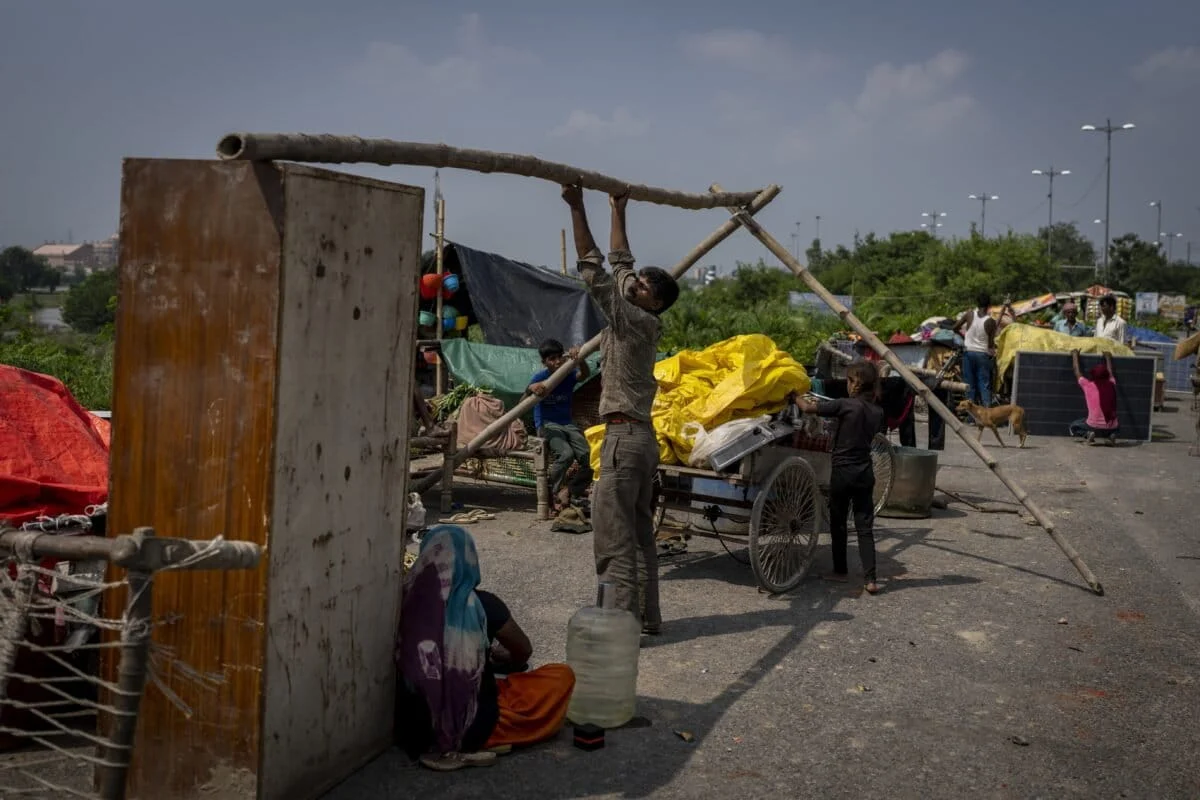
In the quiet stretches of rural India, a silent transformation is taking place. It is not marked by the sudden violence of a cyclone or the dramatic surge of a flood, but by the slow, agonizing erosion of a way of life. A recent study, focusing on the phenomenon of "ghost villages," has cast a new light on the mechanics of human migration, revealing that climate change is rarely the sole perpetrator of displacement. Instead, it acts as a "threat multiplier," exposing the deep-seated vulnerabilities of rural infrastructure and the failure of institutional support systems.
The research, led by Prasanta Moharaj, an assistant professor of sociology at Dayananda Sagar University, Bengaluru, argues that migration is not a direct, linear outcome of environmental change. Rather, it is the final link in a chain of impacts—beginning with agricultural disruption and ending in a compelled flight for survival. By examining the tragic trajectory of Meenakshipuram in Tamil Nadu and drawing parallels with the sinking coastlines of Odisha, the study offers a sobering blueprint of the future of internal displacement in the Global South.
Main Facts: The "Threat Multiplier" Effect
The core finding of the study, recently published in a Springer-related journal, challenges the simplistic narrative that "climate change causes migration." According to Moharaj, the environmental stressor is the catalyst, but the explosion of displacement is fueled by socio-economic instability and weak governance.
The Chain of Causality
The research identifies a specific sequence of events that leads to the abandonment of rural settlements:
- Environmental Stress: Rising temperatures and erratic rainfall patterns lead to prolonged droughts.
- Productivity Collapse: These stresses deplete groundwater and destroy crop yields, the backbone of the rural economy.
- Economic Weakening: As agriculture fails, local markets dry up, and debt cycles among farmers intensify.
- Institutional Failure: The lack of alternative livelihood programs, crop insurance, and basic infrastructure (such as reliable water management) leaves residents with no safety net.
- Compelled Migration: When the "adaptive capacity" of the village is exhausted, migration becomes the only survival strategy left.
The Human Element: Beyond Economics
Crucially, the study highlights that the decision to leave is not purely financial. It is shaped by social marginalization and emotional ties. While younger generations may seek better prospects in urban centers, older residents often experience "place attachment," leading to a fractured community where the most vulnerable are left behind in crumbling villages.
Chronology: The Rise and Fall of Meenakshipuram
The study uses the case of Meenakshipuram, a village in the Tuticorin district of Tamil Nadu, as a primary lens. Once a self-sustaining agrarian community, Meenakshipuram is now a "ghost village," its streets empty and its homes reclaimed by the elements.
The Decades of Decline
The decline of Meenakshipuram did not happen overnight. In the late 20th century, the region began experiencing a shift in the monsoon cycle. Rainfall, which was once predictable, became sporadic. By the early 2000s, repeated droughts had turned the local landscape into a dust bowl. As the water table plummeted, the cost of drilling deeper borewells became prohibitive for small-scale farmers.
By 2010, the exodus had begun in earnest. Families sold their livestock and moved to nearby industrial hubs or cities like Chennai and Madurai. The schools closed, the local shops shuttered, and the social fabric of the village began to unravel.
The Lone Sentinel: The Story of Kandaswamy
Meenakshipuram gained national attention several years ago because of one man: Kandaswamy. While his children and neighbors fled the encroaching desolation, Kandaswamy refused to leave. He became the village’s only resident, living among the ruins of his community.
The study explores Kandaswamy’s motivations as a counterpoint to the migration trend. His refusal to move was rooted in an emotional and spiritual attachment to his ancestral land—a factor often overlooked in climate migration data. His death eventually marked the official "death" of the village, turning Meenakshipuram into a symbol of the "immobility" that affects those who cannot, or will not, leave climate-impacted zones.
Supporting Data: The Triple Crisis of Environment, Economy, and Policy
The research utilizes secondary data to quantify the stressors that led to the collapse of Meenakshipuram and similar rural hubs. The data points to a "triple crisis" that makes rural life unsustainable.
1. Environmental Indicators
The study notes that the region around Meenakshipuram faced a significant increase in the number of "heatwave days" and a 20-30% reduction in average annual rainfall over three decades. These factors combined to create a permanent state of water scarcity, rendering traditional rain-fed agriculture impossible.
2. Socio-Economic Vulnerability
Migration patterns in the village were heavily influenced by existing social hierarchies. The study found that marginalized groups—those with less land and fewer assets—were the first to be forced out. Without access to credit or government subsidies, these families had no "buffer" against a single failed harvest.

3. The Infrastructure Gap
A critical piece of data highlighted by Moharaj is the "adaptive capacity" index. In villages where the government invested in check dams, drought-resistant seeds, and paved roads to markets, migration rates were significantly lower. Meenakshipuram, however, suffered from chronic underinvestment, which accelerated its abandonment.
Parallel Case Studies: From Tamil Nadu to Odisha
The findings from Meenakshipuram are not isolated. Prasanta Moharaj draws a direct comparison to his hometown in Odisha’s Kendrapara district, where a cluster of villages known as Satabhaya (meaning "Seven Brothers") is facing a similar fate, albeit for different environmental reasons.
The Sinking Coast of Satabhaya
In Satabhaya, the threat is not drought but the sea. Rising sea levels and coastal erosion have swallowed five of the seven original villages. Like Meenakshipuram, Satabhaya was once a thriving hub of fishing and agriculture. Today, it is a site of mass displacement.
Socio-Political Complexity
Moharaj points out that the situation in Odisha is further complicated by socio-political factors. The region has a large population of long-settled migrants, and the process of relocation and rehabilitation has been marred by bureaucratic delays and disputes over land rights. This reinforces the study’s thesis: the environment may push people out, but it is the socio-political system that determines whether they can survive or are forced to flee.
Official Responses and Institutional Gaps
The study serves as a critique of current policy frameworks regarding internal displacement in India. While India has a National Action Plan on Climate Change (NAPCC), the research suggests that these policies often fail to reach the "hyper-local" level of villages like Meenakshipuram.
The Absence of a "Migration Policy"
India currently lacks a comprehensive national policy specifically dedicated to climate-induced internal migration. Most migrants are classified under general "economic migration," which ignores the forced nature of their displacement. This lack of classification means that displaced persons often lose access to social welfare benefits (like ration cards or healthcare) when they cross state or district borders.
The Failure of Local Governance
The study notes that local panchayats (village councils) are often underfunded and ill-equipped to handle the complexities of climate adaptation. In Meenakshipuram, the absence of a proactive local government to lobby for water infrastructure or alternative employment schemes was a decisive factor in the village’s demise.
Implications: The Future of Rural India
The implications of Moharaj’s research are profound for a country where nearly 65% of the population still resides in rural areas. The transformation of Meenakshipuram into a ghost village is a warning of a broader "hollowing out" of the Indian countryside.
1. The Rise of "Trapped Populations"
The study warns of a growing category of "trapped populations"—individuals who are too poor or too old to migrate, yet remain in areas that can no longer support life. These individuals face extreme poverty and health risks as basic services vanish from their abandoned villages.
2. Urban Pressure and Slum Expansion
Forced migration from the interior leads to the rapid, unplanned growth of urban slums. As rural refugees move to cities, they often transition from "environmental vulnerability" to "urban vulnerability," living in precarious settlements with poor sanitation and high exposure to urban heat islands.
3. The Need for "In-Situ" Adaptation
The most significant takeaway from the study is the urgent need for "in-situ" adaptation. If the government can improve the adaptive capacity of villages—through better irrigation, policy support for diverse livelihoods, and social safety nets—the "compelled response" of migration can be transformed into a "voluntary choice."
Conclusion: A Call for Holistic Policy
The story of Meenakshipuram and the lone vigil of Kandaswamy serves as a poignant reminder that climate change is not just a scientific phenomenon; it is a sociological crisis. As Prasanta Moharaj’s research demonstrates, the abandonment of a village is a failure of the state and the economy as much as it is a result of a warming planet.
To prevent the map of India from being dotted with more ghost villages, policy-makers must look beyond carbon emissions and focus on the resilience of the rural social fabric. Migration should be a path to opportunity, not a desperate flight from a land that can no longer provide water, food, or hope. Without immediate institutional intervention, the "Seven Brothers" of Odisha and the empty streets of Meenakshipuram will become the new normal for millions of rural citizens across the subcontinent.
