

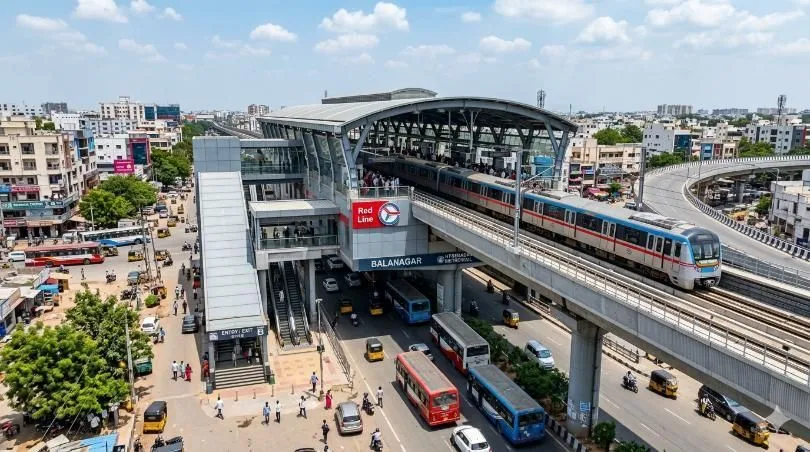
For decades, the mention of the Balanagar Y-Junction in Hyderabad evoked a singular emotion among commuters: dread. As one of the city’s most notorious traffic bottlenecks, this intersection served as the chaotic meeting point for heavy industrial machinery, interstate transit, and local commuters. However, the landscape of North Hyderabad underwent a paradigm shift with the commissioning of the Hyderabad Metro Rail (HMR). At the heart of this transformation stands the Dr. B.R. Ambedkar Balanagar Metro Station.
More than just a transit stop, the Balanagar Metro Station has emerged as a vital lung for the city’s industrial corridor, offering a seamless, air-conditioned alternative to the dust and noise of the streets below. This report explores the station’s evolution, its operational significance, and its profound impact on the socio-economic fabric of the region.
I. Main Facts: The Strategic Anchor of the Red Line
The Balanagar Metro Station is a critical node on the Hyderabad Metro’s Red Line (Line 1), which spans approximately 29 kilometers from Miyapur in the northwest to LB Nagar in the southeast. Situated in the Medchal-Malkajgiri district, the station serves as a bridge between the traditional industrial heartland of Balanagar and the rapidly developing residential pockets of Kukatpally and Moosapet.
Station Specifications:
- Official Name: Dr. B.R. Ambedkar Balanagar Metro Station (Renamed in 2018).
- Line: Red Line (Line 1).
- Structure: Elevated, three-level station (Street, Concourse, and Platform).
- Location: Balanagar Main Road, near the Y-Junction.
- Connectivity: Links the industrial estates of Jeedimetla and Balanagar to the IT hubs of Hitech City (via Ameerpet interchange) and the commercial centers of MGBS and Koti.
The station was designed to handle high footfalls, catering to both the blue-collar workforce of the nearby factories and the white-collar professionals residing in the new high-rise apartments flanking the metro corridor.
II. Chronology: From Industrial Congestion to Modern Mobility
The journey of the Balanagar Metro Station is intertwined with the broader timeline of the Hyderabad Metro Rail project, one of the world’s largest Public-Private Partnership (PPP) projects in the metro sector.
- 2012–2016: The Construction Phase: Work on the Red Line progressed through some of the city’s most congested zones. The Balanagar stretch was particularly challenging due to the heavy movement of industrial trucks and the presence of underground utilities.
- November 29, 2017: The Grand Inauguration: The station was opened to the public as part of the initial 30-km stretch (Miyapur to Nagole) inaugurated by Prime Minister Narendra Modi. This launch marked the beginning of a new era for North Hyderabad.
- September 2018: A Symbolic Renaming: In a move to honor the architect of the Indian Constitution, the Telangana government officially renamed the facility the "Dr. B.R. Ambedkar Balanagar Metro Station." This was part of a larger initiative to give the city’s transit hubs a distinct cultural and historical identity.
- 2021–2022: Post-Pandemic Recovery: Following the global lockdowns, the station saw a rapid surge in ridership as the industrial sector resumed full operations and the Balanagar flyover (constructed by the HMDA) was integrated into the local traffic plan to complement the metro.
III. Supporting Data: Station Layout and Operational Logistics
The architectural philosophy of the Balanagar Metro Station focuses on "user-centric flow," ensuring that passengers can transition from the chaotic street level to the platform in under three minutes.
1. Layout and Platforms
The station follows the standard HMR elevated template but is scaled for higher-than-average industrial traffic:
- Street Level: Features four distinct entry/exit points (Arms) to ensure commuters do not have to cross the dangerous Y-Junction on foot.
- Concourse Level: Contains ticket vending machines (TVMs), retail kiosks, security checkpoints, and Automatic Fare Collection (AFC) gates.
- Platform Level:
- Platform 1: Eastbound toward LB Nagar (via Ameerpet and MGBS).
- Platform 2: Westbound toward Miyapur.
2. Gate Information (The Four Arms)
To manage the complex geography of the Y-Junction, the station utilizes a four-arm exit system:
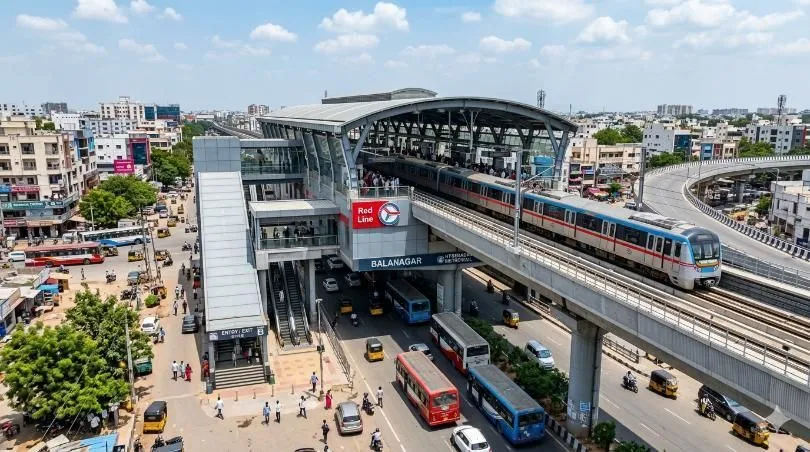
- Arm A: Exit toward the Balanagar Industrial Area and IDPL.
- Arm B: Directs commuters toward the Sanathnagar side and local bus stops.
- Arm C: Access to the Moosapet side, facilitating easy transit for residents of nearby housing boards.
- Arm D: Strategically placed for those heading toward the Kukatpally commercial stretch.
3. Facilities and Security
In alignment with global standards, the station is equipped with:
- Full CCTV Coverage: Monitored by both HMR security and the local police.
- Accessibility: Elevators and escalators are standard, with tactile flooring for visually impaired commuters.
- First-Mile/Last-Mile Connectivity: Dedicated bays for electric autos and ride-sharing services.
IV. Official Responses and Governance Vision
The Hyderabad Metro Rail Limited (HMRL) and the Government of Telangana have frequently highlighted Balanagar as a success story in "Transit-Oriented Development" (TOD).
In various press briefings, HMRL Managing Director N.V.S. Reddy has emphasized that the goal of stations like Balanagar is to "de-clutter the street and reclaim the city for the pedestrian." Official statements from the Municipal Administration and Urban Development (MA&UD) department indicate that the Balanagar Metro was a prerequisite for the approval of several high-density residential projects in the vicinity.
Furthermore, the integration of the metro station with the 6nd-longest flyover in Hyderabad (the 2.17 km Balanagar Flyover) was a calculated move by the state government. Officials noted that while the flyover handles long-distance vehicular transit, the metro station handles the "human load," effectively segregating traffic and reducing the carbon footprint of the industrial corridor.
V. Implications: Real Estate, Economy, and Lifestyle
The presence of the Dr. B.R. Ambedkar Balanagar Metro Station has had a "halo effect" on the surrounding five-kilometer radius. The implications are visible across three primary sectors:
1. The Real Estate Boom
Before 2017, Balanagar was viewed primarily as a place of work—a grey zone of factories and warehouses. Today, it is a burgeoning residential hub.
- Property Appreciation: Real estate prices for apartments near the metro station have seen an appreciation of 40-60% since the station’s inauguration.
- Rental Demand: There is a high demand for "walk-to-metro" housing. Professionals working in Mindspace or Financial District now prefer living in Moosapet or Balanagar because the metro provides a predictable 20-minute commute to Ameerpet, where they can switch to the Blue Line.
2. Commercial and Retail Transformation
The "industrial vibe" is rapidly being replaced by a "lifestyle vibe."
- Retail Giants: The proximity of D-Mart and the development of the Phoenix Mall (one of the largest upcoming retail spaces in North Hyderabad) are direct results of the footfall guaranteed by the metro station.
- SME Growth: Small businesses, cafes, and service centers have proliferated around the station’s exit points, creating a micro-economy that thrives on the daily flow of thousands of passengers.
3. Environmental and Social Impact
By shifting thousands of commuters from two-wheelers and buses to the electric rail, the station has contributed to a localized reduction in vehicular emissions. Socially, the station has democratized access to the city. A factory worker from Balanagar can now reach the upscale malls of Banjara Hills or the historical sites of Old City with the same ease and cost-effectiveness as a corporate executive.
VI. Conclusion: The Anchor of North Hyderabad
The Dr. B.R. Ambedkar Balanagar Metro Station is far more than a stop on a railway map; it is the anchor of a neighborhood in transition. It has successfully decoupled the area’s identity from the "traffic chaos" of the Y-Junction and rebranded it as a modern, accessible, and vibrant part of Greater Hyderabad.
As the city continues to expand, the station stands as a testament to the power of strategic infrastructure. For the thousands of daily commuters who glide over the gridlock below, the metro is not just a mode of transport—it is a daily gift of time, comfort, and dignity. Whether you are an investor looking at the skyrocketing property values or a student heading to class, the Balanagar Metro Station is the heartbeat of North Hyderabad’s future.
