

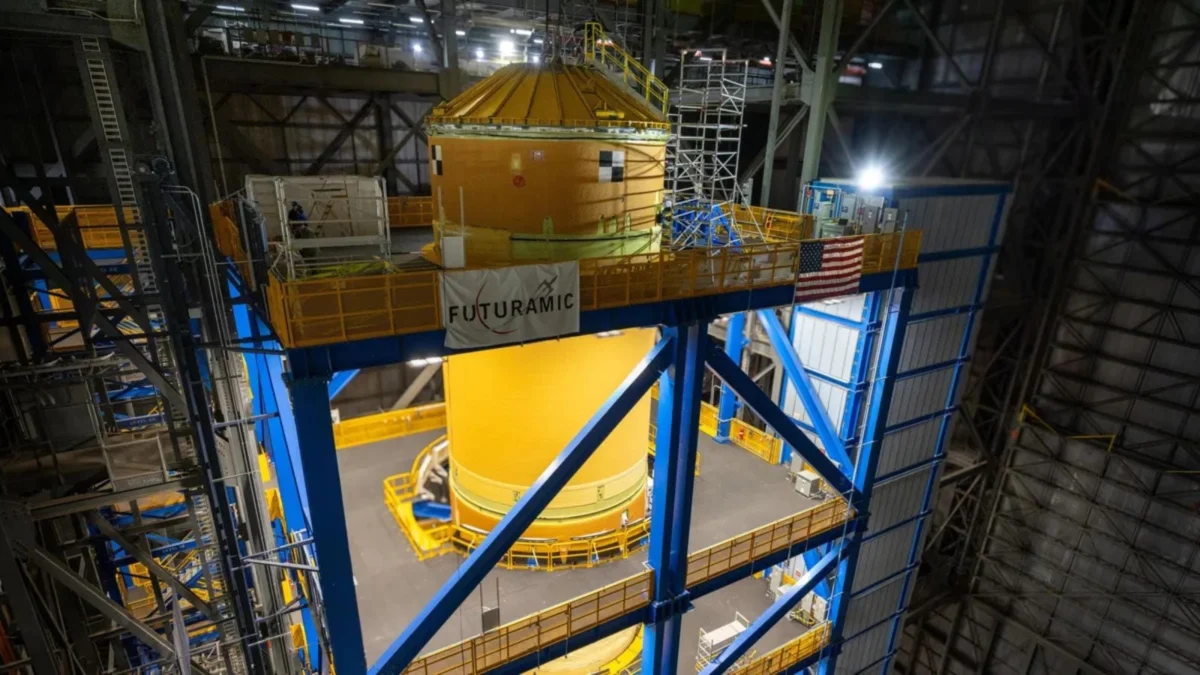
KENNEDY SPACE CENTER, FL — In a move that signals the next critical phase of America’s return to deep space, NASA engineers have officially begun the assembly of the Space Launch System (SLS) rocket destined for the Artemis III mission. This milestone, marked by the vertical integration of the massive core stage within the historic Vehicle Assembly Building (VAB), arrives at a transformative moment for the agency as it balances ambitious exploration goals with the technical realities of next-generation hardware development.
While Artemis III was originally envisioned as the triumphant return of human boots to the lunar surface, the mission has recently been redefined as a high-stakes orbital validation flight. This pivot underscores NASA’s commitment to a "safety-first" architecture, ensuring that the complex docking maneuvers and life-support handoffs required for lunar landings are battle-tested before astronauts attempt a descent to the moon’s treacherous South Pole.
Main Facts: The Integration of a Titan
The centerpiece of this assembly operation is the SLS core stage, a 212-foot-tall engineering marvel that serves as the backbone of the world’s most powerful operational rocket. On May 13, 2026, technicians at the Kennedy Space Center successfully executed the "breakover" maneuver, lifting the stage from its horizontal transport cradle into a vertical orientation.
Currently stationed in High Bay 2 of the VAB, the core stage is undergoing a rigorous series of checkouts. This stage houses the propellant tanks for liquid hydrogen and liquid oxygen, which will feed the four RS-25 engines at its base. Once these engines—repurposed and upgraded from the Space Shuttle program—are fully integrated and tested, the entire assembly will be moved to High Bay 3. There, it will be mated with the twin five-segment solid rocket boosters (SRBs) and the interim cryogenic propulsion stage (ICPS).
The Artemis III mission, now targeted for a late 2027 launch, represents a shift in the program’s flight manifest. Due to developmental delays in the Human Landing System (HLS) programs managed by SpaceX and Blue Origin, NASA leadership has opted to utilize Artemis III as a crewed "dress rehearsal" in Earth orbit. The crew will focus on docking with HLS prototypes and testing the deep-space capabilities of the Orion spacecraft, effectively bridging the gap between the circumlunar flight of Artemis II and the intended landing on Artemis IV.
Chronology: The Path from Apollo’s Shadow to Artemis’s Light
The road to the assembly of the Artemis III SLS has been defined by incremental successes and strategic recalibrations. To understand the significance of today’s milestone, one must look at the timeline of the Artemis program:
2022: Artemis I – The Proof of Concept
The program began in earnest with the uncrewed Artemis I mission. The maiden flight of the SLS rocket and the Orion capsule proved that the heat shield could withstand atmospheric reentry at lunar speeds and that the SLS could successfully deliver a payload to a Trans-Lunar Injection (TLI) orbit.
2025: Artemis II – Human Re-entry into Deep Space
Completed just weeks prior to the current assembly update, Artemis II was a resounding success. It carried a crew of four—including the first woman, the first person of color, and the first international partner (Canadian) to leave Low Earth Orbit (LEO)—on a free-return trajectory around the moon. This mission validated the Orion’s life-support systems in a crewed environment.
2026: The Assembly of Artemis III
With the hardware for Artemis III now entering the VAB, NASA is moving from "testing" to "operationalizing" the SLS. The current assembly phase is expected to last through the remainder of 2026, involving thousands of hours of cabling, thermal protection application, and avionics integration.
2027–2028: The New Horizon
Following the revised 2027 launch of Artemis III, NASA is eyeing 2028 for Artemis IV. This mission is now slated to be the first to attempt a crewed landing near the lunar South Pole, utilizing the experience gained from the docking tests performed during Artemis III.
Supporting Data: Technical Specifications and Logistics
The scale of the SLS and the Artemis III mission profile can be quantified through staggering data points that highlight the industrial might required for deep-space exploration.
The SLS Core Stage and Stack
- Core Stage Height: 212 feet (64.6 meters).
- Total Rocket Height: Approximately 322 feet (98 meters) when fully integrated with the Orion capsule and Launch Abort System.
- Total Lift-off Thrust: 8.8 million pounds, which is 15% more thrust than the Saturn V rocket used during the Apollo era.
- Fuel Capacity: The core stage holds 537,000 gallons of liquid hydrogen and 196,000 gallons of liquid oxygen.
- Weight: When fully fueled, the stack weighs nearly 5.75 million pounds.
The Human Landing System (HLS) Context
The decision to pivot Artemis III to an orbital test mission is driven by the complexity of the HLS.
- SpaceX Starship HLS: Requires multiple "tanker" launches to refuel in Earth orbit before it can transit to the moon.
- Blue Origin Blue Moon Lander: Utilizes a different architecture involving a dedicated cislunar transporter.
By performing docking tests in Earth orbit during Artemis III, NASA can verify the "soft-capture" and "hard-mate" docking mechanisms between Orion and these massive landing vehicles without the life-critical pressure of a lunar descent.
Official Responses: Safety, Persistence, and Innovation
NASA officials have remained steadfast in their defense of the program’s schedule changes, framing the Artemis III mission revision as a pragmatic evolution rather than a setback.
NASA Administrator’s Office:
In a statement following the core stage lifting, NASA leadership emphasized the agency’s "safety-first" culture. "We are not just going back to the moon; we are going there to stay. That requires us to be disciplined. By using Artemis III to master the complexities of docking and integrated operations with our commercial partners, we ensure that when we do land on Artemis IV, we do so with the highest possible margin of safety."
Kennedy Space Center Operations:
Engineers within the VAB have noted that the assembly of the third SLS core stage has benefited significantly from "lessons learned" during the first two builds. "We are seeing a 20% increase in processing efficiency," noted a senior integration lead. "The hardware is the same, but our familiarity with the tolerances and the vertical integration flow has matured. This is how you build a sustainable space program—by making the extraordinary feel like a routine operation."
Industry Partners:
Representatives from Boeing (the prime contractor for the SLS core stage) and Aerojet Rocketdyne (provider of the RS-25 engines) have reiterated their commitment to the 2027 launch window. They noted that the Artemis III engines include upgraded controllers and additional insulation to handle the intense thermal loads of the SLS flight profile.
Implications: The Geopolitical and Scientific Stakes
The assembly of Artemis III carries weight far beyond the walls of the Vehicle Assembly Building. Its success or failure will ripple through the geopolitical landscape and the future of the commercial space economy.
The New Space Race
The United States is currently in a "soft power" competition with China’s space agency (CNSA), which has announced its own plans to land taikonauts on the moon by 2030. NASA’s ability to maintain a steady cadence of SLS launches—even if the mission profiles change—is vital to maintaining American leadership in space policy and the establishment of the Artemis Accords, a set of international principles for lunar exploration.
Scientific Discovery at the South Pole
The ultimate goal of the Artemis program is the lunar South Pole, a region believed to contain vast reserves of water ice in permanently shadowed craters. This ice is more than just a scientific curiosity; it is a "local resource" that can be broken down into oxygen for breathing and hydrogen for rocket fuel. By perfecting docking maneuvers in Artemis III, NASA paves the way for the logistics chains that will eventually support a permanent lunar base, known as the Artemis Base Camp.
The Commercial Paradigm Shift
Artemis III marks a unique hybrid in space history. It combines a traditional "government-owned" rocket (the SLS) with "service-based" landing systems provided by the private sector. The success of the docking tests in late 2027 will validate this public-private partnership model. If SpaceX and Blue Origin can prove their vehicles are ready for crewed operations during Artemis III, it will catalyze further private investment in orbital infrastructure, potentially leading to a robust "lunar economy" involving mining, tourism, and advanced research.
Conclusion: A Monumental Undertaking
As the SLS core stage stands tall in High Bay 2, it serves as a physical testament to human ingenuity and the relentless pursuit of the unknown. The assembly of the Artemis III rocket is more than a mechanical process; it is the construction of a bridge to the future. While the path to the lunar surface has proven more complex than initially anticipated, the steady progress at Kennedy Space Center suggests that the return to the moon is no longer a question of "if," but a matter of "when." Late 2027 will be the next great test of that resolve.
