

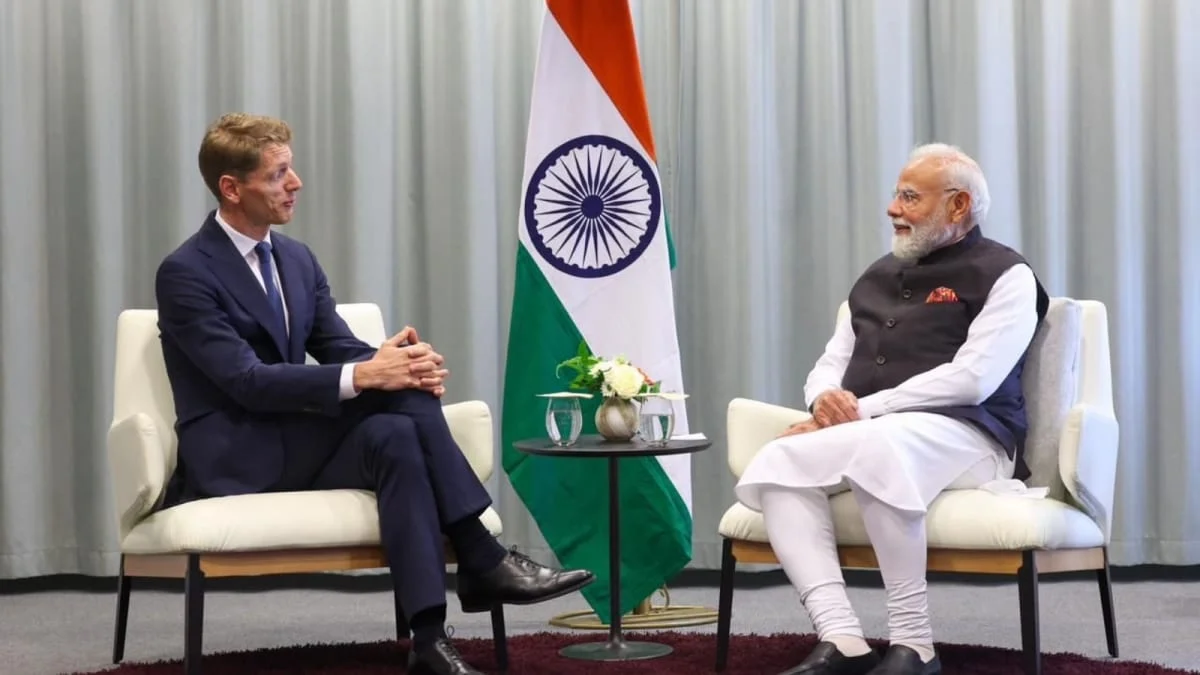
Gothenburg, Sweden – May 17, 2026 – Prime Minister Narendra Modi, currently on a high-stakes diplomatic visit to Sweden, today held a pivotal meeting with Robert Maersk Uggla, the Chairman of Maersk, the world’s second-largest shipping company. The discussions, held in the vibrant port city of Gothenburg, centered on significantly expanding investment opportunities within India’s burgeoning port infrastructure, logistics, and maritime connectivity sectors, underscoring New Delhi’s strategic push to transform into a global logistics hub.
The meeting with the head of the Danish shipping giant, a critical player in global supply chains, signals India’s proactive engagement with leading international enterprises to bolster its economic growth and improve trade efficiencies. The dialogue comes amidst a broader two-day itinerary for Prime Minister Modi in the Scandinavian nation, marked by high-level political engagements and the conferment of Sweden’s most distinguished honour for a Head of Government.
Deepening Economic Ties: The Maersk Dialogue
Main Facts:
Prime Minister Modi’s engagement with Robert Maersk Uggla in Gothenburg was a highlight of his visit, aimed at attracting substantial foreign direct investment into India’s rapidly expanding maritime and logistics sectors. The discussions revolved around avenues for Maersk to deepen its already significant presence in India, particularly in modernizing and expanding port infrastructure, enhancing logistical networks, and improving overall maritime connectivity.
Maersk, an integrated container logistics company, operates across all aspects of the supply chain, from ocean shipping to inland logistics and port terminal operations. Its strategic investments are crucial for any nation aspiring to streamline its trade and become a competitive manufacturing and export base. India, with its extensive coastline and ambitious economic targets, presents a compelling proposition for global logistics behemoths like Maersk.
Official Responses:
Following the productive meeting, Prime Minister Modi took to X (formerly Twitter) to share details, stating, "In Gothenburg, met Mr. Robert Maersk Uggla, Chairman of Maersk. We discussed the large scope of opportunities in India and deepening investments, especially in sectors like port infrastructure, logistics and more." The tweet, accompanied by an image of the two leaders, underscored the strategic importance India places on collaboration with global industry leaders to achieve its economic objectives.
While Maersk has not yet released a detailed statement, industry observers suggest that such high-level engagements often lay the groundwork for future substantial commitments. A source close to the Indian delegation, speaking on condition of anonymity, indicated that "the Prime Minister outlined India’s vision for a world-class logistics ecosystem, highlighting the Sagarmala Programme and the National Logistics Policy. Maersk, with its global expertise and technological prowess, is seen as an ideal partner in this transformative journey."
The discussions likely touched upon various facets of port development, including the modernization of existing berths, development of new deep-water ports, enhancement of cargo handling capabilities, and the integration of advanced digital technologies for port operations. Furthermore, the dialogue would have explored opportunities in creating multi-modal logistics parks, developing cold chain infrastructure, and optimizing last-mile delivery solutions, all critical components for reducing logistics costs and improving supply chain efficiency in India.
A Strategic European Outreach: PM Modi’s Sweden Itinerary
Chronology:
Prime Minister Modi’s arrival in Sweden earlier on Sunday set the stage for a series of high-profile engagements. He was accorded a ceremonious welcome at Gothenburg Airport by his Swedish counterpart, Ulf Kristersson, a gesture symbolizing the strong bilateral ties between the two nations. Adding to the diplomatic gravitas, his aircraft was notably escorted by Swedish Air Force jets upon its descent into Gothenburg, a rare honour typically reserved for state visits.
Upon his arrival, Prime Minister Modi articulated the overarching goals of his two-day visit in a social media post: "I will be meeting Prime Minister Kristersson with the aim of advancing the India-Sweden friendship in trade, investments, innovation, defence and more." This statement highlighted the multi-faceted nature of the engagement, extending beyond mere economic transactions to encompass strategic cooperation across various sectors.
A significant event on his itinerary is the European Business Round Table for Industry, where he is scheduled to meet European business leaders alongside Prime Minister Kristersson and the President of the European Commission, Ms. Ursula von der Leyen. This roundtable is poised to "deepen investment linkages between India and Europe," as stated by PM Modi, emphasizing India’s broader engagement with the European Union as a bloc. The presence of the EC President underscores the importance of India as a strategic partner for the EU, particularly in the context of global supply chain diversification and economic resilience.
The overarching theme of the Prime Minister’s two-day tour is to explore new avenues of cooperation, aiming to further enhance bilateral trade, which impressively reached USD 7.75 billion in 2025. This figure represents a robust growth trajectory, and the current visit is expected to inject fresh impetus into achieving even higher trade volumes and broader economic collaboration.
India’s Maritime Vision and the Global Supply Chain Context
Supporting Data:
India’s focus on port infrastructure and logistics is not new, but it has gained significant momentum under the Modi administration’s "Make in India" and "Atmanirbhar Bharat" (self-reliant India) initiatives. The Sagarmala Programme, launched in 2015, is a flagship national initiative aimed at promoting port-led development by harnessing India’s 7,500 km coastline and 14,500 km of potentially navigable waterways. The program envisions port modernization, new port development, port connectivity enhancement, and coastal community development. As of 2025, over 800 projects worth approximately USD 100 billion are under various stages of implementation or development under Sagarmala, demonstrating the scale of ambition.
The National Logistics Policy (NLP), introduced in 2022, further complements this vision by aiming to reduce logistics costs in India from the current 13-14% of GDP to a global average of 8% by 2030. This reduction is critical for making Indian goods more competitive in international markets. The NLP focuses on multimodal logistics, digitalization, skill development, and the creation of a unified logistics ecosystem. Global players like Maersk, with their integrated logistics solutions and advanced technological platforms, are instrumental in achieving these targets. Maersk already has a substantial footprint in India, operating container terminals, inland depots, and providing end-to-end logistics services. Expanding this collaboration would mean bringing more capital, technology, and best practices into India’s logistics sector.
The global shipping industry, having navigated the complexities of the COVID-19 pandemic and geopolitical disruptions, is increasingly seeking resilient and diversified supply chains. India, with its vast domestic market, growing manufacturing capabilities, and strategic geographical location, is emerging as a critical alternative or supplementary hub to existing global manufacturing and logistics centres. Maersk’s potential deeper investment aligns perfectly with the global ‘China Plus One’ strategy, where companies look to diversify their manufacturing and sourcing bases to mitigate risks.
Furthermore, the maritime sector is at the forefront of the green transition. Maersk itself has ambitious decarbonization targets, aiming for net-zero emissions by 2040. Discussions with PM Modi may also have touched upon India’s initiatives for green ports, renewable energy integration in port operations, and the adoption of sustainable shipping practices, aligning with global climate goals and fostering a more environmentally responsible logistics ecosystem.
Recognition of Global Leadership: The Royal Order of Polar Star
Implications:
Adding another significant feather to his cap, Prime Minister Modi was conferred with Sweden’s prestigious Royal Order of Polar Star Commander Grand Cross earlier in the day. This honour, considered the highest that can be awarded to a Head of Government by the Scandinavian nation, underscores the deepening strategic partnership and mutual respect between India and Sweden.
The Royal Order of the Polar Star, established in 1748 by King Frederick I, is awarded to members of the Swedish Royal Family and foreign heads of state, members of royal families, and high-ranking officials who have made significant contributions to Sweden or for distinguished public service. Being granted the "Commander Grand Cross" signifies the highest degree within the order for foreign recipients, reflecting extraordinary recognition of PM Modi’s leadership and his role in strengthening international relations.
This recognition marks the 31st international honour received by Prime Minister Modi since assuming office, a testament to India’s rising global stature and the effectiveness of its diplomatic outreach. Previous international accolades have come from diverse nations, highlighting India’s growing influence across various geopolitical blocs. The conferment of such a distinguished award by Sweden is seen as a clear reflection of the burgeoning ties between India and Sweden, which extend beyond economic cooperation to encompass strategic alignment on various global issues.
The symbolic weight of this award reinforces India’s position as a significant global player and acknowledges its contributions to international cooperation and development. For Sweden, bestowing such an honour on PM Modi signals its commitment to fostering a strong and enduring partnership with India, a rapidly growing economy and a democratic force in the Indo-Pacific region.
Future Outlook and Strategic Partnerships
Implications:
The meeting with Maersk’s chairman and the broader agenda of PM Modi’s Sweden visit underscore India’s assertive strategy to leverage economic diplomacy for national development and global influence. The discussions are expected to lead to concrete investment proposals and enhanced operational efficiencies within India’s logistics sector, directly contributing to job creation, technological transfer, and improved trade competitiveness.
Beyond the immediate economic gains, the visit has significant geopolitical implications. Strengthening ties with Sweden, a key member of the European Union, contributes to India’s broader engagement with Europe. The planned European Business Round Table, with the President of the European Commission in attendance, is a crucial platform for advancing discussions on a potential India-EU Free Trade Agreement, which could unlock immense economic potential for both sides.
Furthermore, India-Sweden relations are not confined to trade and investment. Areas like innovation, defence, and green technology are increasingly becoming focal points of cooperation. Sweden, known for its advanced defence industry and cutting-edge environmental technologies, offers valuable partnerships for India’s indigenous defence manufacturing push and its ambitious renewable energy targets. Joint ventures and technology transfers in these areas could further diversify and deepen the bilateral relationship.
Prime Minister Modi’s visit to Sweden, therefore, serves multiple strategic objectives: securing vital investments for critical infrastructure, strengthening economic and technological partnerships with a leading European nation, and reinforcing India’s global diplomatic standing through prestigious international recognition. As India continues its trajectory towards becoming a USD 5 trillion economy and a major player in global supply chains, such engagements with key international stakeholders like Maersk and strategic partners like Sweden will be instrumental in shaping its future growth and influence. The foundations laid in Gothenburg today promise a more integrated and efficient future for India’s maritime and logistics sectors, propelling the nation closer to its ambitious economic goals.
