

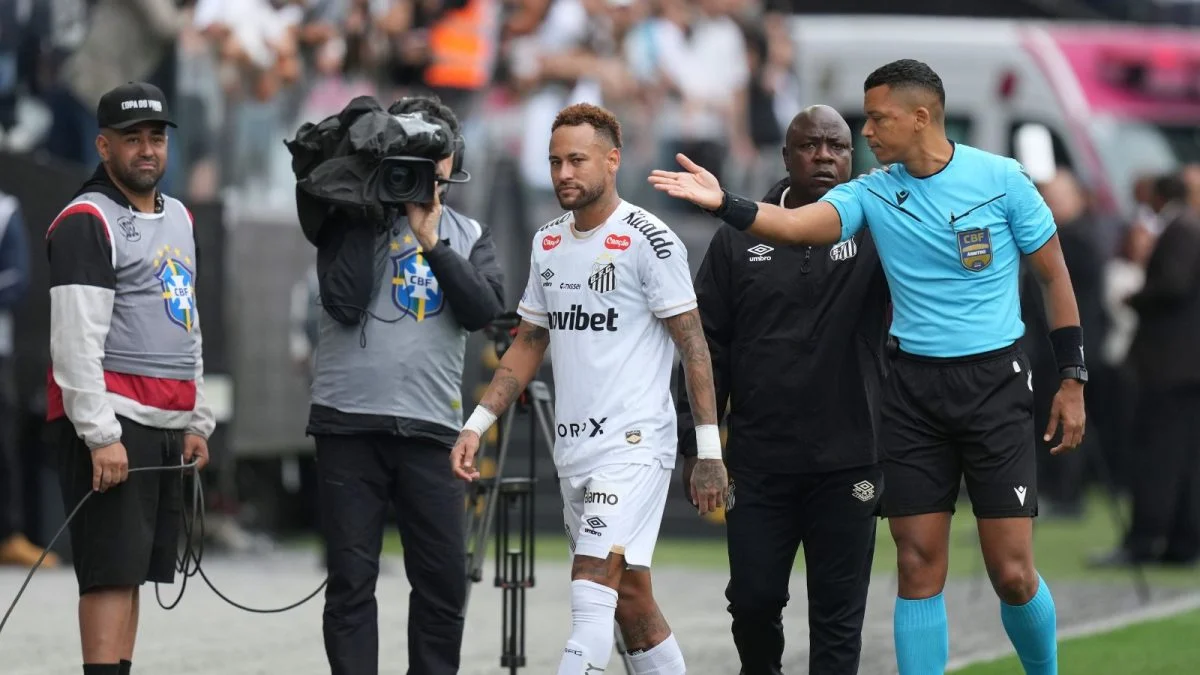
New Delhi, India – Brazilian football icon Neymar found himself at the centre of an extraordinary and infuriating officiating blunder on Sunday, May 17, 2026, when he was mistakenly substituted during Santos’s crucial Serie A match against Coritiba. The incident, which saw the star forward prematurely exit what was billed as his final audition before Brazil’s FIFA World Cup squad announcement, has ignited a fierce debate over refereeing standards and the integrity of the game. Santos ultimately succumbed to a 3-0 defeat, with the controversial removal of their talisman casting a long shadow over the proceedings and intensifying scrutiny on Neymar’s precarious path to the national team.
Main Facts: A Blunder of Epic Proportions
The pivotal moment arrived late in the second half of the Brazilian Serie A encounter between Santos and Coritiba. With Santos trailing and desperately seeking a comeback, a planned substitution intended to inject fresh impetus into their attack descended into chaos. The fourth official, tasked with displaying the numbers of players involved in a substitution, erroneously held up the board showing jersey number 10, belonging to Neymar, instead of number 31, worn by defender Gonzalo Escobar.
Neymar, the undisputed technical leader and creative heartbeat of the Santos side, initially reacted with disbelief. His initial confusion quickly morphed into palpable fury as the gravity of the error became apparent. Despite his vehement protests and the frantic efforts of the Santos coaching staff to rectify the mistake, the decision stood. The global football community watched in astonishment as one of the sport’s most recognizable figures was forced to leave the pitch due to a bewildering administrative oversight, effectively ending his participation in a match that held significant personal and professional stakes.
The incident was not merely a momentary lapse; it was a costly error that fundamentally altered the dynamics of the game. Santos, already struggling to break down Coritiba’s defence, lost their most potent attacking threat. The team’s morale visibly sagged, and their hopes of salvaging a result evaporated, culminating in a dispiriting 3-0 loss. Beyond the immediate match result, the blunder’s timing was particularly cruel for Neymar, who was using this fixture as his final opportunity to impress national team coach Carlo Ancelotti ahead of the highly anticipated World Cup squad announcement the following day. The unexpected and frustrating exit added another layer of complexity to a career already marked by dramatic highs and challenging lows, leaving his World Cup aspirations hanging precariously in the balance.
Chronology of the Blunder: From Confusion to Fury
The atmosphere at Vila Belmiro was charged with anticipation on Sunday evening. For Santos, the match against Coritiba was vital for their Serie A campaign, a chance to climb the table and assert their dominance. For Neymar, it was more than just another league fixture; it was a grand stage, a final dress rehearsal. The veteran forward, aged 34, was acutely aware that every touch, every pass, every moment on the field would be scrutinized by national team observers, including, presumably, Carlo Ancelotti himself.
The Build-Up to Disaster:
The game had unfolded with Coritiba establishing a comfortable lead, leaving Santos chasing the game in the second half. Manager Fabián Bustos had been contemplating tactical changes to spark a comeback. Around the 78th minute, with the scoreline firmly against Santos, a substitution was prepared. The intention, as confirmed by later reports and the substitution sheet itself, was to replace defender Gonzalo Escobar (No. 31) with a more attacking player, Robinho Jr. (No. 27), in a desperate bid to shift momentum.
The Fateful Moment:
As the ball went out of play, the fourth official, positioned on the touchline, raised the electronic substitution board. The numbers illuminated, starkly displaying "10" (player leaving) and "27" (player entering). A collective gasp rippled through the stadium, quickly followed by a murmur of confusion. Neymar, jogging near the centre circle, initially glanced at the board with a quizzical expression, assuming it was for an opponent or a momentary technical glitch. However, as the realization dawned that his own number was illuminated, his face contorted into a mask of disbelief.
Neymar’s Outburst:
The television cameras, always fixated on the star, captured the full spectrum of Neymar’s reaction. He stopped dead in his tracks, his eyes wide with shock. He gesticulated wildly towards the fourth official, shaking his head vehemently. He then rushed towards the Santos technical area, demanding an explanation from his coaches and the team staff. Footage showed him snatching the official substitution slip from a bewildered team official. Holding it aloft for the cameras and the referee to see, he emphatically pointed to the number "31" clearly printed on the sheet, juxtaposing it with the "10" still glaring on the electronic board.
The Irreversible Decision:
Despite Neymar’s passionate protest, the chaos on the Santos bench, and the undeniable evidence of the handwritten slip, the referee, apparently deferring to the fourth official’s initial signal, upheld the substitution. The rules, once a player has crossed the touchline and the substitute has entered, generally consider the change irreversible, regardless of a clerical error. Neymar, incandescent with rage, could do little but comply. He slowly made his way off the field, offering a sarcastic thumbs-up to the officials and muttering expletives, his frustration palpable to everyone present. The walk off the pitch was not just a player leaving a game; it was a moment of profound personal and professional humiliation, compounded by the knowledge of what this game represented for his international future.
The Aftermath:
With Neymar’s premature and unjustifiable departure, Santos’s already slim chances of a comeback vanished entirely. The team’s attack, deprived of its creative maestro, lacked cohesion and penetration. Coritiba capitalized on the disarray, extending their lead and comfortably seeing out the game with a 3-0 victory. The final whistle brought not relief, but a lingering sense of injustice and disappointment for Santos and their star player. The incident quickly became the dominant talking point, overshadowing the match itself and sparking outrage across social media platforms.
Supporting Data and Context: Rules, Precedents, and Neymar’s Fragile Path
The bizarre substitution error involving Neymar is not just a sensational headline; it raises serious questions about the protocols governing professional football matches and the human element in officiating. To understand the gravity of the situation, it’s crucial to delve into the relevant regulations, historical precedents, and Neymar’s recent career trajectory.
The Law of the Game Regarding Substitutions:
According to Law 3 of the Laws of the Game, governed by FIFA, a substitution is completed when a substitute enters the field of play. From that moment, the substituted player becomes an "outgoing player." While errors can occur, the emphasis is often on the point of entry. Once the substitute has entered, the game effectively considers the change made. This strict interpretation, designed to prevent constant stoppages and potential exploitation of rules, often leaves little room for rectification, even in cases of clear administrative error by officials. The fourth official’s role is primarily administrative, assisting the referee with substitutions, checking equipment, and managing the technical areas. However, their signal on the electronic board is a direct instruction to the referee. The apparent failure of communication or cross-verification between the fourth official and the referee, and the failure to consult the official substitution sheet, seems to be at the heart of this specific blunder.
Historical Precedents of Officiating Errors:
While a star player being mistakenly subbed off for another by an incorrect number display is rare at this level, officiating errors, particularly involving mistaken identity or procedural blunders, are not entirely unprecedented in football history.
- Mistaken Identity Red Cards: Perhaps the most famous example is Graham Poll’s three yellow cards for Josip Šimunić at the 2006 World Cup, where Poll forgot to send him off after the second booking. More relevant are cases like Kieran Gibbs mistakenly receiving a red card for Alex Oxlade-Chamberlain’s handball in an Arsenal match. While these involve on-field disciplinary action, they highlight how quickly officials can err in identifying players, even with modern technology.
- Substitution Misunderstandings: Less common are outright erroneous substitutions that stand. Lower league games have seen instances where a player was asked to leave for a substitution, only for the bench to realize they had called the wrong player. However, in the high-stakes environment of top-tier professional football, such a visible and uncorrectable error, especially involving a player of Neymar’s stature, is highly unusual and deeply embarrassing for the officiating body.
Neymar’s Role at Santos and the Significance of the Match:
Neymar’s return to Santos earlier in his career after his European stints was hailed as a homecoming, a move intended to reignite his passion and provide stability after a tumultuous period. At 34, he was no longer the explosive winger of his youth but had evolved into a seasoned playmaker, a "technical leader" whose vision, experience, and set-piece prowess were invaluable to Santos. This match against Coritiba was not just another game; it was a testament to his commitment to the club and a crucial platform to demonstrate his match fitness and current form. The 3-0 loss, exacerbated by his premature departure, underscored his irreplaceable value to the team and the severe consequences of his absence.
Neymar’s Injury History and World Cup Aspirations:
The context of Neymar’s long-term injuries is critical to understanding the depth of his frustration. The 34-year-old talisman, Brazil’s all-time leading scorer, has endured a torrid few years plagued by a series of debilitating injuries. Ankle ligament tears, hamstring strains, and various muscle issues have repeatedly disrupted his career, sidelining him for significant periods and preventing him from consistently reaching his peak form. Each return has been a battle against time, fitness, and the psychological scars of repeated setbacks.
His move back to Brazil was partly seen as a strategic choice to manage his workload, recover fully, and build up rhythm in a familiar environment ahead of what would likely be his final FIFA World Cup. Carlo Ancelotti, known for his meticulous squad selections, was reportedly observing Neymar closely. The "decisive ‘last chance’ outing" was not hyperbole; it was a genuine assessment of the game’s importance. Ancelotti needed to see a fully fit, influential, and consistent Neymar. The substitution blunder, robbing him of crucial minutes and ending his performance on a note of chaos rather than control, couldn’t have come at a worse time. It denied him the opportunity to finish the game strongly, to potentially create a moment of magic, or simply to play the full 90 minutes without incident, which itself would have been a statement of fitness.
Official Responses and Fallout: Silence, Scrutiny, and Social Media Storm
The immediate aftermath of the Neymar substitution blunder was characterized by a mixture of official silence, widespread public outcry, and intense media scrutiny. The incident quickly transcended the boundaries of a domestic league match, becoming a global talking point and a stark reminder of the fallibility of human officiating.
The Fourth Official’s Silence:
In the immediate moments following the match, the fourth official involved in the error remained anonymous and silent. There was no public explanation or apology issued by the individual. This silence, while perhaps understandable in the heat of the moment and under immense pressure, only served to fuel public frustration and speculation regarding the competence and accountability of match officials.
Referee’s Match Report and CBF Review:
The primary document that will officially detail the incident is the match referee’s report submitted to the Brazilian Football Confederation (CBF). This report is expected to provide the referee’s account of the events, including any explanations offered by the fourth official. The CBF is under immense pressure to launch a thorough investigation into the procedural breakdown. Football federations typically take such high-profile errors seriously, not only for the integrity of the game but also for their own reputation. Potential outcomes for the officials involved could range from internal disciplinary action, such as temporary suspension or reassignment to lower-tier matches, to mandatory retraining on substitution protocols. The focus will be on whether standard operating procedures were followed, particularly the cross-referencing of the electronic board with the official substitution sheet.
Santos FC’s Stance and Manager’s Comments:
Santos FC, understandably, expressed their profound dissatisfaction with the incident. Post-match, manager Fabián Bustos was visibly distraught and furious. While careful with his words to avoid direct sanctions, he alluded to the unfairness of the situation and the detrimental impact it had on his team’s performance and morale. "To lose a player of Neymar’s caliber, especially in such a crucial moment and under such inexplicable circumstances, is devastating," Bustos reportedly stated in a terse post-match press conference. "We had a plan, and that plan was completely disrupted by an error that should never happen at this level. It cost us any chance of getting back into the game." The club is expected to file a formal complaint with the CBF, detailing the incident and demanding a full inquiry, though a reversal of the match result is highly unlikely under existing regulations.
Coritiba’s Neutrality:
Coritiba, the beneficiaries of Santos’s misfortune, remained largely neutral in their public comments. While acknowledging the unusual circumstances, their focus was on their own well-deserved victory. Their manager and players refrained from commenting extensively on the officiating error, preferring to celebrate their three points.
Player and Fan Reactions: A Viral Outcry:
The video of Neymar’s furious reaction and his attempt to display the correct substitution slip immediately went viral across social media platforms. Fans, pundits, and former players worldwide expressed their astonishment and condemnation of the blunder. Hashtags demanding accountability for officials trended globally. Many sympathized with Neymar, understanding the immense pressure he was under and the unfortunate timing of the error. The incident sparked a broader conversation about the standard of officiating in Brazilian football and the need for more robust technological or procedural safeguards to prevent such basic errors from occurring in professional matches. The stadium itself had erupted in a chorus of boos and jeers aimed at the officials, reflecting the collective disbelief of the home crowd.
Broader Implications: World Cup Dreams, Integrity, and the Future of Officiating
The mistaken substitution of Neymar is far more than an isolated gaffe; it carries significant implications for his personal career, the integrity of football officiating, and potentially the broader landscape of Brazilian football.
Neymar’s World Cup Selection: An Ancelotti Conundrum:
The most immediate and poignant implication revolves around Neymar’s place in Carlo Ancelotti’s FIFA World Cup squad. The manager was due to announce his final selection the very next day. This match was Neymar’s last chance to present a compelling case for inclusion. Ancelotti, a coach known for his tactical astuteness and preference for players who are both technically gifted and physically robust, would have been looking for a complete performance. The unfortunate incident, however, saw Neymar’s "audition" end not with a flourish, but with frustration and controversy.
While Ancelotti is unlikely to base his decision solely on this single incident, the optics are undeniably poor. It raises questions about Neymar’s temperament under pressure, even if his anger was justified. More critically, it denied him the opportunity to complete the game and demonstrate his full match fitness and sustained influence – aspects crucial for a player with his recent injury history. Other contenders for attacking berths, such as Vinicius Jr., Rodrygo, and Gabriel Martinelli, have been performing consistently, making the competition fierce. Ancelotti must now weigh Neymar’s undeniable talent and experience, his status as Brazil’s all-time leading scorer, against his recent injury record and the unfortunate, truncated nature of his final pre-selection performance. The psychological toll of such a public and unfair exit just hours before the most important squad announcement of his career cannot be underestimated. It adds another layer of mental pressure to a player already under intense scrutiny.
Integrity of the Game and Officiating Standards:
The blunder unequivocally casts a shadow over the integrity of officiating in Brazilian football. Such a fundamental administrative error at the highest level of the domestic league undermines public trust in the competence of match officials. It raises questions about training, communication protocols, and the checks and balances in place. In an era where VAR (Video Assistant Referee) is increasingly utilized to correct on-field errors, a basic clerical mistake like this, which VAR might not typically intervene in for a non-eventful substitution, highlights the need for vigilance at every level of officiating. The incident serves as a stark reminder that even with advanced technology, human error remains a significant factor, and basic procedural adherence is paramount.
Future of Technology and Protocols in Football:
The Neymar incident could ignite further discussions about enhancing technology and refining protocols for substitutions. While the electronic board is meant to clarify, in this instance, it caused confusion. Could a system that requires the referee to visually confirm the player’s number with the actual substitution sheet before allowing the fourth official to display the numbers prevent such errors? Or perhaps a digital system where the change is confirmed electronically by a central official before being displayed? These are questions that football’s governing bodies may need to address to prevent similar embarrassing and impactful mistakes in the future.
Neymar’s Legacy and Public Perception:
Neymar’s career has been a rollercoaster of unparalleled skill, incredible goals, dramatic transfers, and frequent controversies. This incident, while not his fault, adds another chapter to a narrative often defined by drama. For some, it will be seen as another example of external factors disrupting his journey; for others, it might be viewed through the lens of a player who frequently finds himself embroiled in high-profile incidents. Regardless, it’s an unfortunate stain on what was meant to be a straightforward, impactful performance.
What Happens Next?
The immediate focus will shift to Rio de Janeiro, where Carlo Ancelotti will make his announcement. All eyes will be on whether Neymar’s name is called out. Beyond that, the CBF’s response to the officiating error will be crucial. Will there be disciplinary action? Will new protocols be implemented? The reverberations of this bizarre blunder will likely be felt for some time, shaping not only Neymar’s immediate future but also the ongoing debate about standards and accountability in the beautiful, yet sometimes flawed, game of football.
