

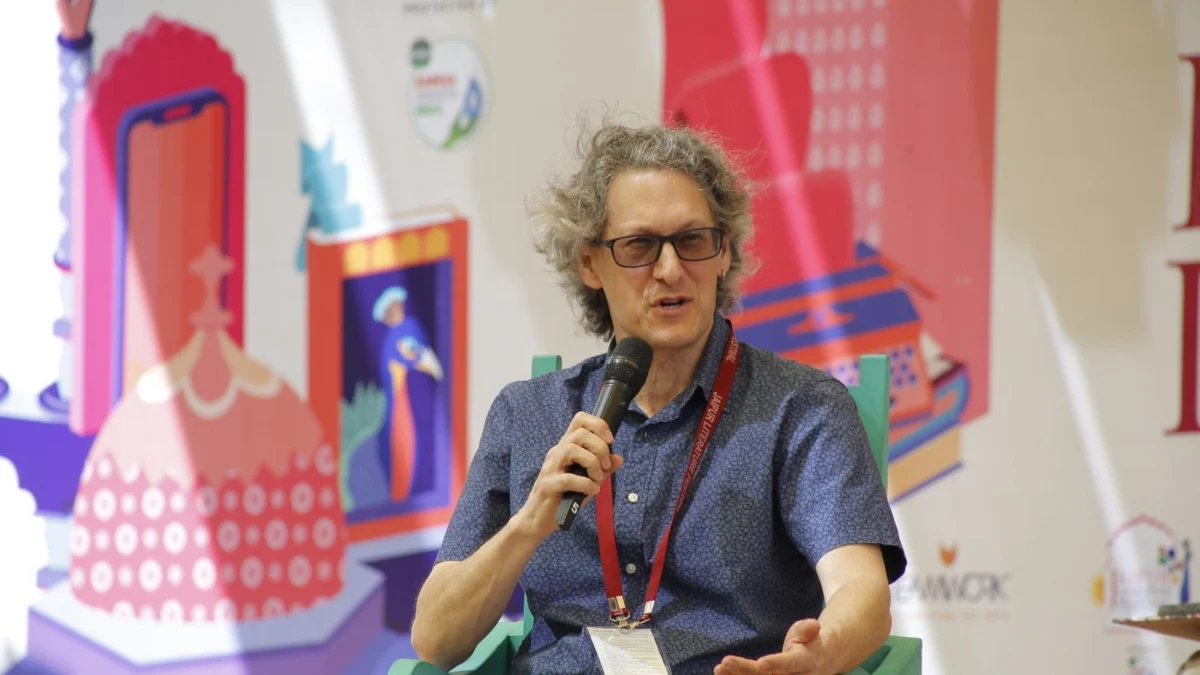
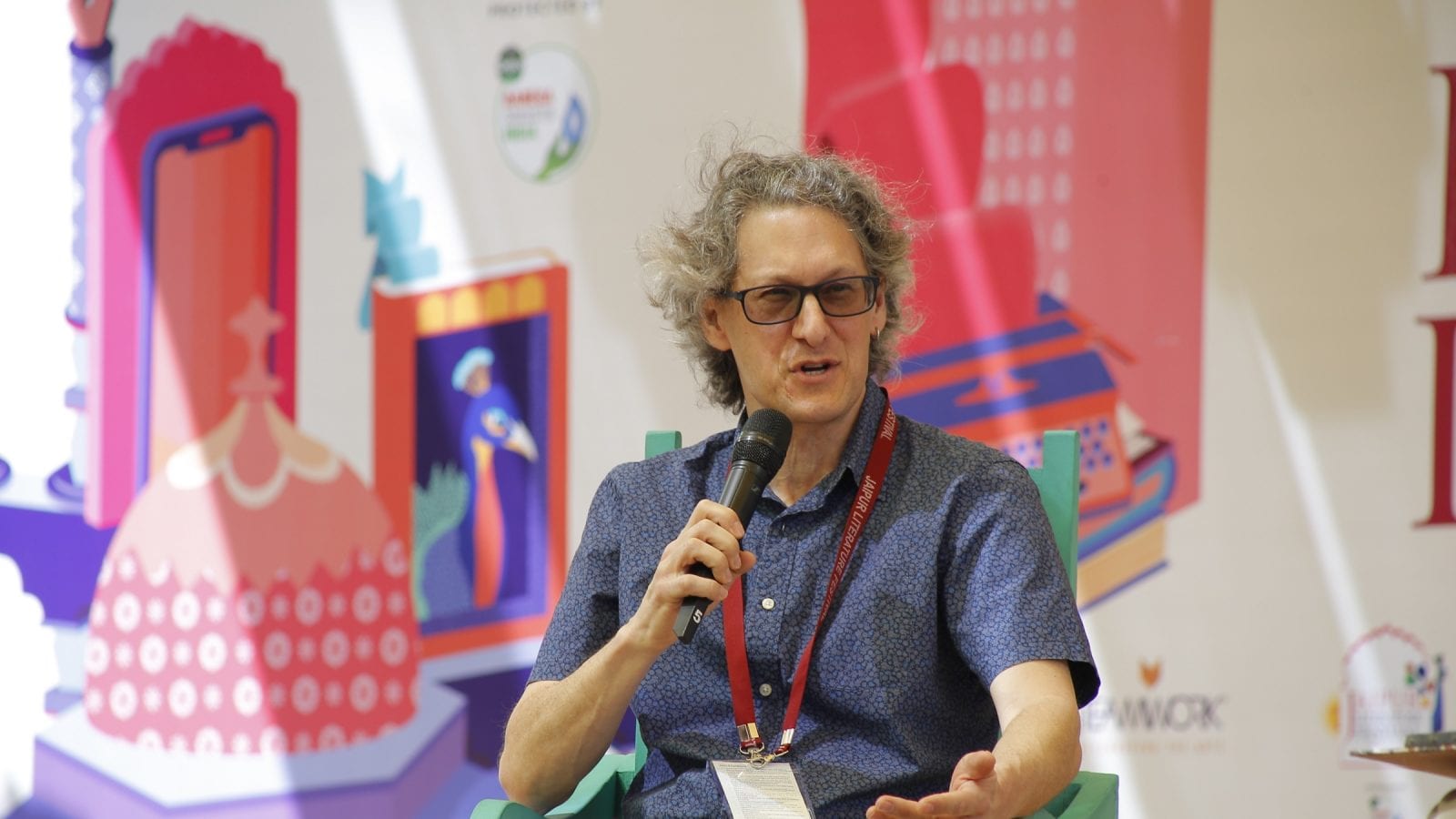
JAIPUR – In the sprawling, intellectually charged atmosphere of the Jaipur Literature Festival (JLF), history is rarely a static record of the past. Instead, it is a living, breathing, and often contested battlefield. Among the most provocative voices at the 2022 festival was Marc David Baer, a Professor of International History at the London School of Economics and Political Science. Baer, the author of the critically acclaimed The Ottomans: Khans, Caesars and Caliphs, offered a masterclass in how imperial legacies are repurposed to serve contemporary political ends.
Through his work, Baer challenges the Eurocentric "decline" narrative of the Ottoman Empire and draws striking parallels between the sultanates of old and the populist movements of today. His insights provide a sobering look at why modern nations—ranging from the United Kingdom to Pakistan—remain deeply entangled in the "imperialist ideals" of their ancestors.
Main Facts: History as a Weapon of the Present
The core of Marc David Baer’s thesis lies in the realization that history is not merely a collection of dates, but a potent political tool. In his interview at JLF, Baer posited that the modern "culture war" is an arena where the political Right and Left engage in fundamentally different ways, often leading to a stalemate or a perceived defeat for liberal perspectives.
The Critical vs. The Mythological
Baer argues that the "Left" or liberal historians are at an inherent disadvantage in culture wars because their methodology is rooted in critical analysis. They seek to deconstruct national myths, highlight systemic flaws, and expose the darker side of revered figures. Conversely, the "Right" often uses history as a source of identity-building and national pride, prioritizing the "heroic" narrative over the "historical" one.
The Revisionist Ottoman Narrative
In The Ottomans: Khans, Caesars and Caliphs, Baer refutes the long-held historiographical belief that the 16th century marked the beginning of a long, slow decline for the Ottoman Empire. Instead, he presents the Ottomans as a dynamic, evolving power that was an integral part of European history, rather than a foreign "Other" knocking at the gates.
Imperial Nostalgia in "Middle-Sized" Powers
A significant portion of Baer’s analysis focuses on why countries like England and Pakistan are currently obsessed with their imperial pasts. He characterizes these as "middle-sized" powers that have seen their global influence shift. To compensate for modern anxieties—be it economic instability, failing education systems, or geopolitical sidelined status—these nations retreat into "imperial dreams" where they once ruled vast territories and shaped the world order.
A Chronology of Power: From the 16th Century to the Digital Age
To understand Baer’s arguments, one must look at the timeline of how the Ottoman Empire projected its image and how that projection has been inherited by modern states.
1. The 16th Century: The Misunderstood Peak
Traditional history often cites the reign of Suleiman the Magnificent as the zenith, after which the empire allegedly stagnated. Baer challenges this, suggesting that the empire’s ability to adapt its identity—merging the roles of Central Asian Khans, Roman Caesars, and Islamic Caliphs—allowed it to remain a relevant and formidable power far longer than Western historians have traditionally admitted.
2. The 19th Century: The Sultan’s PR Machine
As the empire faced the pressures of modernity and European encroachment in the 1800s, Sultan Abdul Hamid II turned to history as a survival strategy. He refurbished the tombs of the founding sultans, Osman and Orhan, not merely out of piety, but as a calculated political move to establish a direct, unbroken lineage of legitimacy. He was an early adopter of photography, using the medium to project an image of "civilized Muslims" to the West, attempting to bridge the gap between Islamic tradition and European modernity.
3. The 21st Century: The Rise of "Ertugrul" and Neo-Ottomanism
Fast forward to the present day, and the Ottoman legacy has been resurrected through popular culture. The Turkish television series Dirilis: Ertugrul has become a cultural phenomenon in Pakistan. Baer identifies this as a form of "imperial dreaming." For a modern Pakistani audience, the show provides a sense of belonging to a glorious, pan-Islamic past that transcends the current struggles of the nation-state.
Supporting Data: The Psychology of the "Middle-Sized" Power
Baer’s observations are supported by the sociopolitical trends currently sweeping through the UK and South Asia. The data, in this case, is found in the rhetoric of national leaders and the consumption of historical media.
The British Context: Churchill and the Empire
In the United Kingdom, the figure of Winston Churchill serves as the primary flashpoint for the culture war. Critical historians point to Churchill’s role in the Bengal Famine and his racist views on Indians as essential parts of his legacy. However, Baer notes that for the political Right, such critiques are viewed as an attack on British identity itself. In a post-Brexit Britain, where the country is navigating its reduced role on the world stage, the "imperial feeling" provides a psychological buffer against the reality of being a "small island."
The Pakistani Context: Identity through Turkey
The popularity of Ertugrul in Pakistan is not an isolated entertainment trend; it is backed by state endorsement. Former Prime Minister Imran Khan famously urged the youth to watch the show to learn about "Islamic values." Baer suggests this is a symptom of a country seeking an external anchor for its identity. By aligning themselves with the Ottoman legacy, Pakistanis can participate in a narrative of global dominance that their current economic and political situation does not provide.
The "Eclectic" Mughal Model
Baer also draws a comparison with India’s Mughal Empire. While both the Mughals and Ottomans began as conquerors, Baer describes the Mughals as perhaps even more "eclectic" than their Ottoman counterparts. The Mughals ruled over a Hindu majority and integrated Shias and Hindus into the highest echelons of power. While the Ottomans were also multi-confessional, Baer notes they were more successful—or perhaps more focused—on conversion than the Mughals were in India.
Official Responses: Scholarly and Expert Perspectives
The academic community has long debated the "invader vs. influencer" dichotomy, particularly regarding the Mughals in India. Baer’s perspective adds a layer of nuance to this discourse, which is often hijacked by partisan politics.
The "Invader" Narrative: In contemporary Indian political discourse, the Mughals are frequently characterized solely as foreign invaders who suppressed indigenous culture.
The Baer Perspective: Baer argues that this is a simplification that ignores the process of "integration." History, he suggests, shows that the Mughals became an intrinsic part of the Indian fabric, just as the Ottomans became an intrinsic part of the European fabric. He posits that the writing of history is often more about the "writer’s present" than the "subject’s past."
Scholars at the JLF echoed Baer’s sentiment that the "Culture War" is a rigged game. If the liberal objective is truth and the conservative objective is cohesion, the two parties are speaking different languages. Baer’s scholarly stance is that the historian’s duty is to the truth, regardless of how "un-useful" it may be for national myth-building.
Implications: The Future of Critical History in a Polarized World
The implications of Baer’s analysis are profound for the future of education, journalism, and national identity.
1. The Erosion of Critical Thinking
If the "Left" continues to lose culture wars because they are critical, the danger is that history will become purely hagiographic. When states prioritize "feeling good" about the past over "learning" from it, they repeat the mistakes of the past. Baer warns that ignoring the racism of a figure like Churchill or the complexities of Ottoman rule leads to a distorted worldview.
2. History as a Distraction from Governance
Baer points out a cynical reality: governments often lean into culture wars when they are failing at governance. In England, the obsession with defending statues or imperial legacies often coincides with crises in the healthcare system (NHS) or rising poverty. By keeping the populace engaged in a battle over the past, the state avoids accountability for the present.
3. The Global Rise of Revisionism
The trend Baer identifies is not limited to the UK, Turkey, or Pakistan. From the "1619 Project" in the United States to the rewriting of textbooks in India, history has become the primary tool for defining who "belongs" to a nation. Baer’s work suggests that as the world becomes more polarized, the "Khan, Caesar, and Caliph" identities will continue to be mined for whatever political currency they can provide.
Conclusion
Marc David Baer’s discourse at the Jaipur Literature Festival serves as a reminder that the Ottoman Empire never truly died; it simply moved from the map to the mind. Whether through the lens of a Turkish TV drama or a British parliamentary debate, the ghosts of empires past continue to haunt the politics of the present. For the critical historian, the task remains to separate the "dreaming" from the "reality," even if that reality is a difficult one for the modern nation-state to swallow.
