

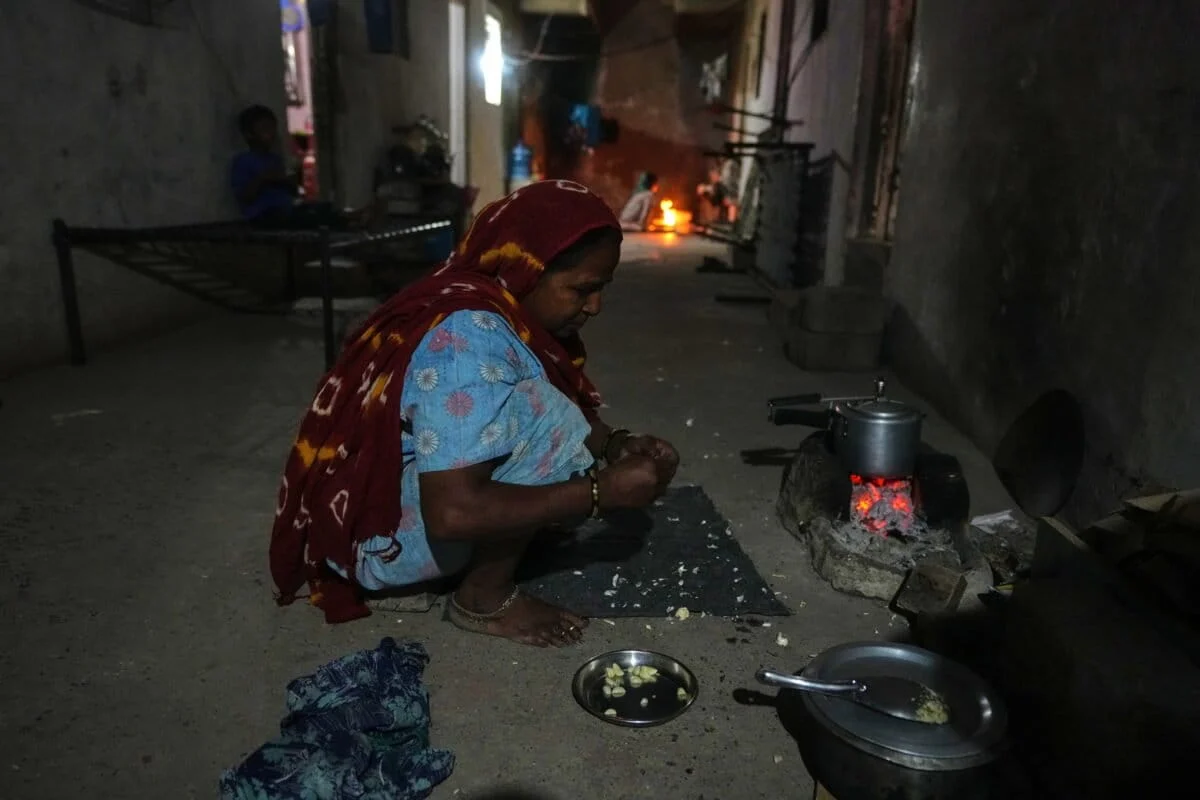
PATNA — In a move that environmentalists and public health experts are calling a "catastrophic regression," the Bihar state government has announced a massive policy shift to address a crippling Liquefied Petroleum Gas (LPG) shortage. As the conflict in West Asia continues to sever critical energy supply corridors, the state has authorized the monthly distribution of 100 kilograms of coal to every household holding a ration card.
This decision, which effectively reintroduces solid fuel into the kitchens of nearly 18 million families, marks a stark departure from India’s decade-long push toward clean cooking energy. While the government frames the move as a necessary response to an "anthropogenic disaster," the logistical, environmental, and medical implications are staggering.
The Core Mandate: Coal for the Masses
Under the new guidelines issued by the Bihar Food and Consumer Protection Department, families covered by the National Food Security Act (NFSA)—totaling approximately 17.9 million households—are now eligible to receive a monthly quota of 100 kg of coal. This massive undertaking will be facilitated through a network of more than 50,000 "fair price shops" across the state.
The scale of the operation is unprecedented. At full implementation, Bihar will burn an estimated 1.79 million tonnes of coal for domestic cooking every month. To put this in perspective, this household consumption alone will rival the fuel requirements of several mid-sized thermal power plants. The Bihar State Mining Corporation Limited (BSMCL) has been appointed as the nodal agency to manage the supply chain, inviting applications from wholesalers who will be allocated up to 10,000 metric tonnes of coal annually to feed the distribution network.
Critically, the government has not specified an end date for this program, suggesting that the "temporary" measure could become a long-term fixture of Bihar’s energy landscape if the geopolitical situation in West Asia remains volatile.

Chronology of a Crisis: From Conflict to Coal
The transition from gas to coal did not happen in a vacuum. It is the result of a rapidly deteriorating global energy market and a series of emergency administrative decisions:
- The Geopolitical Trigger: Following the escalation of conflict in West Asia, critical maritime corridors and pipelines used for LPG supply to India were disrupted. This led to a sharp spike in prices and a subsequent domestic shortage.
- March 30, 2026: As the shortage reached critical levels in Bihar, the state government convened a high-level Crisis Management Group (CMG). The meeting concluded that without an immediate alternative, millions of families would be unable to cook meals. The decision to pivot to coal was made during this session.
- April 21, 2026: The Food and Consumer Protection Department formalized the policy, issuing guidelines that officially classified the LPG shortage as an "anthropogenic disaster"—a term usually reserved for man-made catastrophes like industrial leaks or war-induced famine.
- Late April 2026: The BSMCL began the process of registering wholesale dealers and setting up the logistics for transporting millions of tonnes of coal from mines to village-level fair price shops.
Supporting Data: The Fragility of Bihar’s Energy Transition
The shift to coal is particularly jarring given the significant strides Bihar had made in LPG penetration. According to government records, roughly 23 million families in the state possess LPG connections. Nearly 12 million of these are beneficiaries of the Pradhan Mantri Ujjwala Yojana (PMUY), a flagship federal scheme designed to replace traditional biomass with clean-burning gas.
However, the data also reveals a hidden vulnerability. While connections exist, actual usage has remained inconsistent. The National Family Health Survey (NFHS) indicates that only 29.8% of rural households in Bihar use LPG as their primary cooking fuel. The remaining 70% have historically relied on wood, dung cakes, and other forms of biomass, largely due to the high cost of LPG refills and the easy availability of "free" fuel in rural areas.
In urban centers, the reliance on LPG is much higher, at approximately 78%. It is these urban populations—often living in cramped, poorly ventilated quarters—who now face the prospect of switching to coal, a fuel they may not have used in decades.
Furthermore, Bihar’s coal consumption was already on a steep upward trajectory. NITI Aayog data shows that in the 2024-25 period, the state consumed 41.87 million tonnes of coal—a six-fold increase from a decade prior. The new cooking mandate will add nearly 21 million tonnes to that annual figure, potentially doubling the state’s carbon footprint.

Official Responses: Necessity vs. Policy Silence
The government’s stance on the coal rollout is a mixture of defensive pragmatism and bureaucratic reticence.
Narendra Kumar, a member of the Bihar State Pollution Control Board (SPCB), defended the decision as a survival tactic. "Nothing can be one-sided," he told reporters. "Gas is the only clean alternative to coal, but if there’s no clean fuel, we can’t let anyone die of hunger. Right now, there’s no choice. We will have to strike a balance."
However, other departments seem less certain. When questioned about the specifics of the rollout and the long-term health risks, Birendra Kumar Prasad, joint secretary of the Food and Consumer Protection Department, remained vague. "A policy regarding this has not yet been finalized. Until the government issues regulations, we are not in a position to say anything," he stated, despite the fact that distribution guidelines have already been circulated.
Independent observers and activists are more cynical. Gopal Krishna, an environmental lawyer and Director of the East India Research Council, suggested the policy might be a "Trojan horse" for commercial coal expansion. "LPG shortages have hit commercial activities like hotels and small eateries the hardest. I believe the government’s main target is to allow coal in commercial activities. They are testing the waters by distributing it to ration card holders first," Krishna remarked.
Implications: A Looming Public Health and Logistical Disaster
The decision to distribute coal at such a massive scale carries profound implications for public health, urban safety, and administrative logistics.

1. The Public Health Crisis
Bihar already struggles with some of the worst air quality in India. A 2025 report by the Centre for Research on Energy and Clean Air (CREA) found that PM2.5 levels exceeded national standards in 20 out of 23 monitored cities in the state.
Nandikesh Sivalingam, Director of CREA, warned that indoor coal burning is far more dangerous than industrial emissions. "Thermal power plants have mechanisms to control particulate matter (PM) emissions. In a household kitchen, there is no such mechanism. Indoor coal burning could cause more health impacts than burning coal in a power plant," he said. The inhalation of coal smoke is linked to chronic obstructive pulmonary disease (COPD), lung cancer, and stunted lung development in children.
2. Urban Hazards and Fire Risks
In densely populated urban areas like Patna, the policy is a recipe for disaster. Prabhakar Kumar of Patna University pointed out that most urban poor live in single-room rented accommodations. "They lack open space to cook outdoors. If they cook inside their rooms, it will lead to lethal levels of indoor pollution and a significantly heightened risk of fire outbreaks," he warned. Furthermore, many landlords prohibit the use of coal or wood stoves due to the soot and fire hazard, leaving tenants with a fuel they cannot legally or safely use.
3. The Logistical Nightmare for Dealers
The administrative burden falls squarely on the shoulders of the 53,493 fair price shop owners. Ashok Kumar, a ration dealer in Nalanda, expressed panic over the scale of the task. "I serve 450 families. That means I will receive 45,000 kg of coal every month. Where do I put it?" he asked.
Most dealers operate out of small storefronts designed for grain sacks, not bulk minerals. The coal requires separate storage to prevent moisture damage and theft. "If we store it outside, it will be stolen at night. If we rent a warehouse, who pays the rent? The government hasn’t provided funds for this," Kumar added.

4. Practicality and Time Poverty
For the end-users, coal is a step backward in terms of efficiency. Krishna Devi, a daily wage laborer in Muzaffarpur, noted that coal stoves take a long time to ignite and reach cooking temperature. "We leave for work early. With gas, we cook quickly and leave. If we use coal, we will waste hours just waiting for the fire. For us, gas is not a luxury; it is a necessity for our livelihood."
Conclusion: A Step Backward for Climate Goals
The Bihar government’s decision represents a significant setback for India’s climate and health goals. For years, the state has been advised to follow the Graded Response Action Plan (GRAP), which specifically prohibits the use of coal and firewood in open spaces and hotels to curb air pollution. By mandating the use of coal in millions of homes, the state is effectively institutionalizing the very practice it once sought to ban.
Experts like Bhargava Krishna of the Sustainable Futures Collaborative argue that the government should have pivoted toward electric cooking solutions—such as induction stoves—rather than regressing to fossil fuels. "The provision of coal is a step backward, even if temporary. The focus should have shifted toward electricity, which can be generated from diverse sources," he stated.
As Bihar prepares to burn nearly two million tonnes of coal a month, the "anthropogenic disaster" of the LPG shortage may soon be eclipsed by a self-inflicted public health catastrophe. The state now finds itself in a precarious position: trying to feed its population today while potentially poisoning them tomorrow.
