

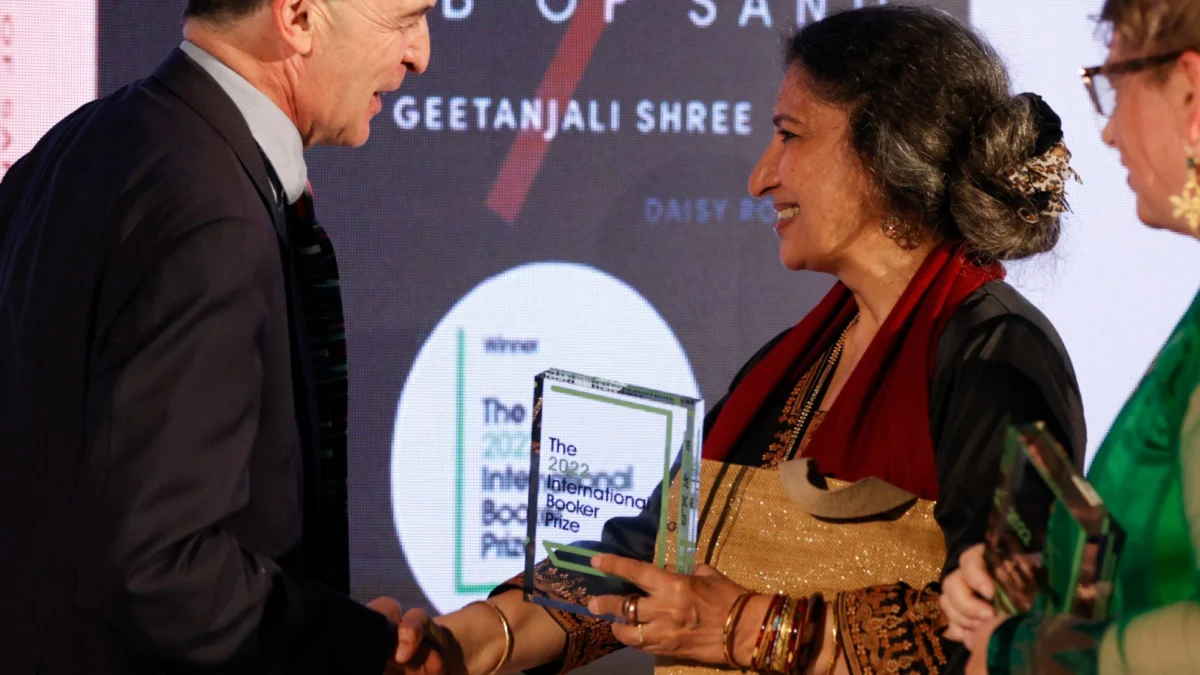
In a moment that has been hailed as a watershed for Indian literature, Delhi-based author Geetanjali Shree has been awarded the 2022 International Booker Prize for her novel Tomb of Sand. Originally published in Hindi as Ret Samadhi, the work was translated into English by Daisy Rockwell. This victory marks a historic "first" on multiple fronts: it is the first book originally written in any Indian language to win the prestigious award, and Shree is the first Indian author to receive the International Booker.
The announcement, made during a ceremony in London, has sent ripples of pride throughout the global literary community, particularly across South Asia. The prize, worth £50,000 (approximately $63,000), is split equally between the author and the translator, underscoring the collaborative nature of bringing regional masterpieces to a global English-speaking audience.
The Main Facts: A Victory for the Hindi Language
Tomb of Sand is a sprawling, experimental, and deeply emotive novel that follows the life of an 80-year-old woman, referred to as Ma, who sinks into a deep depression following the death of her husband. However, rather than fading away, she undergoes a transformative rebirth. She insists on traveling to Pakistan, confronting the unresolved trauma of the 1947 Partition of India, and re-evaluating what it means to be a mother, a daughter, and a woman.
The novel was published in its original Hindi form, Ret Samadhi, in 2018. It was brought to the English-speaking world by Tilted Axis Press, a UK-based publisher founded by translator Deborah Smith (who won the International Booker for Han Kang’s The Vegetarian), which focuses on literature from Asia and Africa.
The International Booker Prize is distinct from the Booker Prize. While the latter is awarded to a novel written originally in English and published in the UK or Ireland, the International Booker is awarded annually for a single book that is translated into English and published in the UK or Ireland. Shree’s win signifies a shifting tide in the global literary landscape, where the "center" of literature is moving beyond the Anglosphere.
Chronology: The Journey from ‘Ret Samadhi’ to Global Recognition
The path to this historic win began long before the glitzy ceremony in London.
- 2018: Publication in India: Ret Samadhi was published by Rajkamal Prakashan. While Geetanjali Shree was already an established name in Hindi literature—her 2000 novel Mai had previously been shortlisted for the Crossword Book Award—Ret Samadhi was recognized immediately by critics for its linguistic playfulness and unconventional narrative structure.
- 2021: The Translation Process: Daisy Rockwell, an American translator and artist based in Vermont, took on the Herculean task of translating Shree’s dense, pun-filled, and rhythmic Hindi into English. The challenge was to maintain the "dhwani" (echo/sound) of the original while making it accessible to a global reader.
- March 2022: The Longlist: The literary world took notice when Tomb of Sand was named among the 13 books on the International Booker Prize longlist. It was the first time a Hindi novel had ever reached this stage.
- April 2022: The Shortlist: The book defied expectations by making it to the final shortlist of six books, competing against works by established giants like Nobel laureate Olga Tokarczuk and Bora Chung.
- May 26, 2022: The Coronation: At a ceremony at One Marylebone in London, Frank Wynne, the chair of the judges, announced Tomb of Sand as the winner.
Supporting Data: The Narrative and the Translation
To understand the magnitude of this win, one must look at the complexity of the work itself. Tomb of Sand is not a traditional linear narrative. It is a polyphonic explosion of language that tackles heavy themes—border politics, gender roles, and aging—with a whimsical, almost surrealist touch.
The Plot and Themes
The protagonist’s journey from a bed-ridden widow to a defiant traveler is a metaphor for breaking through borders—physical, psychological, and linguistic. The novel spends significant time exploring the "shadow of the Partition," an event that continues to define the psyche of the Indian subcontinent. By taking an octogenarian protagonist back across the border to Pakistan, Shree challenges the notion that the elderly are static figures of the past. Instead, she presents them as agents of radical change.
The Art of Translation
Daisy Rockwell’s translation has been lauded as a "tour de force." Hindi is a language rich in onomatopoeia, cultural idioms, and gendered nuances that do not always have direct English equivalents. Rockwell chose not to "sanitize" the text for Western sensibilities. Instead, she retained the spirit of the original’s linguistic acrobatics.
In her translator’s note, Rockwell often speaks of the "untranslatable" nature of Shree’s prose, yet the success of the book proves that emotional resonance can transcend linguistic barriers. The win serves as a validation for translators everywhere, who often work in the shadows of the authors they represent.
Official Responses: A Chorus of Celebration
The reaction to Shree’s win was instantaneous and overwhelming. From the halls of the Booker Foundation to the literary circles of New Delhi, the sentiment was one of profound vindication.
Geetanjali Shree’s Acceptance Speech:
In her moving acceptance speech, Shree expressed her disbelief and humility. "I never dreamt of the Booker, I never thought I could. What a huge recognition," she said. "Behind me and this book lies a rich and flourishing literary tradition in Hindi, and in other South Asian languages. World literature will be the richer for knowing some of the best writers in these languages."
She also touched upon the state of the world, noting that the book’s themes of crossing borders were more relevant than ever. "The prize will definitely take the book to many more people than it would have reached otherwise," she added.
The Judging Panel:
Frank Wynne, the first translator to chair the International Booker judging panel, described the novel as "extraordinarily exuberant." He stated, "This is a luminous novel of India and partition, but one whose spellbinding brio and fierce compassion weaves youth and age, male and female, family and nation into a kaleidoscopic whole."
The Literary Community:
Prominent Bengali writer and translator Arunava Sinha took to social media to celebrate, tweeting: "Yessss! A first win for a Hindi novel, an Indian novel, a south Asian novel. Congratulations!"
The Booker Prize Foundation chair, Mark Damazer, also emphasized the importance of the work in bridging cultural divides, noting that the book provides a window into a world that many English readers have never accessed.
Implications: What This Means for the Future of Literature
The victory of Tomb of Sand is more than just an individual achievement; it is a systemic shift in the global publishing industry. For decades, Indian literature on the world stage was dominated by "Indian Writing in English" (IWE)—authors like Salman Rushdie, Arundhati Roy, and Vikram Seth. While these authors are immensely talented, their dominance often obscured the vast, diverse literary output occurring in India’s 22 official regional languages.
1. Boosting Regional Translations
Shree’s win is expected to trigger a "translation revolution." International publishers are now likely to look more closely at works written in Tamil, Bengali, Malayalam, Marathi, and other Indian languages. There is a growing realization that the "real India" is often captured most authentically in the mother tongues of its people.
2. Challenging the Monolingual Existence
As Shree herself noted in a previous interview, "Only a narrow self and mind would want a shrunken monolingual existence." This win encourages readers to step outside their linguistic comfort zones. It challenges the hegemony of the English language as the sole arbiter of "great literature."
3. Economic Impact for Translators and Independent Presses
The success of Tilted Axis Press—a small, independent publisher—demonstrates that you don’t need the massive marketing budgets of the "Big Five" publishers to make a global impact. This win will likely lead to increased funding and interest in small presses that champion translated works. Furthermore, the 50/50 split of the prize money reinforces the professional status of translators as co-creators of the text.
4. A New Perspective on Partition
By revisiting the Partition through the eyes of an elderly woman rather than through the lens of political violence, Shree has offered a new way for the world to understand the trauma of 1947. This humanistic approach allows for a shared grief that transcends nationalistic boundaries, a message that is increasingly vital in today’s polarized political climate.
Conclusion
Geetanjali Shree’s Tomb of Sand is a reminder that stories do not have borders. While the novel is deeply rooted in the soil of North India and the cadence of the Hindi language, its themes of love, loss, and the stubborn persistence of the human spirit are universal.
As the first Hindi novel to scale this peak, it has opened a door that can never be closed again. The literary world is no longer looking just at what India writes in English; it is finally listening to the many voices of India that have been speaking, singing, and storytelling in their own tongues for centuries. This win is not just a celebration of a book, but a celebration of the diversity of the human imagination.
