

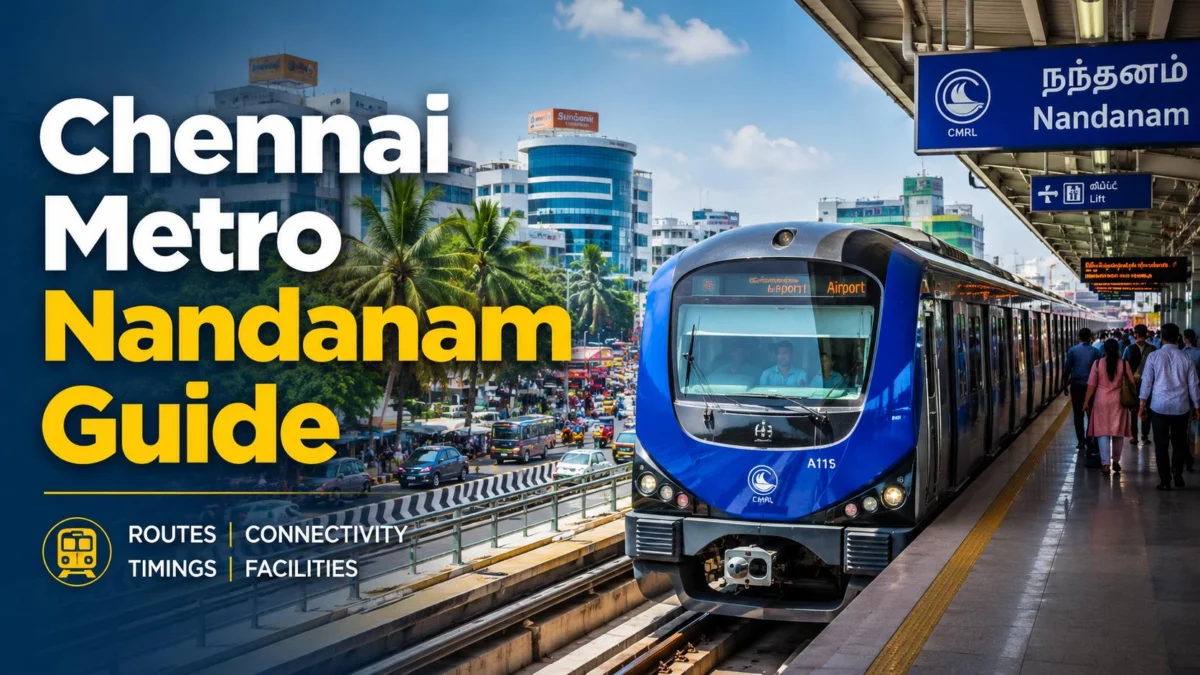
CHENNAI – In the rapidly evolving landscape of Tamil Nadu’s capital, the Chennai Metro Rail Limited (CMRL) has emerged as more than just a transit system; it is the skeletal framework of a modernizing metropolis. At the center of this transformation lies the Nandanam Metro Station, a critical underground node on the Blue Line (Corridor 1) that has redefined urban mobility for thousands of commuters, office-goers, and residents.
Since its inception, the station has served as a vital link between the historic commercial districts of Central Chennai and the burgeoning industrial and residential corridors of the South. This comprehensive report explores the station’s operational excellence, its chronological development, and its profound impact on the city’s socio-economic fabric.
1. Main Facts: Infrastructure and Operational Specifications
The Nandanam Metro Station (Station Code: SCR) is a marvel of underground engineering, designed to handle high-density passenger traffic while maintaining the aesthetic and functional standards of international transit hubs. Located beneath the bustling Anna Salai (formerly Mount Road), the station serves as a gateway to some of Chennai’s most prestigious neighborhoods.
Technical Profile
The station is part of the Blue Line, which stretches from Wimco Nagar Depot in the north to the Chennai International Airport in the south. Unlike elevated stations, the underground layout of Nandanam requires sophisticated climate control and safety systems.
- Platform Design: The station features an Island Platform configuration. This layout allows a single platform to serve trains moving in both directions, optimizing space and simplifying passenger navigation.
- Dimensions: To prevent overcrowding during peak hours, the station boasts an extensive layout ranging between 230 to 250 meters in length.
- Safety Technology: One of the standout features is the implementation of Platform Screen Doors (PSDs). These glass barriers remain closed until a train is securely docked, significantly reducing the risk of accidents and enhancing the efficiency of the station’s air conditioning system.
- Access Points: The station is equipped with four strategic entry/exit gates. These are positioned to provide direct access to Chamiers Road and different segments of Anna Salai, ensuring that commuters can exit the underground environment directly into the heart of their destination.
2. Chronology: From Blueprint to Commercial Success
The journey of the Nandanam Metro Station is intertwined with the broader timeline of the Chennai Metro Rail Project Phase 1. The realization of this station was a significant milestone in CMRL’s mission to provide a viable alternative to the congested road networks of Anna Salai.
- Planning and Excavation (2012–2017): The construction of the Nandanam station presented unique challenges due to its location under one of India’s busiest arterial roads. Tunnel Boring Machines (TBMs) worked tirelessly to carve out the path through Chennai’s complex soil profile without disrupting the heritage structures and high-rises above.
- Inauguration (May 25, 2018): The station officially opened for commercial operations on May 25, 2018. This opening was part of the final underground stretch of the Blue Line, completing the link between AG-DMS and Little Mount.
- Operational Maturity (2019–Present): Since its opening, the station has seen a steady increase in footfall. It has transitioned from a new infrastructure project into an essential daily utility, surviving the operational shifts necessitated by the global pandemic and emerging stronger as a preferred mode of transport for Chennai’s workforce.
3. Supporting Data: Connectivity and Commuter Dynamics
Data from urban transit studies indicates that the Blue Line is the most consistent and punctual route within the CMRL network. Nandanam plays a pivotal role in these statistics due to its proximity to major employment hubs.
Connectivity Matrix
Nandanam acts as a central transit point for several elite and commercial localities:
- T. Nagar: Chennai’s primary shopping district is just minutes away.
- Alwarpet: An upscale residential and commercial area housing several corporate offices and diplomatic missions.
- Kotturpuram & CIT Nagar: Key residential pockets that rely on Nandanam for fast access to the airport and the central railway station.
Train Frequency and Timings
To accommodate the "9-to-5" rush, CMRL has optimized the frequency at Nandanam:
- Peak Hours: Trains arrive every 4 to 6 minutes, catering to the thousands of professionals heading to the corporate offices lining Anna Salai.
- Off-Peak Hours: The frequency adjusts to every 8 to 10 minutes, ensuring efficient energy usage while maintaining convenience.
- Operating Hours: Service begins at 05:40 AM on weekdays and concludes with the last train at 11:40 PM, providing a wide window for both early-morning travelers and late-night commuters.
4. Official Responses and Institutional Oversight
The Chennai Metro Rail Limited (CMRL) has frequently highlighted Nandanam as a model for underground station management. Official statements from CMRL spokespersons emphasize the "multimodal integration" strategy that the station embodies.
Security and Maintenance
In response to the high volume of passengers, CMRL has deployed a multi-layered security protocol. This includes:
- 24/7 Surveillance: A comprehensive CCTV network monitored from a central control room.
- Professional Personnel: Security staff at all entry points conducting baggage scans and physical checks.
- Facility Management: Continuous maintenance of the "clean premises" policy, which has seen Nandanam consistently ranked high in passenger satisfaction surveys.
Future Integration: Phase 2 Expansion
Official plans for Chennai Metro Phase 2 suggest that Nandanam’s importance is only set to grow. While it currently serves the Blue Line, future expansions include a planned Yellow Line interchange nearby. This will eventually link the station to the Madhavaram-SIPCOT corridor, further cementing Nandanam’s status as a mega-transit hub.
5. Implications: The "Metro Effect" on Real Estate and Economy
The introduction of the Nandanam Metro Station has triggered what economists call the "Metro Effect"—a significant surge in property values and commercial activity in the vicinity of transit nodes.
Real Estate Metamorphosis
The property market in Nandanam, T. Nagar, and Alwarpet has witnessed a paradigm shift.
- Residential Demand: There is a heightened demand for "walkable" apartments—properties within a 500-meter to 1-kilometer radius of the station. Working professionals are increasingly willing to pay a premium for residences that offer a 20-minute commute to the airport or the city center.
- Commercial Growth: Older buildings along Anna Salai are being refurbished into modern co-working spaces and corporate suites, driven by the ease of access provided by the metro.
Environmental and Social Impact
Beyond the economy, the implications are environmental. By diverting thousands of commuters from private vehicles to the electric-powered metro, the Nandanam station contributes to a reduction in the carbon footprint of Anna Salai.
- Traffic Decongestion: Before 2018, the Nandanam Junction was notorious for gridlock. While traffic remains heavy, the metro has provided a "pressure valve," allowing a significant percentage of the population to bypass the surface-level congestion entirely.
- Social Accessibility: The station has made the city more accessible to students attending nearby institutions like the Government Arts College for Men, providing them with a safe, air-conditioned, and affordable transit option.
6. Passenger Facilities: The Commuter Experience
For the average traveler, Nandanam Metro Station is defined by its convenience. The station interior is designed with a "passenger-first" philosophy.
- Digital Integration: Interactive electronic signs and digital route maps provide real-time updates on train arrivals, reducing commuter anxiety.
- Amenities: The concourse level features automatic ticket vending machines (ATVMs), clean restrooms, and drinking water facilities.
- Last-Mile Connectivity: CMRL has fostered an ecosystem of last-mile options outside the station gates. Share-autos, e-rickshaws, and MTC (Metropolitan Transport Corporation) bus stops are strategically located at the exits, ensuring that the journey does not end at the station steps.
Conclusion: A Cornerstone of Chennai’s Future
The Nandanam Metro Station is more than a stop on a map; it is a testament to Chennai’s urban resilience and forward-thinking infrastructure planning. By bridging the gap between residential comfort and commercial necessity, it has become an indispensable part of the city’s daily rhythm.
As Chennai moves toward the completion of Phase 2, the role of stations like Nandanam will evolve from simple transit points to integrated community hubs. For the office worker avoiding the heat of Anna Salai, the student heading to class, or the traveler rushing to catch a flight, Nandanam Metro Station stands as a cool, efficient, and reliable sanctuary in the heart of a bustling metropolis.
Data Summary Table
| Feature | Detail |
|---|---|
| Line | Blue Line (Corridor 1) |
| Structure | Underground, Double Track |
| Platform | Island Type |
| Operational Since | May 25, 2018 |
| Daily Last Train | 11:40 PM |
| Security | PSDs, CCTV, Bag Scanners |
| Future Connectivity | Planned Yellow Line Integration |
Disclaimer: This report is based on current operational data and urban planning reports provided by CMRL and local real estate indices. Schedule updates should be verified via the official CMRL mobile application.
