The Indian motorcycling landscape is on the cusp of a significant shift as Bajaj Auto, one of the world’s largest two-wheeler manufacturers, prepares to enter the dedicated adventure touring segment. While the Pune-based manufacturer has long been the production powerhouse behind KTM’s global small-capacity adventure lineup, it has never fielded a purpose-built ADV under its own badge—until now.
Recent spy shots captured near Varve, Pune, have sent ripples through the automotive industry, revealing a motorcycle that appears to be far more than a mere styling exercise. This new machine represents the spearhead of Bajaj’s ambitious plan to launch eight new models in the 125cc to 250cc segment by 2026-2027.
1. Main Facts: A Purpose-Built Explorer Emerges
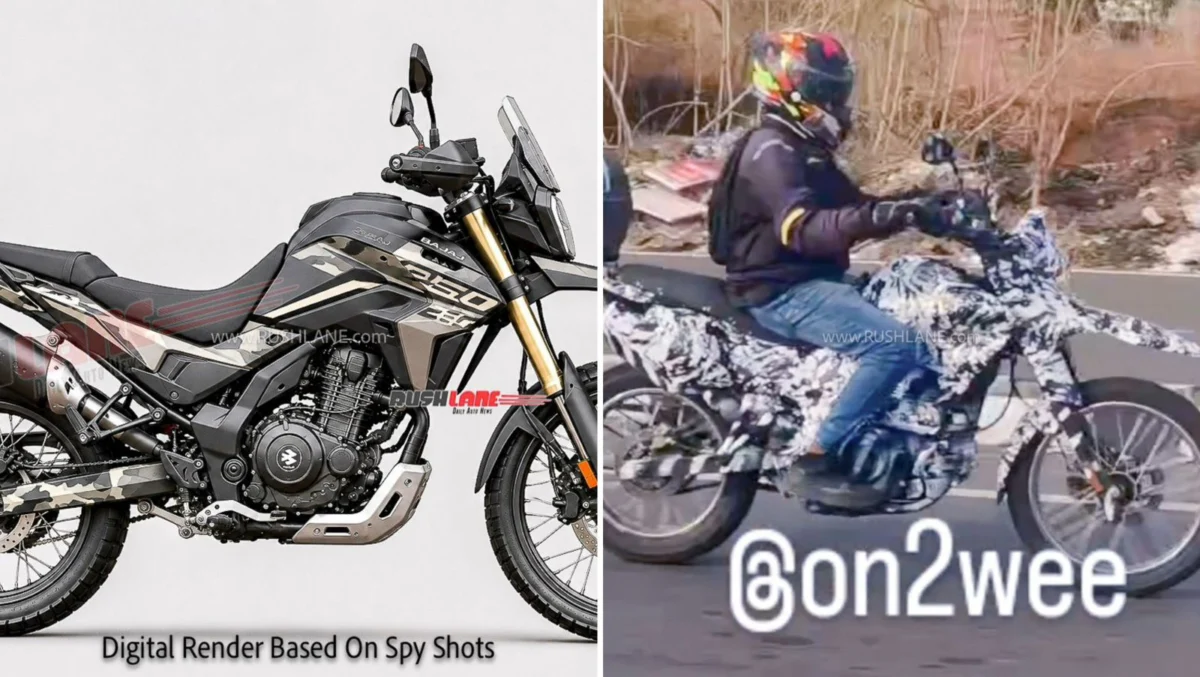
The leaked images, credited to "On 2 Wheels," provide the most comprehensive look yet at Bajaj’s first "serious" adventure motorcycle. Unlike the Pulsar AS (Adventure Sport) series of the past, which featured minimal hardware changes over the standard roadster, this new prototype showcases a dedicated chassis and suspension geometry designed for dual-purpose utility.

Key Technical Observations:
- Stance and Geometry: The motorcycle exhibits a high-ground-clearance silhouette with a signature "beak" front fender, a hallmark of modern ADV design. The rake appears optimized for stability at highway speeds while maintaining enough agility for technical trails.
- Suspension Hardware: The test mule is equipped with long-travel telescopic front forks. While some enthusiasts hoped for USD (Upside Down) forks, Bajaj likely opted for telescopic units to keep the retail price competitive and maintenance simple for rural markets. The rear features a centrally mounted monoshock.
- Wheel Configuration: The prototype rolls on wire-spoke wheels, which are preferred for off-roading due to their ability to absorb impacts better than alloy wheels. The setup appears to be a 19-inch front and 17-inch rear combination, striking a balance between off-road "rolling over" capability and on-road cornering stability.
- Ergonomics: The rider triangle is characterized by a tall, wide handlebar and mid-set footpegs, facilitating an upright seating position. The fuel tank is sculpted with deep knee recesses, essential for riders to grip the bike while standing on the pegs during off-road maneuvers.
- Touring Amenities: The presence of a top box and a spacious single-piece seat suggests that Bajaj is prioritizing "sport-touring" comfort. Despite the luggage, the pillion space remains generous, indicating a focus on long-distance two-up travel.
2. Chronology: The Road to the Bajaj ADV
The journey toward a Bajaj-branded adventure motorcycle has been a decade in the making, marked by strategic partnerships and evolving market demands.
- 2012–2016: The KTM Influence: Bajaj’s partnership with KTM allowed them to manufacture the 390 Adventure and 250 Adventure for global markets. During this period, Bajaj gained invaluable data on high-performance ADV chassis and liquid-cooled engine thermal management.
- 2017: The Dominar "Touring" Experiment: Bajaj launched the Dominar 400, marketed as a "Hyper-tourer." While successful, the motorcycling community criticized its heavy weight and limited suspension travel, which prevented it from being a true adventure bike.
- 2021–2023: Market Shift: The success of the Hero Xpulse 200 and the Royal Enfield Himalayan 411 proved that Indian consumers were ready for affordable, small-capacity ADVs. Bajaj began internal development of a platform that could bridge the gap between the budget-friendly Xpulse and the premium KTMs.
- Early 2024: The Strategic Announcement: Bajaj leadership confirmed the development of eight new motorcycles in the 125-250cc range. This announcement explicitly mentioned "off-roaders" and "ADVs" as part of their sub-brand expansion.
- June 2026: The first production-ready test mules are spotted in Maharashtra, signifying that the development cycle has moved from the laboratory to real-world durability testing.
3. Supporting Data: The KTM-Derived Powertrain Mystery
Perhaps the most debated aspect of the spy shots is the engine casing. Close inspection reveals a design that deviates from the current Pulsar N250’s oil-cooled SOHC unit.
Engine Analysis
The engine on the test mule appears to be a liquid-cooled, DOHC (Double Overhead Camshaft) single-cylinder unit. Industry analysts suggest two possibilities:

- The KTM 250 Platform: Bajaj may utilize the 249cc liquid-cooled engine from the KTM 250 Adventure. This engine produces approximately 31 PS of power and 25 Nm of torque. Using this proven powerplant would allow Bajaj to offer "KTM-level" performance at a "Bajaj" price point.
- A New Generation Architecture: Bajaj may be debuting a new "Pulsar-plus" engine architecture that incorporates liquid cooling to meet stricter emission norms while providing the sustained high-RPM performance required for highway touring.
Comparative Specification Estimates
| Feature | Bajaj ADV 250 (Estimated) | Hero Xpulse 210 | Suzuki V-Strom SX |
|---|---|---|---|
| Engine Type | Liquid-Cooled, 1-cyl | Liquid-Cooled, 1-cyl | Oil-Cooled, 1-cyl |
| Power | 28 – 31 PS | 25 PS | 26.5 PS |
| Front Wheel | 19-inch Spoke | 21-inch Spoke | 19-inch Alloy |
| Rear Wheel | 17-inch Spoke | 18-inch Spoke | 17-inch Alloy |
| ABS | Dual-Channel (Switchable) | Dual-Channel | Dual-Channel |
4. Official Responses and Industry Sentiment
While Bajaj Auto has not released a formal statement regarding the specific "Varve spy shots," the company’s recent corporate communications provide a clear roadmap.
Executive Insights
In previous investor calls, Rajiv Bajaj, Managing Director of Bajaj Auto, emphasized the "premiumization" of the brand. He noted that the company is looking to dominate the 250cc segment, which is increasingly becoming the "sweet spot" for Indian enthusiasts who find 150cc bikes too slow for highways and 400cc+ bikes too expensive to maintain.
Dealership Intelligence
Sources within Bajaj’s premium dealership network (Probiking) suggest that training for a "new category of motorcycle" is slated for late 2026. This aligns with the production-ready appearance of the test mule, which features finalized body panels, lighting, and exhaust systems.

5. Implications: Redefining the Entry-Level ADV Segment
The entry of a Bajaj ADV into the market has far-reaching implications for competitors and consumers alike.
Market Disruption
Bajaj is known for its "value-engineering" and aggressive pricing. If the company can price this 250cc ADV between ₹1.80 lakh and ₹2.10 lakh (ex-showroom), it will create a massive challenge for:
- Hero Xpulse 210: While the Xpulse is a superior off-roader (due to its 21-inch front wheel), it lacks the highway cruising power that the Bajaj 250cc engine will likely provide.
- Suzuki V-Strom SX: The Suzuki is a fantastic road-biased tourer, but its alloy wheels and limited ground clearance make it less capable on broken trails. Bajaj’s spoke-wheel setup directly addresses this weakness.
- Royal Enfield: While the Himalayan 450 sits in a higher price bracket, a Bajaj ADV could lure away potential Scram 411 buyers looking for modern technology and lower weight.
Strategic Importance of the 250cc Segment
The 250cc segment is crucial for Bajaj’s global export strategy. This new ADV is not just for India; it is designed for markets in Latin America, Southeast Asia, and Africa, where rugged terrain and the need for reliable, high-speed commuting overlap. By leveraging KTM’s engineering DNA and Bajaj’s manufacturing scale, the company is positioned to offer a "global" product at a "local" price.

Technological Expectations
Given the competitive nature of the segment, the production version is expected to feature:
- Full LED Lighting: Including a projector headlamp for superior night visibility.
- Bluetooth Connectivity: Turn-by-turn navigation via a digital instrument cluster.
- Switchable ABS: Allowing the rider to disable ABS at the rear wheel for controlled slides in off-road conditions.
- Slipper Clutch: To prevent rear-wheel hop during aggressive downshifts.
Conclusion: A New Era for Bajaj
The sighting of the new Bajaj ADV motorcycle marks the end of the "commuter-only" era for the brand. By moving into the adventure space with a dedicated, well-engineered platform, Bajaj is acknowledging the maturing tastes of the Indian motorcyclist.
If the final product retains the hardware seen in these spy shots—specifically the long-travel suspension, wire-spoke wheels, and the potent 250cc liquid-cooled engine—it could very well become the new benchmark for the "everyman’s adventure bike." As testing continues through 2026, the industry waits to see if Bajaj can once again disrupt a segment, just as it did with the original Pulsar two decades ago.