

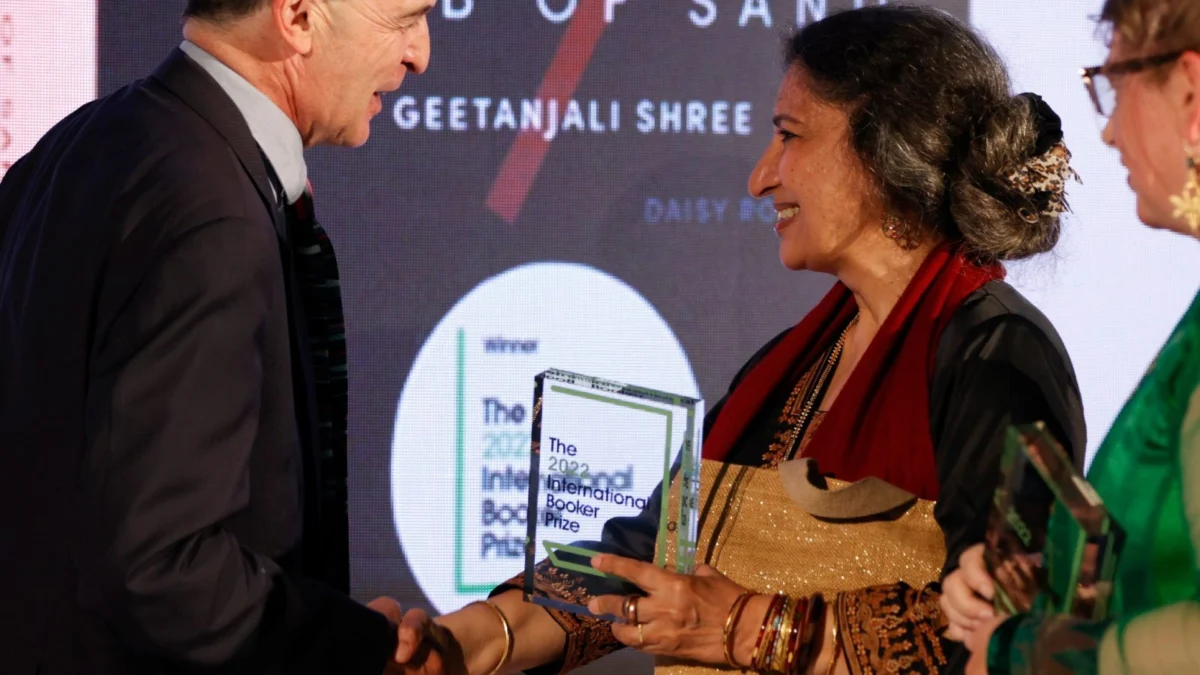
In a landmark moment for global literature, Delhi-based author Geetanjali Shree has been awarded the 2022 International Booker Prize for her novel Tomb of Sand (Ret Samadhi). This historic victory marks the first time a novel originally written in an Indian language—and specifically Hindi—has won the prestigious award. The prize, which recognizes fiction translated into English and published in the United Kingdom or Ireland, carries a £50,000 purse, shared equally between the author and her American translator, Daisy Rockwell.
The announcement, made during a ceremony in London, has sent ripples of celebration through the international literary community, signaling a paradigm shift in how South Asian regional literatures are perceived and consumed on the global stage.
The Main Facts: A Historic Achievement
The International Booker Prize is distinct from the Booker Prize for Fiction; while the latter is awarded to a novel written in English, the International Booker celebrates the art of translation. Tomb of Sand emerged victorious from a shortlist of six formidable contenders, including works from Nobel laureate Olga Tokarczuk and esteemed writers like Mieko Kawakami and Bora Chung.
The novel, originally titled Ret Samadhi and published in Hindi in 2018, tells the evocative story of an 80-year-old woman who sinks into a deep depression following the death of her husband. However, the narrative takes a transformative turn as she gains a new lease on life, ultimately deciding to travel to Pakistan to confront the lingering ghosts of her past and the trauma of the 1947 Partition.
The judging panel, chaired by Frank Wynne, described the book as "extraordinarily exuberant" and a "luminous novel of India and Partition." By winning this award, Geetanjali Shree has achieved several milestones simultaneously:
- The first Hindi-language book to win the International Booker.
- The first book by an Indian author to win the International Booker.
- The first novel from South Asia to receive this specific recognition.
Chronology: The Journey from ‘Ret Samadhi’ to Global Acclaim
The trajectory of Tomb of Sand is a testament to the power of independent publishing and the vital role of dedicated translators.
- 2018: Ret Samadhi is published in India by Rajkamal Prakashan. The novel is immediately noted for its linguistic experimentation and its subversion of traditional narrative structures. Shree’s prose, known for being rhythmic and playful, challenges the conventions of the Hindi novel.
- 2019–2021: The translation process begins. Daisy Rockwell, a renowned translator of Hindi and Urdu literature, takes on the daunting task of bringing Shree’s dense, pun-filled, and lyrical prose into English. The project is picked up by Tilted Axis Press, an independent UK publisher founded by Deborah Smith (who translated the 2016 winner, The Vegetarian).
- March 2022: The International Booker Prize announces its longlist of 13 books. Tomb of Sand is included, marking the first time a Hindi novel has ever reached this stage.
- April 2022: The "Magnificent Six" shortlist is revealed. Shree and Rockwell remain in the running, generating significant buzz in the Indian literary circuit and among "Bhasha" (regional language) advocates.
- May 26, 2022: At a gala ceremony at Southbank Centre in London, Tomb of Sand is declared the winner.
Supporting Data: Themes, Style, and Literary Context
To understand the magnitude of this win, one must look at the substance of the work itself. Tomb of Sand is not merely a "Partition novel"; it is a sprawling, 600-page exploration of boundaries—between life and death, mother and daughter, past and present, and the literal borders between nations.
The Narrative Structure
The book follows "Ma," an octogenarian who initially turns her back on the world. As she re-emerges, she defies social conventions, striking up an unlikely friendship with a hijra (transgender) character and insisting on visiting the land she left behind during the Partition. The story is told through a "polyphonic" lens, where even inanimate objects or animals sometimes provide a perspective, creating a rich, kaleidoscopic view of Indian life.
The Challenge of Translation
Translating Ret Samadhi was widely considered an "impossible" task. Shree’s Hindi is idiosyncratic; it relies heavily on the sounds of words, internal rhymes, and cultural nuances specific to the North Indian heartland. Daisy Rockwell’s translation was praised by judges for maintaining the "word-play" and "originality" of the source text. Rockwell has noted in interviews that she treated the translation as a musical score, ensuring that the English version retained the "spirit of the dhrupad" (a genre of Hindustani classical music) found in Shree’s writing.
Geetanjali Shree’s Career
Prior to this win, Geetanjali Shree was already a respected figure in Indian literature. Born in Mainpuri, Uttar Pradesh, she has authored three novels and several collections of short stories. Her work has consistently explored the intersections of history and memory. Her 2000 novel Mai was previously shortlisted for the Crossword Book Award and translated into multiple languages, establishing her as a writer who bridges the gap between traditional sensibilities and modern experimentalism.
Official Responses: Voices from the Literary World
The reaction to the win has been overwhelmingly positive, with leaders and literary icons hailing it as a "watershed moment."
In her acceptance speech, Geetanjali Shree expressed her disbelief and humility:
"I never dreamt of the Booker, I never thought I could. What a huge recognition. I am amazed, delighted, honored and humbled. There is a melancholy satisfaction in the award going to it. ‘Ret Samadhi/Tomb of Sand’ is an elegy for the world we inhabit, a lasting energy that retains hope in the face of impending doom. The Booker will surely take it to many more people than it would have reached otherwise."
Daisy Rockwell, reflecting on the collaborative nature of the prize, stated:
"It is a love letter to the Hindi language. This win shows that Hindi literature is not just for India, but for the whole world. It is a world-class literature that deserves this stage."
Frank Wynne, chair of the judges, remarked on the book’s vitality:
"This is a luminous novel of India and Partition, but one whose spellbinding brio and fierce compassion weaves youth and age, male and female, family and nation into a kaleidoscopic whole."
Bengali writer Arunava Sinha, a prominent figure in the translation community, took to social media to highlight the broader significance:
"Yessss! A first win for a Hindi novel, an Indian novel, a South Asian novel. Congratulations! Only a narrow self and mind would want a shrunken monolingual existence."
Implications: What This Wins Means for the Future
The victory of Tomb of Sand is expected to have long-lasting implications for the publishing industry and the visibility of South Asian languages.
1. A Boost for ‘Bhasha’ Literature
For decades, "Indian Literature" in the West was synonymous with "Indian Writing in English" (IWE)—authors like Salman Rushdie, Arundhati Roy, and Vikram Seth. Shree’s win redirects the global gaze toward the "Bhasha" writers—those writing in Hindi, Bengali, Tamil, Kannada, and other regional languages—who have often been sidelined despite having massive readerships within India.
2. Increased Investment in Translation
Publishers in the UK and US are now likely to scout more aggressively for works in translation from the Indian subcontinent. The success of Tilted Axis Press, a small indie publisher, proves that there is a market for complex, non-Western narratives if they are translated with care and marketed effectively.
3. Challenging the Partition Narrative
By revisiting the Partition through the eyes of an 80-year-old woman in the 21st century, Shree has challenged the traditional, often male-centric, historical accounts of 1947. This win validates a more fluid, emotional, and feminist approach to historical trauma, encouraging other writers to explore "the borders within us."
4. Linguistic Pride
In India, the win has sparked a sense of linguistic pride. While Hindi is one of the most spoken languages in the world, it has historically lacked the "literary prestige" accorded to European languages in international prize circuits. This award dismantles that hierarchy, proving that the nuances of the Hindi heartland are universally resonant.
As Tomb of Sand climbs the bestseller charts globally, it stands as a monument to the bridge-building power of literature. It serves as a reminder that stories, much like the protagonist of the novel, have the power to cross even the most fortified borders, turning "sand" into a lasting legacy of human connection.
