

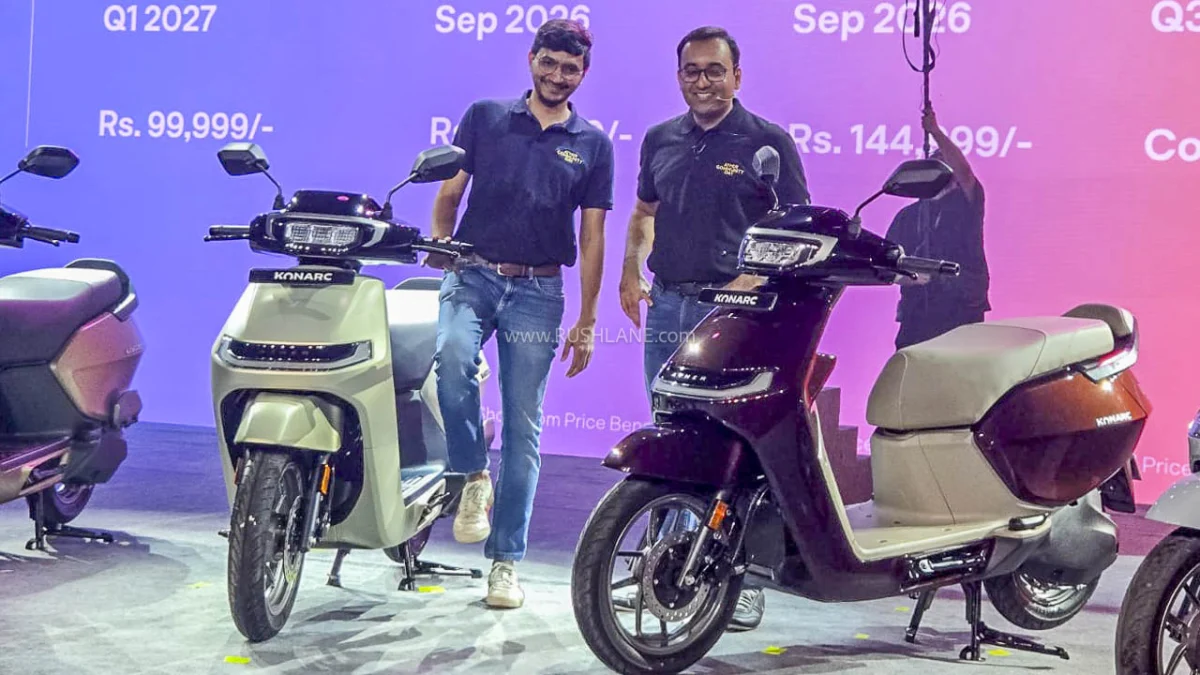
The Indian electric vehicle (EV) landscape has witnessed a seismic shift with Ather Energy’s latest announcement at its annual Community Day. Known for its premium positioning and performance-oriented engineering, the Bengaluru-based startup has officially entered the mass-market fray with the launch of the Ather Konarc. Priced starting at an aggressive Rs 99,999, the Konarc is not just a new model but a strategic pivot for the company, underpinned by an entirely new scalable architecture known as the EL platform.
This move signals Ather’s intention to challenge the dominance of established players and low-cost competitors by offering a product that balances the brand’s signature build quality with a more accessible price point.

Main Facts: A New Chapter for Ather Energy
The Ather Konarc represents several "firsts" for the company. It is the first production scooter to utilize the EL platform, a modular architecture designed to reduce manufacturing costs while maintaining high structural integrity. Unlike the 450 series, which focuses on high-speed performance and cutting-edge tech, the Konarc is designed for the pragmatic urban commuter.
Variant Hierarchy and Pricing
Ather has structured the Konarc lineup into two primary branches: the Konarc S (the accessible, "Smart" choice) and the Konarc Z (the premium, feature-rich version).

At launch, the company focused on the pricing and specifications of the Konarc S:
- Konarc S (100 km IDC Range): Rs 99,999
- Konarc S (125 km IDC Range): Rs 1,21,999
- Konarc S (161 km IDC Range): Rs 1,44,999
- Konarc S (200 km IDC Range): Price to be announced.
The Konarc Z will be offered in 125 km and 161 km range options, with pricing and specific delivery dates to be detailed closer to its mid-2027 rollout.

Key Technical Specifications
Across the board, the Konarc series emphasizes reliability over raw speed. The top speed for all currently announced variants is capped at 70 km/h. This is a deliberate design choice to optimize battery efficiency for city stop-and-go traffic.
The battery capacities are tailored to the range:

- 2.1 kWh for the 100 km variant.
- 2.7 kWh for the 125 km variant.
- 3.5 kWh for the 161 km variant.
All batteries are encased in aluminum for superior thermal management and carry an IP67 rating, ensuring they are dustproof and can withstand immersion in water—a critical requirement for the Indian monsoon.
Chronology: The Roadmap to Market
Ather Energy has laid out a phased delivery schedule that spans nearly two years, indicating a meticulous ramp-up of the new EL platform production line.

- September 2026: Deliveries of the mid-range Konarc S (125 km and 161 km variants) are scheduled to begin. These will likely serve as the "early adopter" models for those looking for a balance of range and cost.
- Q1 2027 (January–March): The entry-level Konarc S (100 km variant) will start reaching customers. This variant is expected to be the volume driver, targeting the sub-Rs 1 lakh segment.
- Q2 2027 (April–June): The premium Konarc Z series (125 km and 161 km versions) will commence deliveries. This variant will likely include more sophisticated software features and aesthetic enhancements.
- Q3 2027 (July–September): The flagship long-range Konarc S, boasting a 200 km IDC range, will enter the market. This variant aims to eliminate range anxiety for long-distance urban commuters.
Supporting Data: Engineering and Practicality
The Konarc is a departure from the "sleek and sporty" design language of the Ather 450X. Instead, it adopts a more robust, "built-to-last" philosophy.
Chassis and Body Construction
For the first time, Ather has moved toward a steel unibody chassis with metal body panels. This is a significant move in the Indian market, where metal-bodied scooters (like the Honda Activa) are traditionally perceived as more durable and easier to repair than those with plastic or composite panels.

The scooter rides on a unique wheel combination: a 14-inch front wheel and a 12-inch rear wheel. The larger front wheel is designed to provide better stability over potholes and uneven urban terrain, while the 12-inch rear wheel ensures the scooter remains nimble.
Practicality and Storage
Ather has focused heavily on the "utility" aspect of the EV:

- Underseat Storage: A generous 31-litre boot space allows for a full-sized helmet and additional groceries.
- Reverse Park Assist: Standard across variants to help maneuver the steel-bodied scooter in tight parking spots.
- Braking: The entry-level 100 km version uses drum brakes at both ends to keep costs low, while the 125 km and 161 km versions upgrade to a 220 mm front disc brake for improved stopping power.
The Onboard Charging Revolution
Perhaps the most innovative feature of the EL platform is the integrated charging system. Traditionally, EV owners have to carry a bulky external charger "brick." The Konarc includes a 450W onboard charger as standard. This means users only need a simple cable to plug into any standard 5A household socket.
For those needing faster turnaround times, Ather offers a second 450W charger as an accessory, bringing the total capacity to 900W. This effectively halves the charging time, allowing the 3.5 kWh battery to reach 80% charge in just over 3 hours.

Official Context and the "Magic Key"
During the Community Day event, Ather’s leadership emphasized that the Konarc is about bringing "Ather-level engineering" to a broader audience. While the 450 series was about proving that electric scooters could be fast and cool, the Konarc is about proving they can be the primary vehicle for any Indian household.
A major highlight of the presentation was the "Magic Key." This feature, demonstrated in official launch videos, aims to simplify the user experience. While specific technical details of the Magic Key’s encryption were kept under wraps, it serves as a multi-function proximity sensor that handles locking, unlocking, and boot access without the need for traditional physical keys or cumbersome app-based toggles.

Connectivity and Software
True to Ather’s tech-first DNA, the Konarc is not a "dumb" scooter:
- DeepView Display: The entry-level model features a 4.2-inch screen, while the higher variants boast a 7-inch unit.
- AtherStack Pro: This software suite brings features like AutoHold (hill hold), AirWalk, and theft alerts to the Konarc.
- Ather Grid: Access to Ather’s fast-charging network is integrated, with the 161 km variant capable of gaining 15 km of range in just 10 minutes of charging.
Implications: A Strategic Pivot in the EV War
The launch of the Ather Konarc has profound implications for the Indian two-wheeler market and for Ather Energy as a company.

1. Market Penetration
By breaking the Rs 1 lakh barrier, Ather is now in direct competition with the Ola S1 X, the TVS iQube’s base variants, and even high-end internal combustion engine (ICE) scooters like the Suzuki Access 125 and Honda Activa 125. This allows Ather to move from being a "niche premium player" to a "mass-market contender."
2. The EL Platform as a Foundation
The EL platform is the real hero of this story. By creating a scalable architecture, Ather can now launch various body styles—possibly electric motorcycles or even more utilitarian cargo scooters—using the same internal components. This economy of scale is vital for long-term profitability.

3. Reliability and Warranty
Ather is tackling the "longevity" concern head-on. By offering a standard 3-year/30,000 km warranty and an extended 10-year/1 lakh km battery warranty (Ather Eight70), the company is attempting to reassure skeptical buyers that an EV can last as long as a petrol scooter.
4. Shift in Performance Philosophy
The 70 km/h top speed limit is a calculated risk. While some enthusiasts might find it low, the vast majority of urban commuters rarely exceed 50-60 km/h in dense traffic. By capping the speed, Ather ensures that the range figures are more realistic and that the battery life is preserved over thousands of cycles.

Conclusion
The Ather Konarc is more than just a new product; it is a statement of intent. It combines the ruggedness of a metal body with the sophistication of Ather’s software and the convenience of an onboard charger. While the delivery timelines are distant—stretching into 2027—the Konarc sets a high benchmark for what a sub-Rs 1 lakh electric scooter should offer.
As the Indian government continues to push for electrification through various schemes, Ather’s move to democratize high-quality EV technology could be the catalyst that drives the next wave of adoption among middle-class Indian households. The success of the Konarc will likely determine Ather’s trajectory for the next decade, transitioning them from a startup to a household name in the Indian automotive landscape.
