

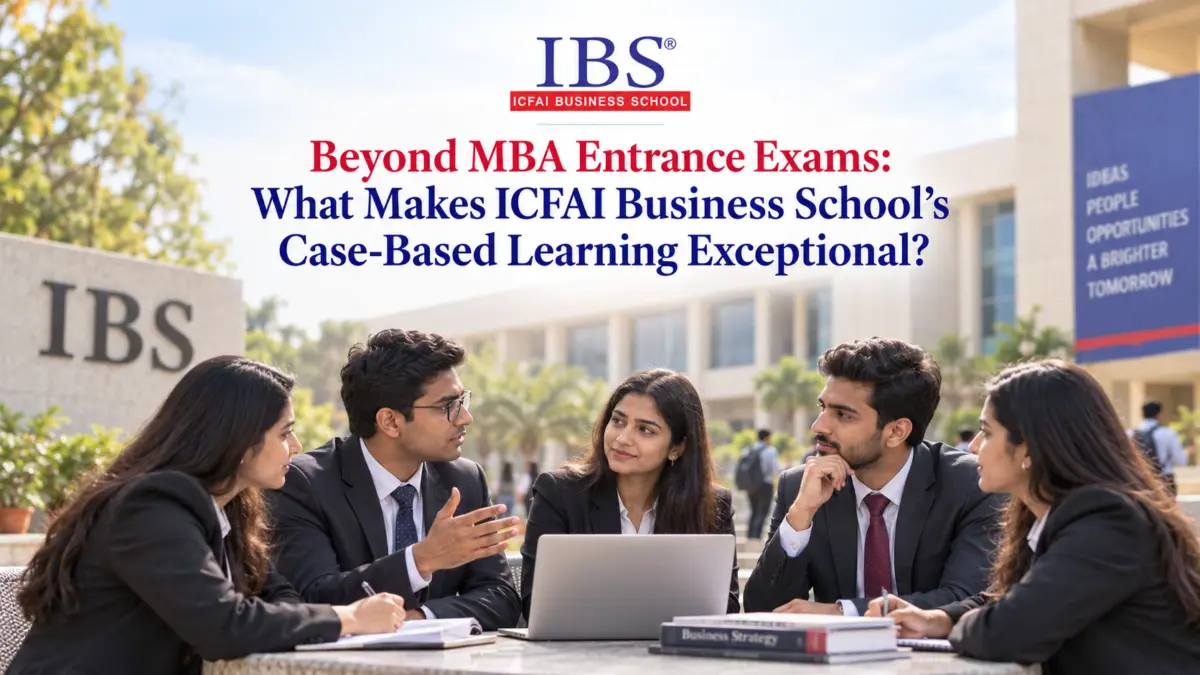
New Delhi, India – [Insert Date] – In the highly competitive landscape of Indian management education, where entrance exam percentiles often dictate the narrative, ICFAI Business School (IBS) is charting a distinct course. The institution is emphasizing a pedagogical approach that transcends rote memorization and standardized testing, focusing instead on cultivating true leadership acumen through an immersive, world-class case-based learning methodology. This commitment to real-world application is positioning IBS as a significant player in preparing graduates for the complexities of the modern business environment.
At the core of IBS’s distinctive academic philosophy lies the IBS Case Research Center (IBS CRC). Garnering a remarkable third-place global ranking, placing it in the esteemed company of institutions like Harvard Business Publishing and INSEAD, the IBS CRC is a prolific producer of management cases with substantial international teaching impact. These meticulously crafted case studies are not merely academic exercises; they form the bedrock of the rigorous two-year full-time MBA and PGPM curricula offered across IBS’s nine campuses nationwide. This integrated approach ensures that every IBS student benefits from direct exposure to the same kind of authentic business challenges that are analyzed and debated in leading global business schools.
The Power of Case-Based Pedagogy: Bridging Theory and Practice
The case-based teaching methodology employed by IBS serves as a critical conduit, seamlessly connecting theoretical management principles with the practical demands of executive decision-making. This pedagogical approach immerses students in intricate and often ambiguous business scenarios. This immersive experience compels learners to grapple with incomplete data, dissect critical operational dilemmas, and formulate strategic solutions within defined constraints.
Unlike passive learning models, students at IBS are actively engaged in dynamic classroom debates and collaborative group discussions. Within these forums, they are tasked with presenting, justifying, and defending their proposed frameworks, often facing rigorous critique from their peers. This iterative process is instrumental in honing a suite of indispensable executive capabilities.
Technically, the case-based approach cultivates:
- Critical Thinking: Students learn to dissect complex problems, identify underlying assumptions, and evaluate different perspectives.
- Quantitative Analysis: The necessity of data-driven decision-making is emphasized, as students must interpret financial statements, market data, and operational metrics.
- Data Synthesis: Learners develop the ability to sift through vast amounts of information, extract relevant insights, and synthesize them into actionable intelligence.
- Strategic Alignment: Students are challenged to connect tactical decisions with broader organizational goals, ensuring that proposed solutions are aligned with strategic objectives.
Practically, this methodology sharpens crucial soft skills, including:
- Active Listening: Students must attentively absorb the arguments and perspectives of their classmates and faculty.
- Persuasive Communication: The need to articulate and defend their reasoning effectively hones their ability to convey complex ideas clearly and convincingly.
- High-Pressure Decision-Making: Simulated real-world scenarios often involve time constraints and significant stakes, fostering the ability to make sound judgments under duress.
These are precisely the qualities that employers actively seek in future leaders, equipping IBS graduates with a distinct advantage in navigating the complexities and uncertainties inherent in real-world corporate challenges.
A Glimpse into Real-World Application: Student Testimonials
To further illustrate the practical impact of IBS’s case-based methodology, the institution offers compelling video testimonials from its campuses. These videos showcase how ICFAI leverages authentic business scenarios within its curriculum to demonstrably enhance students’ analytical and decision-making capabilities. These firsthand accounts provide invaluable insights into the transformative learning experience at IBS.
[Link to Student Testimonials: https://ibsindia.org/StudentTestimonials/CaseStudies.html]
Charting Your Course: IBSAT 2026 Admissions Open
For prospective students aspiring to join the ranks of future business leaders, the IBS Admission Test (IBSAT) 2026 presents a significant opportunity. A strong performance in IBSAT serves as a streamlined pathway into one of India’s most robust and respected business school networks.
Key Details for IBSAT 2026 Admissions (MBA / PGPM 2027-2029 Batch):
The IBSAT 2026 is the gateway to the MBA and PGPM programs for the 2027-2029 academic session. This comprehensive admission test assesses candidates on key cognitive abilities and management aptitude, crucial for success in the rigorous IBS curriculum.
Chronology of the Admissions Process:
- Application Period: Prospective candidates are encouraged to visit the official IBSAT website to complete their applications within the stipulated timeframe. Early application is often advisable to avoid last-minute technical glitches and to allow ample time for preparation.
- IBSAT 2026 Examination: The test will be conducted across numerous centers nationwide, offering candidates convenience and accessibility. The examination typically comprises sections designed to evaluate verbal ability, reading comprehension, logical reasoning, and quantitative aptitude.
- Selection Process: Following the IBSAT examination, shortlisted candidates will be invited for the subsequent stages of the selection process, which may include Group Discussion (GD) and Personal Interview (PI) rounds. These stages are designed to assess a candidate’s communication skills, leadership potential, and overall fit with the IBS ethos.
- Final Selection and Admission Offers: Successful candidates will receive admission offers based on their cumulative performance in IBSAT and the subsequent selection rounds.
Supporting Data and Program Strengths:
IBS boasts a strong track record of placing its graduates in reputable organizations across various sectors. The case-based learning model, coupled with a strong emphasis on industry-relevant curriculum, ensures that graduates are well-equipped to contribute meaningfully from day one. The IBS CRC’s global recognition as a leading case producer underscores the quality and relevance of the educational content delivered. Furthermore, the extensive network of IBS alumni provides invaluable career support and mentorship opportunities for current students and recent graduates.
Implications for the Future of Management Education
The success of IBS’s case-based learning model has significant implications for the broader field of management education in India. It highlights a growing recognition that theoretical knowledge, while foundational, must be complemented by practical application and problem-solving skills. As the business world becomes increasingly dynamic and unpredictable, institutions that prioritize the development of adaptable, critical thinkers will be best positioned to produce graduates who can thrive.
The emphasis on real-world scenarios, as championed by IBS, fosters a learning environment that mirrors the challenges and opportunities faced by managers in the actual corporate arena. This approach not only enhances learning but also instills confidence and readiness in students as they transition from academia to the professional world. By investing in a curriculum deeply rooted in case studies and research, IBS is not just educating students; it is actively shaping the next generation of business leaders.
Connect with the IBS Community:
For prospective students seeking deeper insights and firsthand perspectives, engaging with the vibrant IBS community is highly recommended. The official PaGaLGuY forum provides a platform to connect with current IBS students and alumni, offering a valuable opportunity to ask questions, share experiences, and gain a comprehensive understanding of the academic and professional journey at ICFAI Business School.
Join the discussion: [Official] IBSAT 2026 | ICFAI Business School (IBS) | MBA/PGP Admissions 2027-29 | PaGaLGuY [https://www.pagalguy.com/t/official-ibsat-2026-icfai-business-school-ibs-mba-pgp-admissions-2027-29-pagalguy/4211078]
In conclusion, ICFAI Business School’s unwavering commitment to a case-based pedagogical approach signifies a forward-thinking strategy in management education. By prioritizing immersive, real-world learning, IBS is not only differentiating itself but also setting a new benchmark for cultivating the dynamic and adaptable leaders the global economy demands.
