

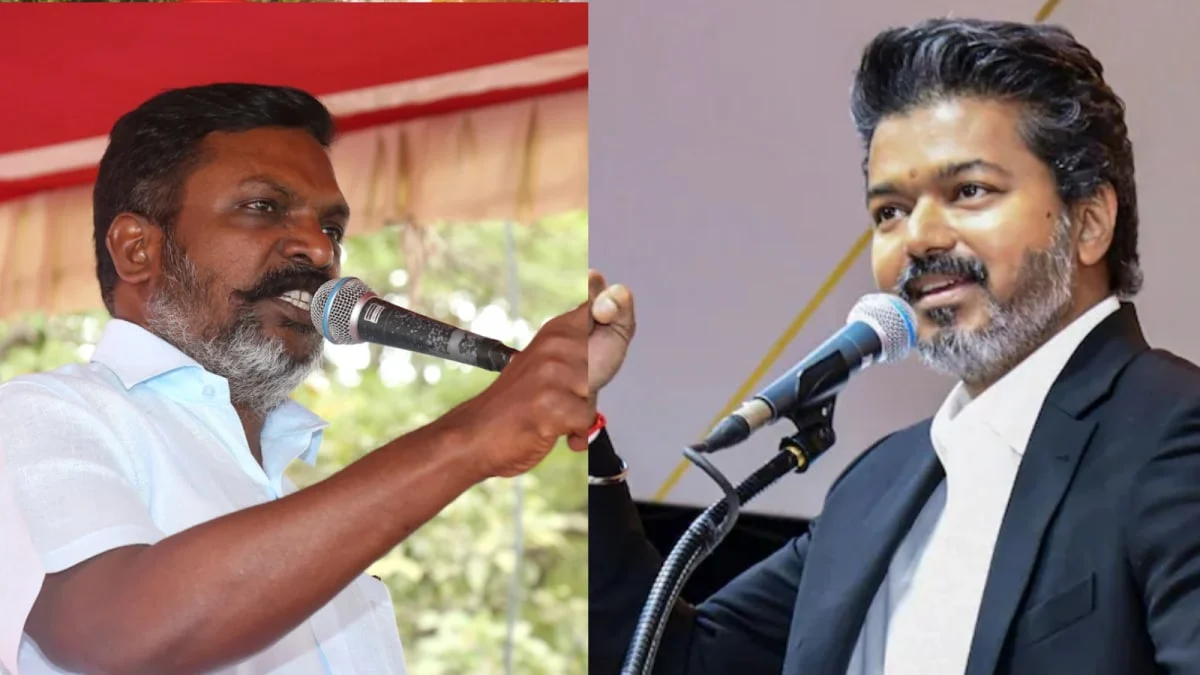
Chennai, Tamil Nadu – In a stunning revelation that has sent seismic waves through Tamil Nadu’s already volatile political landscape, Thol Thirumavalavan, the influential chief of the Viduthalai Chiruthaigal Katchi (VCK), has publicly claimed that both the Dravida Munnetra Kazhagam (DMK) and the All India Anna Dravida Munnetra Kazhagam (AIADMK) — the state’s traditional archrivals — had, at separate junctures, approached him with an unprecedented offer: the Chief Ministership of Tamil Nadu. This extraordinary proposition, according to Thirumavalavan, was allegedly floated as part of a clandestine strategy to form a joint government and, crucially, to prevent the emerging political force, the Tamizhaga Vetri Kazhagam (TVK), from ascending to power.
The DMK has swiftly and emphatically dismissed Thirumavalavan’s assertions, categorically denying that any such offer or discussion ever took place. However, the timing and nature of the VCK chief’s statement have ignited intense debate, particularly as it coincides with a period of heightened political uncertainty in the state, marked by a crucial upcoming floor test and internal dissent within the AIADMK. The VCK, a significant voice for Dalit rights and social justice, holds two assembly seats, a number that has suddenly gained disproportionate importance in the delicate balance of power.
The Unprecedented Claim: A CM Offer to Avert a New Power Centre
Thol Thirumavalavan, a seasoned politician and a prominent figure in the Dalit movement, detailed his surprising account during a recent public address. He stated that the proposals, originating from both the DMK and AIADMK, were linked to the audacious idea of forming a collaborative government between the two Dravidian giants. "I got information that they (DMK-AIADMK) had decided to make me the Chief Minister," Thirumavalavan reportedly stated. The underlying motive, he explained, was a shared apprehension regarding the rapid rise of the TVK, led by the increasingly popular C. Joseph Vijay, and a desire to consolidate traditional power against this new challenge.
According to the VCK chief, this proposition, extraordinary given the decades-long animosity between the DMK and AIADMK, was thoroughly discussed within his party’s senior leadership. However, after extensive consultations, the VCK ultimately chose to reject the offer. "After consulting with party senior leaders, we have rejected it," Thirumavalavan confirmed, leaving political observers to ponder the immense implications of such a rejection and the motivations behind the alleged offer itself.
Chronology of Claims and Counter-Claims
The sequence of events surrounding Thirumavalavan’s claim and the subsequent political fallout unfolds against a backdrop of intense political maneuvering in Tamil Nadu:
- VCK Chief’s Revelation: Thol Thirumavalavan makes the public claim that both DMK and AIADMK approached him with an offer of the Chief Minister’s post to form a joint government and keep TVK out of power. He also states his party’s rejection of this offer after internal deliberation.
- AIADMK Faction’s Accusations: On the very day of Thirumavalavan’s announcement, a dissenting faction within the AIADMK, openly opposing party general secretary Edappadi K. Palaniswami (EPS), accused him of attempting to forge an alliance with the DMK. Their alleged goal: to impede TVK’s burgeoning influence and block its path to power. This faction reportedly declared its support for a government led by C. Joseph Vijay, adding significant weight to the unfolding drama ahead of a crucial floor test.
- DMK’s Immediate Rebuttal: The DMK promptly and unequivocally dismissed Thirumavalavan’s claims, asserting that no such offer was ever made, nor were any discussions regarding a joint government or the Chief Ministership of the VCK chief ever entertained.
- VCK’s Justification for TVK Support: Amidst criticism regarding the timing of VCK’s announcement of support for TVK, Thirumavalavan defended his party’s decision-making process. He clarified that the move required thorough internal consultation, citing a Zoom meeting on May 8th with party leaders, followed by further discussions, making an immediate public announcement unfeasible. He refuted notions that his party had promised an early announcement, stating, "We never said we would announce anything on May 9 morning. The discussion process is long. Therefore, we took our own time before extending support to TVK."
- VCK’s Formal Endorsement: The VCK, holding two crucial assembly seats, officially extended its support to the TVK in its bid to form the government, effectively aligning itself with the new political entrant.
- Impending Floor Test: All these developments converge on the eve of a critical floor test scheduled for Wednesday, where the fate of the next Tamil Nadu government hangs precariously in the balance.
Supporting Data and Contextual Analysis
To fully grasp the magnitude of Thirumavalavan’s claims, it is essential to consider the historical and contemporary political dynamics of Tamil Nadu.
The Enduring Dravidian Rivalry: For over five decades, Tamil Nadu politics has been dominated by the fierce, often bitter, rivalry between the DMK and the AIADMK. The idea of these two parties forming a joint government, let alone under a Chief Minister from a third, smaller party, is virtually unprecedented and defies the fundamental tenets of their political existence. Their electoral battles have traditionally been existential, making any form of collaboration seem like anathema. This deep-seated animosity makes Thirumavalavan’s claim particularly startling.
The VCK’s Pivotal Role: The Viduthalai Chiruthaigal Katchi, under Thol Thirumavalavan, has consistently championed the cause of Dalits and marginalized communities. While not a dominant force in terms of sheer seat numbers, the VCK has historically been a significant ideological voice and a crucial alliance partner, often aligning with the DMK. Its ability to mobilize specific vote banks and its consistent presence in the assembly, even with a smaller tally, grants it leverage, especially in a hung assembly scenario. In the current political climate, where every seat counts, the VCK’s two assembly seats become kingmakers, capable of tipping the scales in favor of one alliance or another.
The Rise of TVK and C. Joseph Vijay: The emergence of the Tamizhaga Vetri Kazhagam (TVK) led by actor-turned-politician C. Joseph Vijay represents a significant disruption to Tamil Nadu’s traditional political binary. Vijay, a superstar with an immense fan following, has successfully leveraged his popularity into a nascent political movement. His party’s performance, while not explicitly detailed in the original article, is strong enough to put it in contention for forming a government, thereby challenging the long-established hegemony of the DMK and AIADMK. The article’s mention of "Tamil Nadu CM Vijay Calls On AIADMK Rebels" and "Vijay Appoints Astrologer… as Officer On Special Duty to CM" strongly suggests that Vijay is either the new Chief Minister or is very close to assuming the office, underscoring the threat he poses to the established order. The traditional parties’ alleged attempt to "keep the TVK away from power" highlights the perceived threat from this new political entity.
Internal Factionalism within AIADMK: The AIADMK has been plagued by internal strife since the passing of its charismatic leader J. Jayalalithaa. The ongoing power struggle, particularly the opposition to Edappadi K. Palaniswami (EPS) by a section of MLAs, has weakened the party and made it vulnerable. The accusation by this rebel faction that EPS was trying to align with the DMK to block TVK adds a layer of circumstantial credibility to Thirumavalavan’s otherwise outlandish claim. It suggests that desperate measures might indeed have been contemplated by sections of the political establishment facing an existential threat.
Official Responses and the Credibility Question
DMK’s Unwavering Denial: The DMK’s response was immediate and unequivocal. Party spokespersons and senior leaders have vehemently denied Thirumavalavan’s claims, dismissing them as baseless speculation. They assert that no such discussions ever occurred, nor would the party entertain such a proposal given its ideological stance and its current political position. The DMK’s strategy seems to be to discredit the claim entirely, preventing it from gaining traction and potentially sowing seeds of doubt among its own cadre or alliance partners. Their denial aims to project an image of stability and adherence to established political norms.
AIADMK’s Fragmented Voice: Unlike the DMK, the AIADMK has not issued a unified, official response to Thirumavalavan’s claims. This silence or fragmented reaction is largely attributable to its ongoing internal power struggles. While the faction opposing EPS has indirectly supported the premise of a potential DMK-AIADMK collaboration against TVK by accusing EPS of such a move, the party as a whole has not directly addressed Thirumavalavan’s specific assertion of being offered the CM post. This lack of a consolidated denial from the AIADMK leadership leaves room for further speculation and allows the claim to linger in the political discourse.
The VCK’s Stance: Thirumavalavan’s decision to reveal these alleged offers, despite his party rejecting them, could be interpreted in several ways. It might be an attempt to highlight the VCK’s political significance and its ability to influence government formation. It could also be a strategic move to expose the desperation of the traditional Dravidian parties in the face of a new challenger, thereby enhancing the legitimacy of TVK and VCK’s support for it. By publicly stating the rejection, VCK positions itself as a principled party unwilling to compromise its political integrity for power, especially when it comes to blocking a popular mandate.
Implications for Tamil Nadu Politics
Thol Thirumavalavan’s startling claim carries significant implications, potentially reshaping the contours of Tamil Nadu’s political future:
Erosion of Trust and Alliance Dynamics: If the claims hold even a shred of truth in the public imagination, they could severely damage the credibility of the DMK and AIADMK. The idea of these rivals colluding in secret, even if denied, can erode public trust and sow discord within their respective alliances. For the DMK, such allegations could complicate its relationship with existing allies, who might question the transparency of its political dealings. For the AIADMK, already fractured, this adds another layer of suspicion and animosity between its warring factions.
Heightened Political Instability: The crucial floor test looms large, and any development that further complicates the political narrative only adds to the instability. Thirumavalavan’s claim, coupled with the AIADMK’s internal dissent and the VCK’s crucial two seats, makes the outcome of the floor test even more unpredictable. A hung assembly or a government formed on narrow margins will likely face persistent challenges, leading to a period of political flux.
Validation of TVK’s Ascent: Ironically, the alleged attempts by DMK and AIADMK to block TVK’s rise, as claimed by Thirumavalavan, inadvertently validate the new party’s strength and potential. It signals that the traditional powerhouses perceive TVK as a genuine threat, not just a fleeting phenomenon. This could further galvanize support for C. Joseph Vijay and his party, positioning them as a viable alternative to the entrenched Dravidian parties.
The Shifting Role of Smaller Parties: The incident underscores the increasing importance of smaller parties and their leaders in a fragmented political landscape. In scenarios where no single party achieves a clear majority, parties like the VCK, despite their modest seat counts, gain significant leverage. They become kingmakers, and their ideological positions, or even their leaders’ personal ambitions, can dictate the direction of government formation.
Redefining Political Ethics and Alliances: The claims force a discussion on the ethics of political maneuvering and the lengths to which parties might go to secure or maintain power. The very notion of ideological rivals forming a "joint government" to block a new entrant challenges traditional alliance formations and could herald a new era of fluid, opportunistic political alignments in Tamil Nadu.
Public Perception and Electoral Impact: How the electorate perceives these claims and denials will be critical. If voters believe there was an attempt to subvert democratic outcomes or engage in backroom deals, it could influence future electoral behavior. The narrative of established parties ganging up against a new, popular force could generate sympathy for the TVK and further erode the base of the traditional Dravidian parties.
As Tamil Nadu braces for the crucial floor test, Thol Thirumavalavan’s sensational claims have undeniably injected an unprecedented level of drama and intrigue into the state’s political discourse. Whether these allegations are eventually substantiated or dismissed as mere political rhetoric, they have undeniably cast a long shadow, forcing a re-evaluation of alliances, motivations, and the very future of governance in one of India’s most politically vibrant states. The political chessboard of Tamil Nadu has rarely seemed so complex, with every move, claim, and denial carrying potentially profound consequences.
