

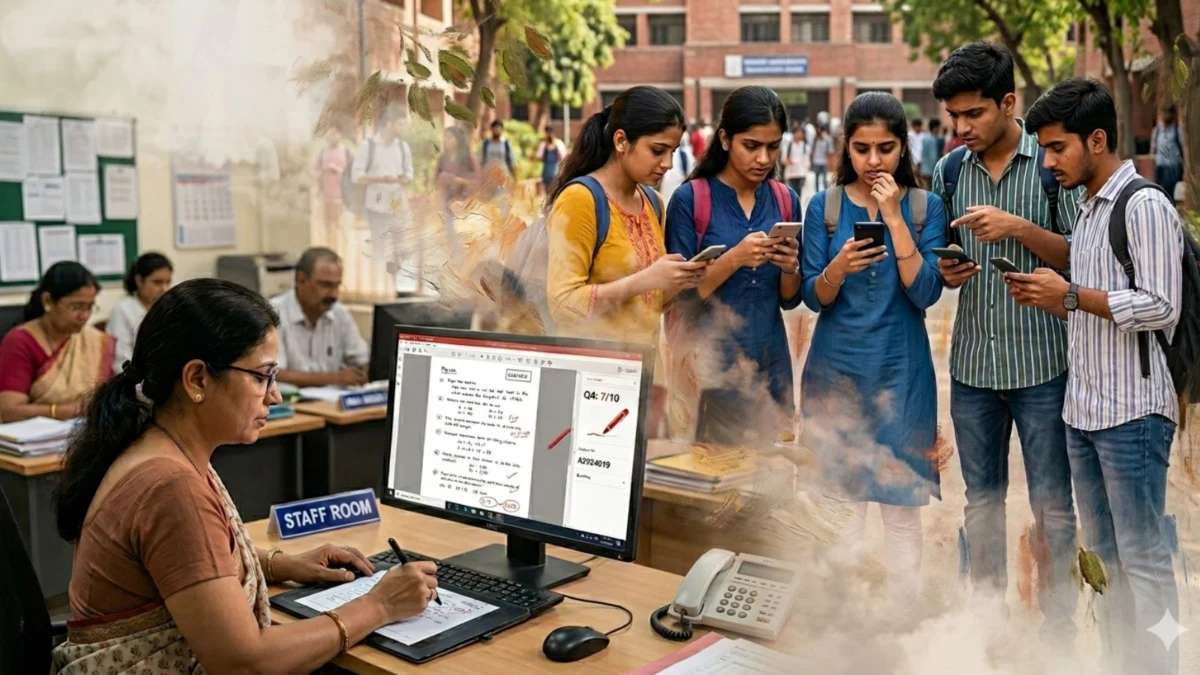
New Delhi: The Central Board of Secondary Education (CBSE) has embarked on a significant technological transformation with the introduction of its On-Screen Marking (OSM) system for Class 12 board examinations, aiming to revolutionize the paper evaluation process. Launched with the promise of a "no touch, no dust – clean evaluation," this digital shift, implemented for the 2026 academic year, has generated a spectrum of reactions from educators and sparked anticipation for potentially earlier declaration of results. While the Board envisions a future of faster, more accurate assessments, the initial rollout has revealed a mixed bag of experiences, highlighting both the system’s inherent strengths and the inevitable challenges of large-scale digital adoption.
The controller of examinations, in early interactions with educators from over 31,000 schools, underscored the paradigm shift, heralding a new era of digital evaluation. As lakhs of students eagerly await their CBSE Class 12 results for 2026, the feedback from evaluators and those intimately familiar with the process offers a revealing glimpse into the Board’s ambitious foray into a paperless correction system.
The Genesis of a Digital Transformation: A Chronology of Change
The announcement of the On-Screen Marking (OSM) system for Class 12 papers in February 2026 marked a pivotal moment in the CBSE’s long-standing evaluation practices. This move was not a sudden development but the culmination of a strategic vision to modernize assessment mechanisms. For years, the traditional method of physically transporting and manually evaluating answer sheets had presented logistical complexities and inherent delays. The OSM system, therefore, represents a deliberate and substantial investment in technological infrastructure and a recalibration of the entire evaluation pipeline.
The Controller of Examinations, Sanyam Bhardwaj, had previously articulated the Board’s intent to compress evaluation timelines. Speaking a few months before the commencement of the CBSE Class 12 exams in 2026, he outlined a streamlined process. The initial day of evaluation was designated for in-depth discussions on the marking scheme and a mock evaluation session. Following this, the actual evaluation was slated to proceed for approximately eight days, with marks being uploaded daily. This represented a dramatic departure from the previous norm, where the evaluation process could extend for up to 60 days. Bhardwaj explicitly stated that the evaluation for Class 12 was expected to be completed in "much fewer days than the earlier 60 days." Regional offices were instructed to conclude their part of the process in about nine days, a reduction from the previous 12 days, thereby saving valuable time in each assessment cycle. The overarching objective, he emphasized, was to "declare results on time, and possibly much before the time in the future."
This aggressive timeline reduction was made possible by the inherent efficiencies of the digital system. The physical movement of answer sheets, a bottleneck in the traditional model, was eliminated. Instead, digital copies of answer scripts are centrally distributed to evaluators within designated centers. As Bhardwaj explained, "When an individual examiner completes one evaluation, they will fetch another answer book from any school assigned to that zone." This decentralized yet centrally managed approach ensures a continuous workflow and mitigates delays caused by physical logistics.
Unpacking the ‘No Touch, No Dust’ Revolution: What’s Different This Year?
The debut of the CBSE’s ‘OSM Onmark portal’ signifies a fundamental departure from the past. The previous system was characterized by the physical movement of answer sheets across multiple centers, involving layers of checking and cross-checking, all contributing to extended timelines. The OSM system, in contrast, allows for the digital distribution of answer scripts to evaluators centrally, within each designated evaluation center. This digital workflow is designed to enhance both speed and accuracy.
One of the most significant advantages touted by the Board is the elimination of totalling and counting errors. The digital platform ensures that every question is evaluated, with a clear mechanism for marking questions as ‘NA’ (Not Applicable) if necessary. Furthermore, the system maintains comprehensive logs, tracking the evaluation history of each script, including mark distribution and any review processes. This meticulous record-keeping addresses a long-standing concern regarding the potential for human error in manual totalling.
Moreover, the OSM system is designed to guarantee that no question remains unevaluated. This is a critical safeguard against potential omissions, which can significantly impact a student’s score. The digital platform provides a structured interface where evaluators must address every part of a question before submitting their assessment, thereby ensuring completeness.
The "no touch, no dust" tagline aptly encapsulates the envisioned experience for the evaluators. This signifies a move away from the physical handling of paper, reducing the potential for smudging, damage, or misplacement of answer sheets. It also implies a cleaner and more organized working environment for the examiners.
Mixed Bag of Feedback: Initial Hiccups and Emerging Efficiencies
Despite the promising design and inherent advantages, the initial feedback from educators paints a nuanced picture of the OSM system’s first large-scale implementation. Sapna Charha, headmistress of Modern Public School, Shalimar Bagh, acknowledged the initial reluctance that often accompanies significant change. "There was a lot of reluctance in the beginning, as is against most changes," she noted, referring to the evaluators’ initial adaptation to screen-based assessment. However, she also observed that most teachers gradually became comfortable with the system after undergoing orientation and training sessions conducted both before and during the evaluation period.
While the Board anticipates a significant acceleration in the evaluation process, some educators have not yet witnessed a dramatic increase in speed. Charha commented, "I am not able to see any speed in the actual evaluation or checking system if I compare OSM versus the traditional." She pointed out that subject-wise evaluation continues in phases, such as physics and mathematics, mirroring the structure of previous years. This suggests that while the underlying mechanism has changed, the sequential nature of evaluating different subjects might still influence the overall timeline perception.
Concerns regarding technical glitches and operational challenges have also surfaced. An Indian Express report highlighted instances where teachers involved in the evaluation process encountered blurred scanned answer sheets, slow-loading scripts, and intermittent server issues. These technical slowdowns during the initial phase of implementation may have offset some of the expected efficiency gains, particularly during this first large-scale rollout.
However, there are also positive indicators of the system’s potential. Priyadarshini Mane, principal of VIBGYOR High Balewadi in Pune, reported that teachers from her school who participated in the evaluation of subjects like mathematics and physics returned nearly two days earlier compared to the manual process. According to Mane, the automated tabulation and the elimination of physical handling have significantly reduced manual workload.
The report also mentioned that some evaluators noted instances where revised instructions during the correction cycle necessitated the reopening and re-checking of already evaluated answer scripts. This, coupled with the learning curve associated with adapting to a portal-based workflow, added to the time taken during the early stages of digital evaluation.
Supporting Data and Official Responses: Navigating the Transition
The CBSE’s commitment to the OSM system is evident in its proactive approach to addressing potential challenges. The Board has emphasized the importance of comprehensive training and orientation for evaluators. These sessions are designed to familiarize teachers with the digital interface, marking scheme, and troubleshooting common technical issues.
Regarding the daily evaluation load, the maximum number of sheets assigned to teachers remained consistent, with 25 papers per day being a typical benchmark. The working hours, from 8 am to 4 pm, also remained unchanged. The key difference lies in the distribution and tracking of work. Each evaluator logs into the portal individually and is assigned a fixed set of answer sheets, with no provision for redistribution among colleagues. This ensures accountability and a clear understanding of individual progress. In contrast, the earlier manual system allowed for quicker evaluators to assist colleagues who might have taken longer to complete their tasks.
Infrastructure readiness has been a critical consideration in the selection of evaluation centers. However, the practical challenges of internet instability remain a concern. While some schools are well-equipped with robust computer labs and stable internet connections, others may face limitations. Charha highlighted this disparity, stating, "In my school, infrastructure was not a problem, but I am sure there must be many schools which could not support such strong infrastructure." She also referred to internet reliability as "an unpredictable thing," despite acknowledging that "the portal itself is beautifully designed, and is easy for teachers to understand, familiarise and pick up on."
The OSM system’s strengths in accuracy and monitoring are undeniable. The platform’s design prevents submission unless every question is evaluated or marked appropriately. It can even detect answers written out of sequence, ensuring a thorough review. The elimination of totalling errors and automated record-keeping directly address long-standing issues associated with the traditional manual system.
However, the transition has not been entirely seamless. Charha suggested that "the Board could have given hands-on training somewhere in the middle of the session, rather than near the exam commencement," pointing to initial hesitation among teachers. Mane echoed this sentiment, acknowledging that the first year of implementation is likely to involve a learning curve. "The exact efficiency gains of on-screen marking may only become clearer once teachers become more accustomed to digital correction workflows in the coming years," she stated, while still describing the transition as "a step in the right direction."
An additional drawback flagged by Charha is the increased screen time, leading to eye fatigue. "When you are constantly sitting in front of the computer, your eyes get tired," she remarked, highlighting a practical challenge for evaluators.
Furthermore, some schools reported operational strain during the evaluation period. Senior teachers were reportedly repeatedly assigned or recalled for board duties, which occasionally affected regular classroom routines for Classes 11 and 12 during the assessment cycle.
Implications for Result Declaration: A Glimpse into the Future
The introduction of the OSM system has naturally led to heightened expectations regarding the speed of CBSE Class 12 result declaration for 2026. The compressed timelines envisioned by the Board suggest that results could be announced sooner than in previous years. Charha expressed cautious optimism, stating, "It appears that it should give the result faster as the overall timelines of handing out answer scripts, allocation of evaluation centres, and the delay in transportation have been done away with."
Mane, however, offered a more tempered perspective. While she believes the system will become more efficient and trustworthy over time, she suggested that "the overall result declaration window this year may remain broadly similar to previous years, given that this is the first large-scale rollout of OSM." This pragmatic view acknowledges that the initial year of implementation, with its associated learning curve and potential technical hiccups, might not immediately translate into drastically earlier results.
The long-term implications of the OSM system are significant. Once the initial transition challenges are overcome, the Board stands to benefit from a more streamlined, accurate, and potentially faster evaluation process. This could lead to earlier result declarations, providing students with more time for college admissions and career planning. Furthermore, the data generated by the OSM system can offer valuable insights into student performance trends and identify areas where pedagogical interventions might be required.
The shift to On-Screen Marking represents a bold stride by the CBSE towards embracing digital transformation in education. While the journey is marked by initial hurdles, the potential for enhanced efficiency, accuracy, and timely results holds promise for both the Board and the millions of students it serves. As educators and students alike look towards the declaration of Class 12 results, the success of this digital leap will be closely watched, setting a precedent for future educational reforms.
