

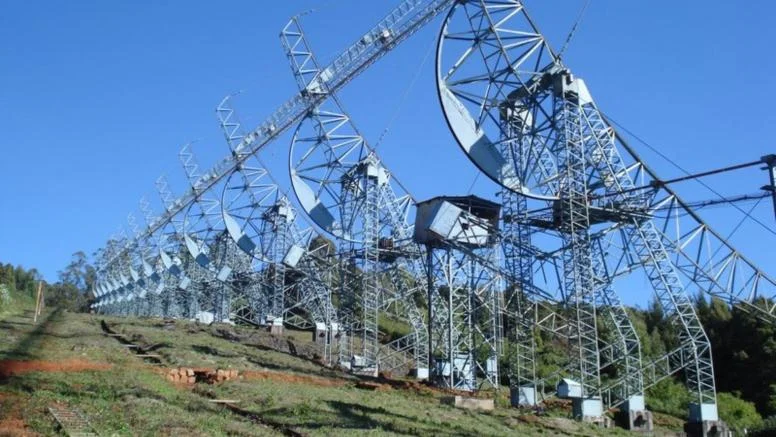
OOTY, TAMIL NADU — High in the Nilgiri Hills, where the air is thin and the landscape is often shrouded in mist, a massive scientific instrument has spent over two decades listening to the silent, invisible rain of the universe. For twenty-two years, the GRAPES-3 muon telescope has been recording the arrival of billions of subatomic particles, and today, a landmark study has revealed that this "cosmic rainfall" holds the key to understanding two of the most complex systems affecting our planet: the Sun’s magnetic shield and the thermal behavior of Earth’s upper atmosphere.
A multi-institutional team of researchers from India and Japan has successfully demonstrated that ground-based muon detectors can provide real-time, highly accurate monitoring of both space weather and atmospheric conditions. By analyzing a staggering dataset of over four billion daily particle detections from 2001 to 2022, the team has unlocked a new method for climate modeling and solar forecasting that could revolutionize our understanding of global environmental shifts.
Main Facts: The Invisible Rain of Muons
The study centers on the GRAPES-3 (Gamma Ray Astronomy PeV Energies Phase 3) experiment, located in Ooty, Tamil Nadu. This facility is one of the world’s most sensitive ground-based instruments for detecting muons—heavy, fast-moving subatomic particles that are cousins to the electron but possess much greater mass.
What are Muons?
Muons are not primary residents of our atmosphere. Instead, they are the "secondary" products of a violent celestial process. Deep space is filled with Galactic Cosmic Rays (GCRs)—high-energy protons and atomic nuclei traveling at nearly the speed of light. When these rays strike the Earth’s upper atmosphere, they collide with oxygen and nitrogen molecules, creating a cascade of secondary particles. These particles quickly decay into muons.
The Dual Discovery
The research, published following decades of observation, highlights a breakthrough in "signal separation." Scientists discovered that the rate of muons reaching the ground is dictated by two primary factors:
- Solar Influence: The Sun’s Interplanetary Magnetic Field (IMF) acts as a barrier. When the Sun is active, its magnetic field strengthens, deflecting cosmic rays away from the solar system and reducing the number of muons created in our atmosphere.
- Atmospheric Temperature: When the upper atmosphere (the stratosphere and troposphere) heats up, the air expands. This expansion increases the distance that precursor particles must travel before they decay into muons. Because of this increased distance, many particles decay prematurely or interact in ways that prevent low-energy muons from reaching ground-level sensors.
Essentially, a lower muon count serves as a dual warning: either the Sun’s magnetic shield is working overtime, or the Earth’s upper atmosphere is warming up.
Chronology: A 22-Year Scientific Odyssey
The journey to this discovery was not an overnight success but a marathon of data collection and technological refinement.
- 2001: The Commencement: The GRAPES-3 telescope, a collaboration between the Tata Institute of Fundamental Research (TIFR) and several Japanese universities, began its long-term monitoring mission. The goal was to study cosmic rays at "PeV" (peta-electron-volt) energies, but the potential for atmospheric monitoring was only beginning to be understood.
- 2001–2011: The First Solar Cycle: Researchers tracked the muon flux through a full 11-year solar cycle. They noticed a distinct "sawtooth" pattern in the data that corresponded with solar activity, but the signal was "noisy," contaminated by Earth’s own seasonal weather changes.
- 2012–2022: Refinement and Automation: As the dataset grew, the team realized they needed more sophisticated tools. They developed automated algorithms to correct for sensor aging and environmental "glitches" in the telescope’s hardware. This period saw the integration of NASA satellite data to serve as a benchmark for their findings.
- 2023–2024: The Mathematical Breakthrough: The team applied a complex mathematical technique known as the Fast Fourier Transform (FFT). This allowed them to isolate the 11-year solar cycle signal from the 1-year seasonal atmospheric signal. By "filtering" the data, they could finally see the two phenomena clearly and independently for the first time.
Supporting Data: The Physics of the "Hadronic Attenuation Length"
To reach their conclusions, the researchers had to navigate the complex world of particle physics. One of the most critical variables in their study was the hadronic attenuation length.
The Density Effect
The research explains that the atmosphere acts like a filter. The density of this filter changes with temperature. When the atmosphere is cold, it is compact. Secondary particles created by cosmic rays have a shorter path to travel to reach the ground. However, when the atmosphere warms, it expands upward.
The team’s data showed a precise correlation: for every degree of warming in the upper atmosphere, there was a measurable decrease in the muon count. This is because the precursor particles (mostly pions and kaons) have more space to interact or decay into other things before they can become the "stable" muons that the GRAPES-3 telescope detects.

The Solar Shield
On the solar side, the data was compared against the Sun’s 11-year cycle. The Sun fluctuates between "Solar Minimum" (low activity) and "Solar Maximum" (high activity). During Solar Maximum, the Interplanetary Magnetic Field is turbulent and strong. The GRAPES-3 data showed that during these peaks, the muon count dropped significantly, as the Sun effectively "blew away" the incoming galactic cosmic rays.
Dealing with Uncertainty
The researchers noted that while their findings are robust, they carry "systematic uncertainties." These stem from the assumed hadronic attenuation length—a measure of how far a particle travels before it hits another nucleus. This length can vary based on the specific energy of the cosmic ray, making the "filtering" process an iterative, ongoing challenge for the team.
Official Responses: A Global Collaboration
The success of the GRAPES-3 project is a testament to international scientific cooperation. The team included experts from:
- India: Tata Institute of Fundamental Research (TIFR) and Cochin University of Science and Technology.
- Japan: Osaka City University, Chubu University, Nagoya University, the University of Tokyo, and Hiroshima City University.
In statements regarding the findings, the researchers emphasized the reliability of ground-based observation. While satellites are essential, they are expensive to maintain and have limited lifespans. A ground-based telescope like the one in Ooty can operate for decades, providing a continuous, unbroken record of the Earth’s environment.
"By using novel, automated algorithms to correct for minor glitches or aging in the detector’s sensors, we were able to iteratively filter out solar influence to obtain a pure atmospheric signal," the research team noted. This ability to self-correct and refine data over twenty years has turned the Ooty observatory into one of the most reliable "thermometers" for the upper atmosphere in existence.

Implications: Climate Modeling and Space Weather Forecasting
The implications of this research extend far beyond the realm of pure physics. They touch upon the most pressing environmental and technological challenges of the 21st century.
1. Enhancing Climate Models
Current climate models rely heavily on weather balloons (radiosondes) and satellite data to measure upper-atmosphere temperatures. However, balloons are launched only a few times a day, and satellites have gaps in their coverage. The GRAPES-3 telescope provides a real-time, 24/7 stream of data. By integrating muon counts into climate models, scientists can gain a more nuanced understanding of how the upper atmosphere is responding to global warming.
2. Space Weather Warnings
Solar storms and fluctuations in the Sun’s magnetic field can wreak havoc on modern technology. They can disrupt GPS signals, damage satellite electronics, and even take down power grids on Earth. The ability of the Ooty observatory to monitor the Sun’s magnetic field through muon fluctuations provides an additional "early warning system" for solar weather, helping engineers protect critical infrastructure.
3. A New Observational Tool
The study proves that cosmic rays are not just "background noise" from space; they are messengers. They carry information about the regions of space they have traveled through and the atmosphere they have passed through. This research establishes ground-based particle detectors as a legitimate and powerful tool for Earth science.
4. Long-term Environmental Monitoring
As the world grapples with the effects of climate change, having a 22-year baseline of atmospheric data is invaluable. The GRAPES-3 dataset allows scientists to look back at two decades of atmospheric expansion and contraction, providing a historical context that is often missing from shorter-term studies.

Conclusion
The GRAPES-3 muon telescope in Ooty has proven that sometimes, the best way to look at the Earth is to look at the stars. By tracking the invisible rain of muons, scientists have bridged the gap between the depths of our solar system and the thin air of our upper atmosphere.
As we move further into an era defined by climatic uncertainty and a reliance on satellite technology, the "celestial messengers" being caught in the Nilgiri Hills will continue to provide the data we need to navigate a changing planet and a turbulent sun. The 22-year study is not just a conclusion, but a beginning—a new way of seeing the invisible forces that shape our world.
