

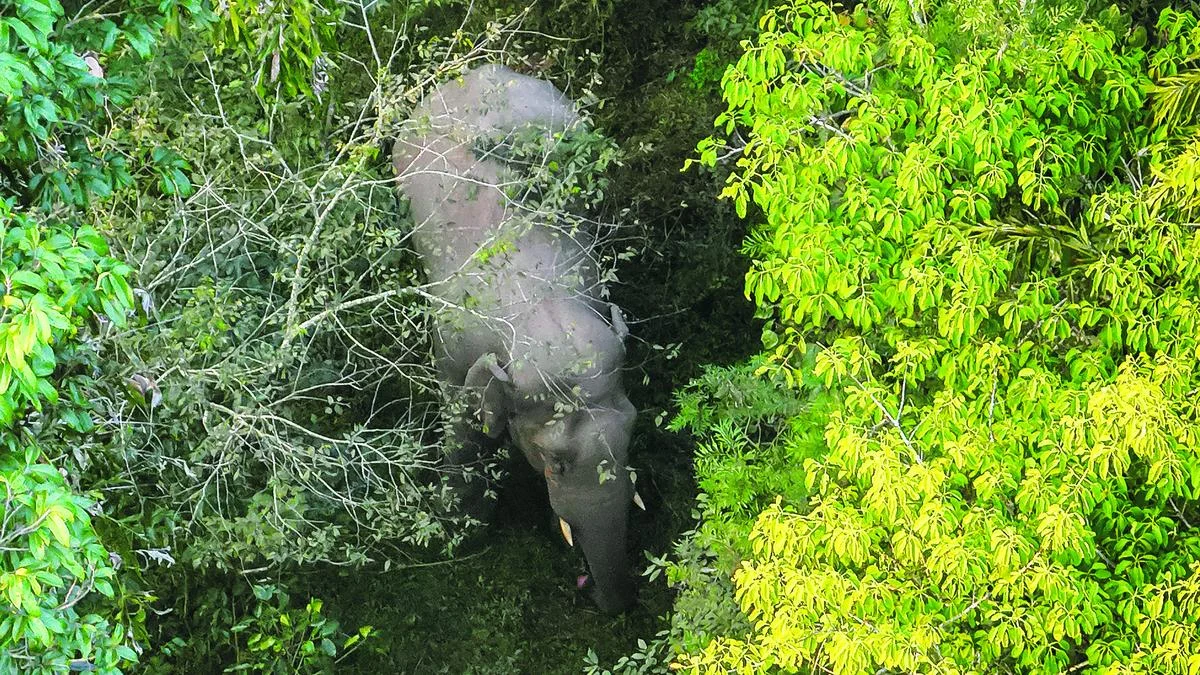
Kodaikanal, India – A profound moment of interspecies trust, witnessed by a farmhand named Kumar on a smallholding in Kodaikanal, has sparked a deep re-evaluation of humanity’s relationship with the natural world. The image of a mother elephant gently nurturing her calf to sleep on land occupied by humans is more than a heartwarming anecdote; it is a potent symbol of a fragile coexistence increasingly threatened by human development. This narrative, held close by the farm’s owner, transcends a simple story, delving into the complex history of land ownership, the ecological imperative of keystone species like elephants, and the urgent need to reimagine our place within the planet’s intricate web of life.
The Uninvited Guests: A Shifting Perspective on Farm Boundaries
Months ago, a simple observation shared by Kumar, a farm employee, resonated deeply with the farm’s owner. A mother and her calf elephant ambled onto the property in broad daylight. The mother, with an unspoken intimacy, nursed her infant until it succumbed to sleep, a scene unfolding on land that, by human convention, was privately owned. This seemingly small act carried immense weight, representing years, perhaps even generations, of cautious observation and a gradual, earned trust. It was a silent declaration that the farm, a human-inhabited space, was perceived as a sanctuary, a place where vulnerability could be expressed without fear.
The significance of this event is amplified in a world where human expansion relentlessly encroaches upon ancient migratory routes. As elephant populations are increasingly forced to navigate altered landscapes, this moment of peace on a Kodaikanal farm stands as a testament to the resilience of nature and the potential for a more harmonious coexistence.
When the farm was first acquired, its proximity to the Anamalai Reserve Forest in Tamil Nadu, a vibrant ecosystem teeming with Bengal tigers, Indian elephants, gaur, leopards, and numerous other endangered species, was perceived as a romantic allure. The owner embraced the self-styled title of "Guardian of the Forest," actively deterring poachers and timber mafias. However, the practicalities of farming in such close proximity to wild inhabitants soon revealed a starkly different reality. The dream of being a solitary protector dissolved as the challenges and escalating costs of keeping formidable wildlife at bay became undeniable. It was a realization that the romantic notion of ownership was fundamentally at odds with the untamed spirit of the land.

The Original Encroachers: Rethinking Human Claims
The initial impulse to fence off and defend the farm from its wild neighbors stemmed from a deeply ingrained, colonial-era concept of private property. This Western notion of absolute ownership, particularly of land, felt increasingly uncomfortable. The fundamental question arose: who truly owns this land? Is it the individual with deeds and capital, or the wild, which has been its custodian for millennia? The narrative of human settlement often overlooks the historical displacement of wildlife, painting a skewed picture of territorial rights.
A pivotal shift in perspective occurred after completing a Permaculture Design course in Thailand under Professor John Champagne. The principles of permaculture advocate for working with nature, rather than against it. This philosophy challenged the deeply ingrained instinct to "keep them out," suggesting instead that farming alongside these magnificent creatures might be a more sustainable and ethical approach. This counterintuitive idea forced a profound re-evaluation of the farm’s purpose and the owner’s role within its ecological context.
The harsh truth began to dawn: agriculture itself was a primary driver of habitat loss and the initial encroachment into wild ecosystems. The very act of clearing land for cultivation represented a fundamental disruption of natural balances. Yet, observing a young child’s uninhibited exploration of the natural world, seamlessly integrating with her surroundings, brought another crucial realization. Humans, too, are an intrinsic part of this delicate ecosystem, as much a component of Nature as the elephant. The crucial distinction, however, lay in responsibility. While the elephants were integral to the forest’s existence, the farm’s owner was, in essence, beholden to them for the very land they occupied.
Bona Fide Ecosystem Engineers: The Indispensable Role of Elephants
Elephants are not merely large mammals; they are "bona fide ecosystem engineers," their movements and existence shaping the landscapes they inhabit. They traverse vast distances in matrilineal herds, following ancient migratory routes passed down through generations. Matriarchs, with their innate knowledge of seasons and water sources, lead their kin across hundreds of kilometers. This extensive movement is not arbitrary; it is essential for their survival, as they require immense quantities of food.

Crucially, as they journey, elephants actively contribute to the creation of highly biodiverse forests. Seeds ingested with fruits are dispersed across the landscape through their dung, facilitating the growth of new plants far from their parent trees. This process enhances genetic diversity and supports the propagation of a wide array of flora. In the summer months, their powerful bodies navigate through dense vegetation, acting as natural pruners. This action allows sunlight and air to penetrate the undergrowth, fostering the development of grasslands that, in turn, support a multitude of other animal species. Their presence is a vital component in maintaining the health and vitality of forest ecosystems, making them a keystone species that underpins the survival of countless other forms of wildlife.
To contemplate barring such an essential force from entering a "regenerative organic farm" feels profoundly misguided. The abstract constructs of fences, property deeds, and even monetary value pale in comparison to the raw power and inherent right of a wild elephant. In their presence, the only logical response is to yield, to make way, acknowledging their rightful place in the natural order.
"Owning" the Planet: A Colonial Legacy and a Path Forward
The notion of "owning" the planet, or even a piece of it, is a concept rooted in a complex history of human ambition and control. The author articulates a deep-seated belief in the "Natural Commons" – the inherent right of every human being to access air, water, forests, and wildlife simply by virtue of their birth. However, in the modern era, these fundamental resources have often been commodified and privatized, accessible only to those with the means to acquire them. Yet, land and the space to exist should arguably remain within the realm of these natural commons.
Early human societies understood this principle, sharing land communally within tribes. Even Plato, a foundational figure in Western philosophy, argued against private land ownership, foreseeing its potential to foster corruption and greed. His ideal republic proposed communal property for its ruling class, a vision that ultimately succumbed to the ascendant force of capitalism. The advent of large European trading companies in the 17th century marked the true genesis of private property as a dominant economic paradigm, inextricably linked to the era of colonialism.

Fortunately, a growing intellectual discourse is challenging this entrenched concept of ownership, particularly in our current era of environmental degradation. Charles Eisenstein, an American activist and author, in his seminal work Sacred Economics, proposes a paradigm shift by advocating for penalties on socially and environmentally harmful activities associated with private property. His framework seeks to decouple the "enjoyment" of ownership – the tangible benefits – from the fruits of labor and creativity invested in it. Permaculture principles further align with this vision, promoting community-based land stewardship and ecological design. This approach advocates for land to be held in trust for the collective ecological and community benefit, rather than for exclusive private ownership.
A Stewardship, Not Ownership: Learning from the Elephant
The question then becomes: how should we conceptualize the land we occupy? A man-made boundary, a fence, does not truly demarcate our territory from the rest of the planet. It is a superficial imposition on a continuous, interconnected system. The author draws a powerful analogy to raising a child: while a parent acts as a protector, guardian, and steward, they can never truly claim ownership of their offspring. This profound truth, the understanding that land can never be definitively "yours," seems to have been largely forgotten in the modern pursuit of private dominion.
The encounter with the elephant mother and calf serves as a potent reminder of our role as temporary custodians, not absolute proprietors. It calls for a fundamental shift in perspective, moving from a mindset of conquest and control to one of reverence and responsible stewardship. By embracing the wisdom embedded in the natural world, particularly in the actions of creatures like elephants who have coexisted with these landscapes for millennia, we can begin to mend the fractured relationship between humanity and nature, making ecological consciousness as innate as breathing.
This series aims to explore these themes through the lens of those who work the land, seeking to integrate the profound lessons of ecology into our everyday thinking, making it feel like a second nature. The Kodaikanal farm, once a symbol of human dominion, is slowly transforming into a testament to shared existence, a space where the echoes of the wild are not feared, but deeply respected and understood.
