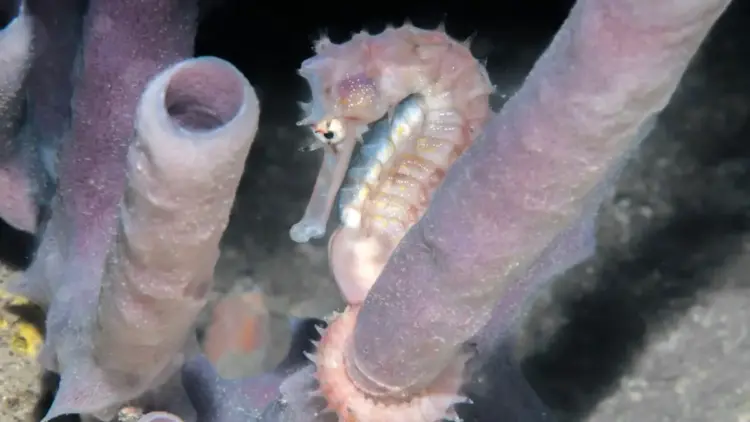
In the vast, biodiverse corridors of the Indian Ocean, a tiny, spiny creature has been hiding its true identity for over a century and a half. What was long dismissed as a common, widespread species has recently been revealed to be a distinct lineage, unique to the Indian Ocean. This discovery, centered around the description of Hippocampus amandavincentae, not only adds a new member to the global seahorse family but also forces a complete re-evaluation of how marine biodiversity is mapped across the Indo-Pacific.
Main Facts: A Taxonomic Revolution in Indian Waters
Scientists have officially identified Hippocampus amandavincentae, a new-to-science seahorse species found in the coastal waters of India. This discovery is a landmark event for marine biology, as it resolves a taxonomic entanglement that dates back to the mid-19th century. For 168 years, this particular seahorse was misidentified as Hippocampus histrix (the thorny or spiny seahorse), a species originally described from Japanese waters.
The study, published in the prestigious journal Zootaxa, reveals that the "spiny seahorse" is not a single, monolithic species ranging from the Red Sea to the Pacific. Instead, the research confirms a "cryptic species" complex, now divided into three geographically distinct entities:
- Hippocampus histrix: Now restricted primarily to the Pacific Ocean.
- Hippocampus jayakari: Found in the Arabian region and the Red Sea.
- Hippocampus amandavincentae: The newly described species, thought to be endemic to the Indian Ocean, ranging from the coast of India to Madagascar and Mozambique.
This discovery brings the total number of seahorse species recorded in Indian waters to seven. Led by Shalu Kannan of the Zoological Survey of India (ZSI) and supported by researchers from the Kerala University of Fisheries and Ocean Studies (KUFOS), the study highlights the importance of "integrative taxonomy"—a method that combines physical characteristics (morphology) with sophisticated genetic sequencing.

Chronology: From 19th-Century Sketches to 21st-Century DNA
The journey to identifying H. amandavincentae is a saga of scientific persistence and evolving technology.
1856: The Original Description
The story begins in 1856 when the German zoologist Johann Jakob Kaup described Hippocampus histrix based on specimens collected near Japan. In the era of classical biology, species were often "clumped" together based on superficial physical similarities. Because H. histrix had distinctive long spines, any spiny seahorse found across the Indo-Pacific was casually assigned this name.
2016: The First Doubts
The consensus began to crumble in 2016. A pivotal paper suggested that H. histrix had become a "catch-all" name for virtually any spiny seahorse in the region. Taxonomists began to suspect that the wide-ranging "species" actually harbored several "cryptic" species—animals that look nearly identical to the naked eye but are genetically and evolutionarily distinct.
2019: The Breakthrough in Thoothukudi
In 2019, Shalu Kannan, then a PhD student at KUFOS, began her search for H. histrix specimens along the Tamil Nadu coast. It took over a year of working closely with local fishing communities to secure the necessary samples. The breakthrough came at the Thoothukudi Fisheries Harbour, where two specimens were recovered from trawler bycatch.

2020–2024: Global Comparison and Publication
The researchers didn’t stop at the two specimens. They collaborated with international taxonomists, including Graham Short, to compare the Indian samples with museum records from around the world. By integrating dive records from the Western Indian Ocean and performing rigorous genetic analysis, the team spent years confirming that the Indian Ocean population was indeed a separate species. The findings were finalized and published in 2024.
Supporting Data: The Anatomy of a Discovery
The identification of H. amandavincentae rested on two pillars: morphology (the study of form) and molecular phylogenetics (DNA analysis).
Morphological Distinctions
While seahorses are masters of camouflage, changing color and texture to match their surroundings, certain skeletal features remain constant. The researchers identified several key differences between the new species and the "true" H. histrix of the Pacific:
- The Coronet: H. amandavincentae possesses five spines on its "coronet" (the crown-like structure on the head), whereas H. histrix typically has four.
- The Snout: The new species has a significantly shorter snout relative to its head length compared to its Pacific cousin.
- Spine Structure: The spines along the trunk and tail of H. amandavincentae are stouter and more robust than the slender, needle-like spines of the Japanese specimens.
- Size: The specimens collected were approximately 16 centimeters long, fitting the general profile of spiny seahorses but differing in the fine-scale arrangement of dermal filaments.
Genetic Divergence
The most undeniable evidence came from the lab. Molecular analysis revealed a 6% to 7% genetic divergence between the Indian Ocean specimens and those from the Pacific. In the world of marine biology, a 2% divergence is often enough to suggest a separate species; a 7% gap indicates that these lineages have been evolving independently for millions of years.

Furthermore, by analyzing genetic sequences deposited in global databases, the team found matches in Madagascar, Mozambique, and the Seychelles. This suggests that H. amandavincentae is the dominant spiny seahorse throughout the Indian Ocean, while H. jayakari occupies the more arid Red Sea and Arabian Gulf corridors.
Official Responses and Expert Insights
The naming of the species—Hippocampus amandavincentae—is a tribute to Dr. Amanda Vincent, the co-founder of Project Seahorse. Dr. Vincent is a world-renowned authority whose work led to the inclusion of seahorses in CITES (the Convention on International Trade in Endangered Species), ensuring international trade is regulated.
Shalu Kannan, the lead author, emphasized the role of local stakeholders: "Without the fishermen’s help, this discovery would not have been possible. They are the eyes and ears of the ocean." She noted that identifying a species is the essential "Step Zero" for any conservation effort; you cannot protect what you haven’t identified.
Dr. Rajeev Raghavan, co-author and Assistant Professor at KUFOS, highlighted the taxonomic vacuum that the study fills. "Describing a seahorse is an international effort. You have to compare your findings with museum specimens housed in London, Paris, or Washington. This study shows that the Indian Ocean is far more unique than we previously realized."

A. Murugan, a member of the IUCN SSC Seahorse, Pipefish, and Seadragon Specialist Group, who was not involved in the study, hailed the discovery as a catalyst for future research. He noted that the "clandestine" nature of seahorse movement makes them difficult to study, and this new description provides a clearer framework for researchers focusing on fish diversity in the Bay of Bengal and the Arabian Sea.
Implications: Conservation in the Age of Bottom Trawling
The discovery of H. amandavincentae is bittersweet, as it shines a light on the extreme pressures facing marine life in Indian waters.
The Bycatch Crisis
The fact that the discovery specimens were found in "bycatch"—the incidental capture of non-target species—is a stark reminder of the impact of bottom trawling. A 2020 study estimated that 13 million seahorses are caught annually in India as bycatch. Because seahorses inhabit the same seafloor environments as high-value commodities like shrimp and blue swimming crabs, they are frequently swept up in non-selective drag nets.
Legal Protection vs. Clandestine Trade
In India, all seahorse species are listed under Schedule I of the Wild Life (Protection) Act, 1972. This grants them the same level of legal protection as tigers and elephants. It is illegal to catch, possess, or trade them. However, a thriving "clandestine" illegal trade persists. Dried seahorses are highly sought after for traditional medicine markets in East Asia. The southeast coast of India, particularly Tamil Nadu, remains a hotspot for this illegal traffic, with frequent seizures of thousands of dried specimens at airports and ports.

Reassessing the Red List
The discovery has immediate implications for the IUCN Red List of Threatened Species. Currently, Hippocampus histrix is listed as "Vulnerable." However, that assessment was based on the assumption that it was a single species found across half the globe. Now that we know it is actually three separate species, the population of each is significantly smaller than previously thought. H. amandavincentae likely requires its own specific conservation assessment, and its status may be even more precarious than the "Vulnerable" label suggests.
The Path Forward
Researchers are now calling for an "underwater roadmap" for Indian marine conservation. While morphology and genetics have identified the species, little is known about its specific habitat preferences, breeding cycles, or population density.
The discovery of H. amandavincentae proves that even in well-traveled waters, the ocean still holds secrets. It serves as a call to action for the Indian government and international conservation bodies to move beyond "paper protection" and address the systemic issues of bottom trawling and illegal trade that threaten the survival of this newly recognized Indian Ocean endemic. As Shalu Kannan aptly put it, "There are more undiscovered species in this region. We have only just begun to scratch the surface."