Bengaluru, often celebrated as India’s Silicon Valley, has long grappled with a paradox: its rapid economic ascent has been mirrored by increasingly paralyzed transit corridors. Among these, the stretch of Ballari Road (NH 44) connecting the central business district to Kempegowda International Airport (KIA) stands as the city’s most critical yet congested artery. In a decisive move to reclaim mobility, the Karnataka government and urban development authorities have greenlit a multifaceted infrastructure project centered on Mehkri Circle and the Hebbal interchange.
With a budget of Rs 725 crore, this ambitious undertaking is not merely a single flyover but a sophisticated integration of an elevated highway and an underground tunnel system. As preliminary construction begins with soil investigations, the project marks a significant milestone in the "Brand Bengaluru" initiative aimed at modernizing the city’s infrastructure.
1. Main Facts: The Engineering Blueprint for Decongestion
The Mehkri Circle project is designed to address the "bottleneck effect" where traffic from the airport, northern suburbs, and eastern tech hubs converges at the Hebbal flyover. The project is split into two primary engineering components that work in tandem:
The Elevated Corridor
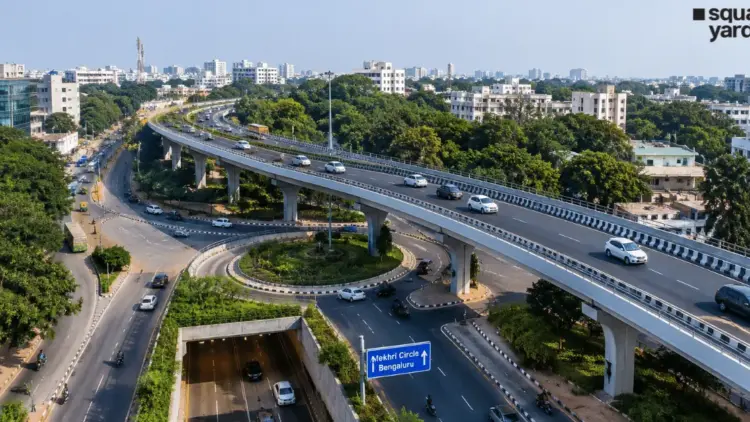
A 1.78-km elevated road will be constructed, beginning near the Veterinary College/UAS Staff Quarters and extending toward Mehkri Circle. This section is designed with a four-lane configuration (two lanes in each direction), intended to peel away "through traffic" from the surface roads. By elevating local and airport-bound commuters, the project aims to free up the ground level for neighborhood transit and public transport.
The Underground Tunnel
In a significant departure from traditional flyover-only solutions, the project includes a 2.28-km tunnel. This subterranean passage will run between the Hebbal-Esteem Mall area and Baptist Hospital. With three lanes in each direction, the tunnel represents a massive capacity increase. This specific alignment is strategic; it targets the highest density of traffic where surface expansion is limited by existing structures and the Hebbal lake ecosystem.
The Mehkri Circle Rotary
At the heart of the project lies a proposed rotary at Mehkri Circle. This junction has historically been a point of friction for vehicles moving between Sadashivanagar, Jayamahal, and the airport road. The rotary is designed to streamline these multi-directional movements, reducing the wait times at signals and improving the "weave" of merging traffic.
2. Chronology: From Planning to Preliminary Construction
The journey of the Mehkri Circle-Hebbal project reflects the urgency of Bengaluru’s traffic crisis.
- The Planning Phase: For years, the Hebbal interchange was identified as the city’s "Number One Bottleneck." Various iterations of the project were discussed, including a controversial steel flyover proposal in previous years, which was eventually scrapped due to environmental concerns.
- Approval and Tendering: Following the conceptualization of the "tunnel road" network for Bengaluru, the state government fast-tracked the Mehkri Circle-Hebbal stretch as a priority corridor. The Rs 725-crore budget was allocated to ensure high-grade materials and modern engineering standards.
- Current Status (Soil Investigation): As of late 2024, the project has transitioned from paper to the field. Soil investigation and geotechnical surveys are currently underway. These tests are vital, particularly for the tunnel component, to determine the rock density and water table levels near Hebbal.
- The 18-Month Countdown: Authorities have set a rigorous 18-month completion target. While ambitious for a project of this complexity, the timeline reflects the government’s desire to provide relief to commuters before the next major election cycle and to keep pace with the rapid development of North Bengaluru.
3. Supporting Data: Real Estate and Economic Impact
Infrastructure projects of this scale invariably reshape the real estate landscape. The Ballari Road corridor is already one of the most expensive and sought-after regions in the city.
Market Insights: North-Central Bengaluru
According to Square Yards Research, property values in the affected localities are poised for a significant uptick as connectivity improves. Below is the current price baseline:
| Locality | Average Price Per Sq. Ft. (Rs) |
|---|---|
| Hebbal | 12,000 – 20,500 |
| Ganganagar | 9,000 – 13,000 |
| Sanjaynagar | 8,700 – 20,500 |
| Sadashivanagar | 11,500 – 25,500 |
| Jayamahal | 11,500 – 16,500 |
| Yeshwanthpur | 13,500 – 19,500 |
| Mathikere | 8,500 – 19,000 |
Economic Drivers
- Manyata Tech Park: Located near Nagawara, this tech hub houses over 100,000 employees. The tunnel and flyover will drastically reduce the commute for professionals living in central and western parts of the city.
- The Airport Corridor: As Kempegowda International Airport expands with its second terminal and increasing cargo operations, the reliability of the NH 44 corridor is essential for the state’s logistics and tourism sectors.
4. Official Responses and Urban Planning Vision
While specific quotes from the current administration emphasize "speed and transparency," the project aligns with the broader vision of the Bangalore Development Authority (BDA) and the Bruhat Bengaluru Mahanagara Palike (BBMP).
Officials have noted that the project is designed to be "future-proof." By combining a tunnel with an elevated road, the city is maximizing the "Vertical City" concept. "We cannot expand roads horizontally anymore due to land acquisition costs and existing heritage structures," noted an urban planning consultant associated with the project. "The only way is to go up and go down."
The project also integrates with the proposed 28-km Yeshwanthpur-KR Pura elevated corridor. This massive transit spine will run from Mathikere Cross through IISc, Mehkri Circle, and Jayamahal, eventually reaching Old Madras Road. The Mehkri Circle project serves as a critical node in this larger network, ensuring that traffic doesn’t just move through one junction but flows seamlessly across the city’s northern quadrant.
5. Neighborhood Implications: Who Wins?
The impact of this Rs 725-crore investment will be felt differently across various micro-markets:
Hebbal: The New Gateway
Hebbal is the primary beneficiary. The proposed tunnel will extend beyond the existing, over-stressed Hebbal flyover, allowing airport-bound traffic to bypass the local "chaos" at the Esteem Mall junction. This will likely transform Hebbal from a mere transit point into a more organized commercial and high-end residential hub.
Ganganagar and Sanjaynagar: Enhanced Accessibility
These established residential neighborhoods have often felt "cut off" by the heavy traffic on Ballari Road. Improved local road access and the reduction of through-traffic on surface streets will make these areas more attractive for families and small business owners who require better connectivity to the city center.
Sadashivanagar and Jayamahal: Preserving the Elite Enclave
For the residents of Sadashivanagar—one of India’s most expensive residential areas—the Mehkri Circle rotary is a double-edged sword. While it promises smoother commutes, the focus will be on ensuring that the elevated structures do not diminish the aesthetic value of the neighborhood. The rotary design aims to minimize the visual impact while maximizing vehicular throughput.
Yeshwanthpur and Mathikere: The Industrial-Academic Link
The connection to Mehkri Circle is vital for the Indian Institute of Science (IISc) and the Yeshwanthpur railway hub. The project facilitates a faster link between the academic/industrial west and the commercial north, fostering a more integrated economic zone.
6. Challenges and Environmental Considerations
No project of this magnitude is without its hurdles. The 18-month completion target is fraught with challenges:
- Geological Risks: Tunneling in Bengaluru involves navigating hard granite and varying soil strata. The proximity to Hebbal Lake requires stringent environmental safeguards to ensure no seepage or structural damage to the water body’s ecosystem.
- Traffic Diversion: Ballari Road is a 24/7 corridor. Managing traffic during the construction of the elevated section and the tunnel entry/exit points will require a Herculean effort from the Bengaluru Traffic Police.
- Utility Shifting: Beneath the surface of Mehkri Circle lies a complex web of water pipes, fiber optic cables, and power lines. Shifting these without disrupting the city’s utility services is often the most time-consuming aspect of such projects.
7. Conclusion: A New Era for Bengaluru Transit?
The Rs 725-crore Mehkri Circle flyover and tunnel project represents more than just asphalt and concrete; it is a litmus test for Bengaluru’s ability to reinvent itself. By addressing the Hebbal-Mehkri bottleneck through a sophisticated multi-level approach, the city is attempting to balance the needs of its high-speed economic engines with the daily requirements of its residents.
If successful and completed within the 18-month window, the project will serve as a blueprint for other congested Indian metros. For the residents of North Bengaluru and the thousands of travelers heading to the airport, the promise of a "signal-free" journey is no longer a distant dream but a construction project in progress. As the soil investigations conclude and the heavy machinery moves in, all eyes will be on this corridor to see if it can truly deliver the mobility Bengaluru so desperately needs.
Disclaimer: This report is based on current project proposals and preliminary construction data. Real estate prices are subject to market fluctuations. Engineering details may be refined as construction progresses.