

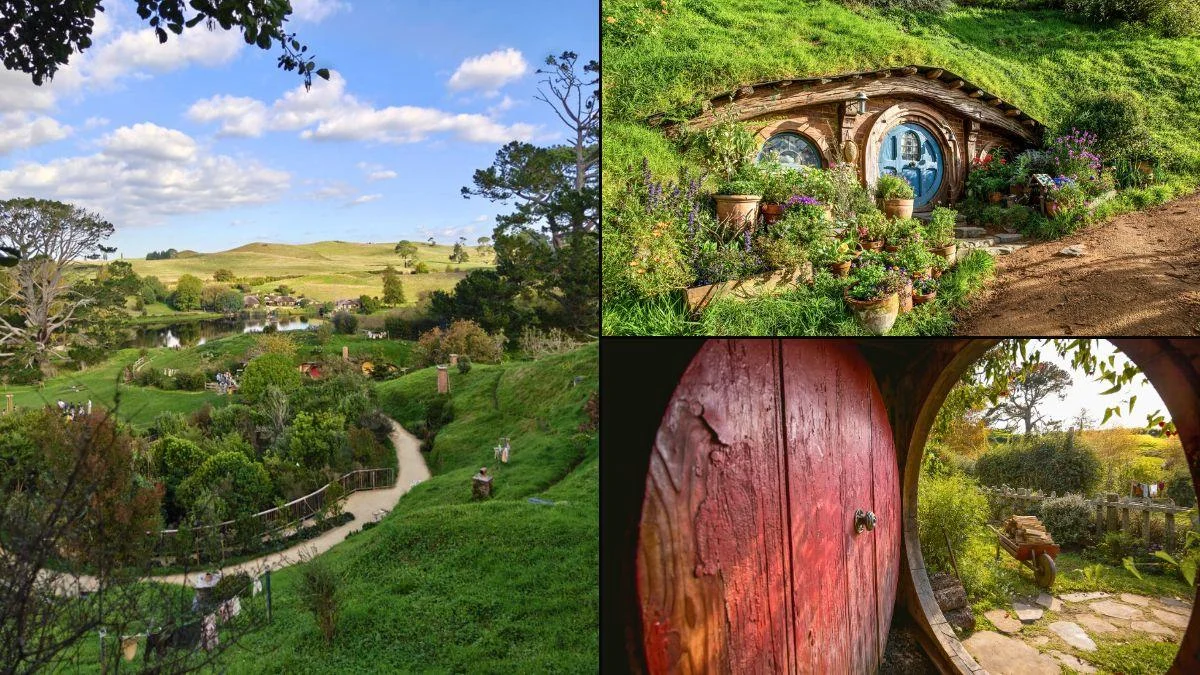
MATAMATA, NEW ZEALAND — For many, the industrial miracle of cinema is a process understood through technical credits and box-office figures. Yet, for a generation raised on the seminal works of J.R.R. Tolkien and the subsequent cinematic adaptations by Sir Peter Jackson, Middle-earth is less a film set and more a cultural inheritance. What began as a 1,250-acre sheep farm in the heart of New Zealand’s Waikato region has transformed into a global pilgrimage site, blurring the lines between cinematic fiction and tangible reality.
The Hobbiton Movie Set, located near the town of Matamata, stands today as a testament to obsessive craftsmanship and the power of "screen tourism." It is a place where the rattle of Gandalf’s cart and the serene image of a Hobbit reading under a tree are no longer confined to the celluloid dreamscape but are accessible to the thousands of travelers who journey across the planet to witness the realization of Tolkien’s "Shire."

Main Facts: A Permanent Monument to High Fantasy
Hobbiton is not merely a collection of props; it is a meticulously maintained 12-acre village featuring 44 permanent Hobbit Holes, a working mill, a double-arched stone bridge, and the world-famous Green Dragon Inn.
The site serves as the primary location for The Shire in both The Lord of the Rings and The Hobbit film trilogies. Unlike most movie sets, which are struck (dismantled) immediately after production, Hobbiton has evolved into a permanent outdoor museum. Following a massive reconstruction project for The Hobbit trilogy in 2009, the set was rebuilt using permanent materials—stone, brick, and timber—ensuring its longevity for decades to come.

According to recent tourism data, Hobbiton remains one of New Zealand’s most sought-after experiences, acting as a cornerstone of the nation’s "100% Pure Middle-earth" marketing campaign. The site recently reached a new milestone in immersive tourism by opening "Bagshot Row," allowing visitors to step inside fully realized Hobbit Hole interiors for the first time in the site’s history.
Chronology: The Evolution of a Landmark
The journey from a working sheep farm to a global icon was marked by several pivotal moments:

1998: The Aerial Discovery
The search for The Shire began in 1998 when Peter Jackson and his location scouts conducted a helicopter survey of the North Island. They were looking for a landscape that felt "untouched by time." Upon spotting the Alexander family’s sheep farm, Jackson noted the rolling green hills and the presence of a magnificent Monterey pine tree overlooking a lake—the perfect "Party Tree." Legend suggests that location scout David Comer arrived unannounced, interrupting the Alexander family during a rugby match to pitch the idea of a fantasy film.
1999: The Initial Build
Construction began in March 1999. The New Zealand Army was drafted to assist with the massive undertaking, using heavy machinery to cut 1.5 kilometers of road into the site and shift enormous amounts of earth. Thirty-nine temporary Hobbit Hole facades were created using polystyrene and plywood. Filming for The Lord of the Rings began in December 1999 and lasted three months.

2002: Accidental Tourism
After filming wrapped, the set was slated for demolition. However, bad weather delayed the teardown of the final 17 facades. During this delay, fans of the books and the first film began trespassing on the farm to see the remnants. Recognizing the demand, the Alexander family and the film studio reached an agreement to start guided tours in 2002.
2009–2011: The Permanent Rebuild
When Jackson returned to film The Hobbit trilogy, the decision was made to rebuild the set out of permanent materials. This second construction phase took two years and involved an obsessive level of detail. The gardens were planted a year in advance of filming to ensure they looked "lived-in," and artificial lichens were applied to fences to simulate age.

2023–Present: The Interior Expansion
Historically, the Hobbit Holes were only exterior facades, with interior scenes filmed on soundstages in Wellington. In December 2023, Hobbiton unveiled a major expansion on Bagshot Row, featuring two Hobbit Holes with complete, walkable interiors, providing a 360-degree immersive experience.
Supporting Data: The Architecture of Immersion
The design of Hobbiton draws heavily from Tolkien’s descriptions and his childhood in the rural English Midlands, specifically Worcestershire and Warwickshire. This influence is visible in the organization of the village into "Farthings" and the use of traditional British pastoral aesthetics.

Technical Craftsmanship and Scale
The site utilizes "forced perspective" to manage the height differences between characters. The Hobbit Holes were built at different scales:
- 90% Scale: These holes make the actors playing Hobbits look the correct size (small) in relation to their dwellings.
- 60% Scale: These smaller holes were used when filming Gandalf (Ian McKellen) to make him appear towering and "wizard-sized" against the Shire architecture.
The Landscape as a Character
The 12-acre set is maintained by a full-time team of gardeners. The "Party Tree," a Monterey pine, was already on-site, but for the "Oak Tree" above Bag End, Jackson’s team constructed a 26-tonne artificial tree made of steel and silicon. To ensure accuracy for The Hobbit, 200,000 artificial silk leaves were imported from Taiwan and wired individually onto the branches.

The Green Dragon Inn
Since opening to the public in 2012, the Green Dragon Inn has served as the functional "pub" for the set. It features heavy timber beams, hand-carved furniture, and a roaring fireplace. The beverages served—including the Girdley Fine Grain Amber Ale, Sackville Apple Cider, and Oatbarton Traditional Stout—are brewed exclusively for Hobbiton by Good George Brewing in nearby Hamilton.
Official Context: The "Screen Tourism" Effect
The development of Hobbiton has been supported by Tourism New Zealand, recognizing the site’s role in the national economy.

Tourism New Zealand Statement:
"The connection between New Zealand and Middle-earth is a unique cultural asset. For many international visitors, the landscape of the Waikato is the primary driver for their journey. Hobbiton represents the gold standard of screen tourism, where a film location becomes a sustainable, long-term contributor to regional development."
The site has created hundreds of local jobs and has turned Matamata from a quiet dairy town into a bustling tourism hub. The collaboration between the Alexander family and Hobbiton Movie Set Tours Ltd. remains a rare example of a private-public-filmic partnership that has thrived for over two decades.

Implications: The Psychological Pull of the Shire
The enduring popularity of Hobbiton suggests a deeper psychological resonance. In an increasingly digital and urbanized world, the Shire represents a "pre-industrial idyll"—a place of comfort, community, and connection to the earth.
For the visitors who walk the path toward Bag End, the experience often transcends simple movie-buff curiosity. The emotional response—witnessed in the "wet eyes" of visitors sitting at a Hobbit’s kitchen table—points to the Shire’s role as a "modern myth." Tolkien’s vision of a "hole in the ground that means comfort" serves as a universal symbol of home.

Furthermore, the site’s influence extends to modern fantasy. Visitors often bring contemporary works, such as the manga/anime Frieren: Beyond Journey’s End, to the site, illustrating how Tolkien’s foundation continues to support new generations of storytelling. Frieren, which explores what happens after a fantasy adventure ends, mirrors the experience of the Hobbiton visitor: the realization that while the adventure is over, the memory of the landscape remains a part of one’s identity.
Conclusion: There and Back Again
As the sun sets over the Waikato hills, casting long shadows across the round green door of Bag End, the line between New Zealand and Middle-earth remains successfully blurred. The site stands as a monument to the idea that some stories are too big to remain on the page or the screen.

Leaving the Shire, as many visitors attest, carries a certain melancholia. Like Bilbo and Frodo Baggins, travelers find that stepping out of their "front door" and into the world of Tolkien changes them. In the heat of distant cities like Delhi or the bustle of London, the memory of the Shire’s cool, tubular halls and the taste of a Green Dragon stout serves as a reminder of the industrial miracle that turned a sheep farm into a piece of living folklore.
Hobbiton is no longer just a movie set; it is a permanent fixture of the global imagination—a place where, for a few hours, the unreal becomes tangible, and the dream of the Shire becomes a memory of a place once occupied.

The author traveled to New Zealand as a guest of Tourism New Zealand.
