

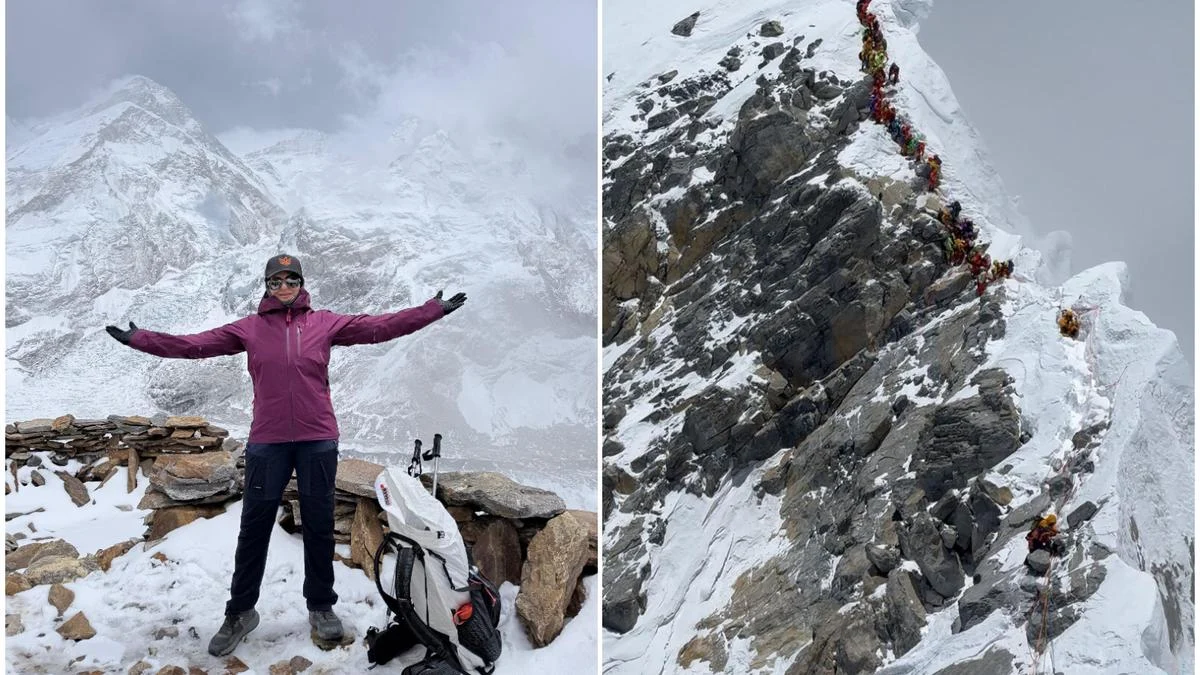
KATHMANDU/CHENNAI – In the high-stakes world of reproductive medicine, precision, calm, and emotional resilience are the hallmarks of success. For Dr. Priya Selvaraj, a renowned fertility expert and Director of GG Hospital in Chennai, these professional virtues were not merely honed in the sterile corridors of a surgical suite, but amidst the thin air and shifting ice of the world’s most formidable peaks. On May 27, Dr. Selvaraj reached the summit of Mount Everest (8,848.86 meters), marking the culmination of a transformative journey that began not with an ambition for records, but as a quest for sanctuary following personal loss and the global upheaval of the COVID-19 pandemic.
Her ascent of "Sagarmatha" represents more than a physical feat; it is a narrative of technical discipline, the shifting ethics of modern mountaineering, and the profound psychological metamorphosis that occurs when a human being is stripped of ego at the edge of the "Death Zone."
Main Facts: A Convergence of Science and Survival
Dr. Priya Selvaraj’s successful summit of Mount Everest was achieved under the aegis of Elite Exped, the expedition company founded by the record-breaking mountaineer Nirmal "Nimsdai" Purja. Guided by the experienced Anup Gurung, a seven-time Everest summiteer, Dr. Selvaraj navigated a season characterized by record-breaking permit issuances and significant environmental challenges.

Key highlights of the expedition include:
- Summit Date: May 27, 2026.
- Preparation: A rigorous four-month specific training window following a successful summit of Mount Manaslu (8,163m) in late 2025.
- Technical Milestones: Completion of Sandakphu Phalut, Khopra Ridge, Kilimanjaro, Everest Base Camp (EBC), and Lobuche East to qualify for 8,000-meter peaks.
- Survival Incident: A near-fatal fall into a crevasse in the Khumbu Icefall, mitigated by strict adherence to safety protocols and a rapid rescue by her Sherpa guide.
- Philosophy: A "no-shortcut" approach, emphasizing a full walk-in and walk-out without the use of helicopters for descent from high camps.
Chronology: The Road to Sagarmatha
The Genesis of a Mountaineer (2020–2024)
Dr. Selvaraj’s journey did not follow the traditional trajectory of a lifelong climber. The emotional toll of the COVID-19 years, coupled with a significant personal loss, prompted a search for a "culturally significant trek" to escape the noise of urban life. What began as a search for refuge quickly evolved into a disciplined pursuit of high-altitude mountaineering.
Between 2021 and 2024, she systematically built her resume, moving from the scenic ridges of Sandakphu and Khopra to the volcanic heights of Kilimanjaro. By the time she reached Everest Base Camp and successfully climbed Lobuche East, she had acquired the technical certifications necessary for the "Big Hills."

The Manaslu Litmus Test (Late 2025)
The true turning point was Mount Manaslu, the world’s eighth-highest peak. For Dr. Selvaraj, Manaslu was a spiritual awakening that provided the "piety and belief" required to face Everest. It served as the ultimate proof of concept: that a medical professional from the sea-level plains of Chennai could survive and thrive in the "thin air."
The Everest Intensive (November 2025 – May 2026)
Training for Everest was a grueling exercise in time management. Balancing her responsibilities as a hospital director and fertility specialist, Dr. Selvaraj followed a schedule designed by Dr. Sunapradeep, a national-level athlete.
The regimen, conducted entirely at sea level in Chennai, focused on:

- Cardiovascular Conditioning: Long-distance running and interval training at Marina Beach.
- Functional Strength: Utilizing the hospital’s own ramps for incline training and a dedicated home gym.
- Combat Sports: Muay Thai to build mental toughness and explosive power.
In May 2026, she arrived in Nepal, joining the Elite Exped team for the spring climbing window.
The Climb and the Crisis (May 2026)
The ascent was fraught with delays. High-altitude "rotations"—the process of climbing to higher camps and descending to acclimatize—were hampered by threatening seracs (giant blocks of glacial ice) over the Khumbu Icefall.
During one of these technical passages, disaster nearly struck. While attempting to jump across a crevasse, Dr. Selvaraj fell. "The only reason I am alive today is because I was tethered to the safety rope," she recalled. Her guide, Anup Gurung, executed a textbook rescue, hauling her out of the icy chasm. The incident served as a stark reminder of the thin line between a successful expedition and a tragedy.

The Summit Push
After weeks of waiting out weather windows at Base Camp, the team moved through the higher camps. On May 27, after negotiating the technical "Hillary Step" and passing the sobering sight of fallen climbers—frozen markers of the mountain’s lethality—Dr. Selvaraj reached the summit. She unfurled the Indian national flag alongside the flag of the GG Fertility Research Foundation, marking a moment of both personal and professional pride.
Supporting Data: The Reality of a Crowded Mountain
The 2026 season on Everest highlighted the growing concerns regarding the commercialization of the peak. According to data from Nepal’s Department of Tourism, a record 494 permits were issued for Everest alone this season. When accounting for Sherpas and support staff, nearly 1,000 individuals were positioned for summit pushes during the same narrow weather windows.
| Metric | Details |
|---|---|
| Permits Issued | 494 (Record High) |
| Total Climbers on Mountain | ~1,000 (including Sherpas) |
| Environmental Impact | Significant littering (oxygen bottles, tents) at Camp 4 |
| Technical Difficulty | High (Khumbu Icefall instability, Hillary Step bottlenecks) |
Dr. Selvaraj noted that the "Death Zone" (above 8,000m) was not only a test of biological endurance but also a site of environmental distress. The accumulation of discarded gear and oxygen canisters at Camp 4 remains a critical issue for the mountain’s sanctity.

Official Responses and the "Sherpa Revolution"
The mountaineering community has increasingly shifted its focus toward the ethical treatment and recognition of Sherpas. Dr. Selvaraj’s expedition underscored this transition. Her guide, Anup Gurung, represents a new generation of Sherpas who are not merely "porters" but mentors and highly skilled technical experts.
Response from Elite Exped:
Led by Nirmal Purja, the company maintains a strict "Base Camp to Base Camp" policy. This stance is a response to the growing trend of "helicopter mountaineering," where wealthy clients fly from high camps back to Kathmandu to avoid the grueling descent. Purja’s philosophy dictates that a climb is only valid if the descent is completed on foot, reinforcing the discipline of the sport.
The Role of the Sherpa:
Dr. Selvaraj emphasized that the narrative of the "solitary conqueror" is a myth. "It is the Sherpas who are the true backbone of Everest," she stated. The industry is seeing a "Sherpa Revolution," where indigenous climbers are moving from being employees to becoming owners and operators of major expedition companies, demanding—and receiving—greater global recognition.

Implications: From the Summit to the Surgery
The implications of Dr. Selvaraj’s achievement extend far beyond the trophy of a summit photo. For the medical community, her journey serves as a case study in the "transferable skills" of extreme sports.
1. Emotional Regulation in Critical Care
Dr. Selvaraj notes that the mountains "devoured her ego" and taught her to "mute fear." In the high-pressure environment of fertility treatments and administrative decision-making, she found that the mental resilience developed at 8,000 meters translated into a profound sense of calm. The ability to remain focused while "mentally spent" is as crucial in a surgical theatre as it is on the Hillary Step.
2. The Ethics of "Access vs. Preservation"
Her account adds to the growing call for more sustainable mountaineering practices. The "indiscriminate littering" she witnessed at Camp 3 and Camp 4 suggests that future permits may need to be tied to stricter environmental bonds or that the number of permits must be capped to prevent life-threatening bottlenecks.

3. Spiritual Resilience as a Medical Tool
In an era of high physician burnout, Dr. Selvaraj’s "pilgrimage" suggests that extreme physical challenges can provide a necessary "reset." By facing the possibility of death and the reality of physical depletion, she returned to her medical practice with a renewed sense of gratitude and clarity.
Conclusion
Dr. Priya Selvaraj’s ascent of Mount Everest is a testament to the fact that the highest summits are reached not just through physical strength, but through technical precision and a willingness to surrender the ego. As she returns to GG Hospital in Chennai, she brings with her the lessons of the Khumbu Icefall: that safety is found in the "safety rope" of discipline, and that the most successful journey is the one that brings you home, transformed.
"If you are fortunate enough to return," she reflects, "you are certainly not the same person that you were when you started out." For this doctor, the mountain was not a conquest, but a teacher.
