Main Facts: The Critical State of the "Rainforests of the Sea"
Coral reefs are frequently described as the "rainforests of the sea," a title they earn through their staggering biodiversity and ecological productivity. While these calcium carbonate structures occupy less than 1% of the global ocean floor, they are the vital life-support systems for over 25% of all marine species. From the commercially vital lobster and snapper to the charismatic sea turtle and the delicate seahorse, the survival of the ocean’s most iconic inhabitants is inextricably linked to the health of these stony architectures.
In the Indian context, coral reefs are not merely biological wonders; they are economic engines and coastal ramparts. They support the livelihoods of millions of fishers and protect coastal communities from the increasing ferocity of storm surges and cyclonic activity. However, the global outlook is grim. Since the 1950s, the world’s living coral cover has plummeted by 50%. The primary culprit is anthropogenic climate change, which drives ocean warming and acidification—processes that lead to mass bleaching and the eventual collapse of reef structures.
![How are degraded coral reefs restored in India? [Explainer]](https://imgs.mongabay.com/wp-content/uploads/sites/30/2026/05/25140628/Coral-Garden-nursery-tables-at-Mithapur-1200x800.jpg)
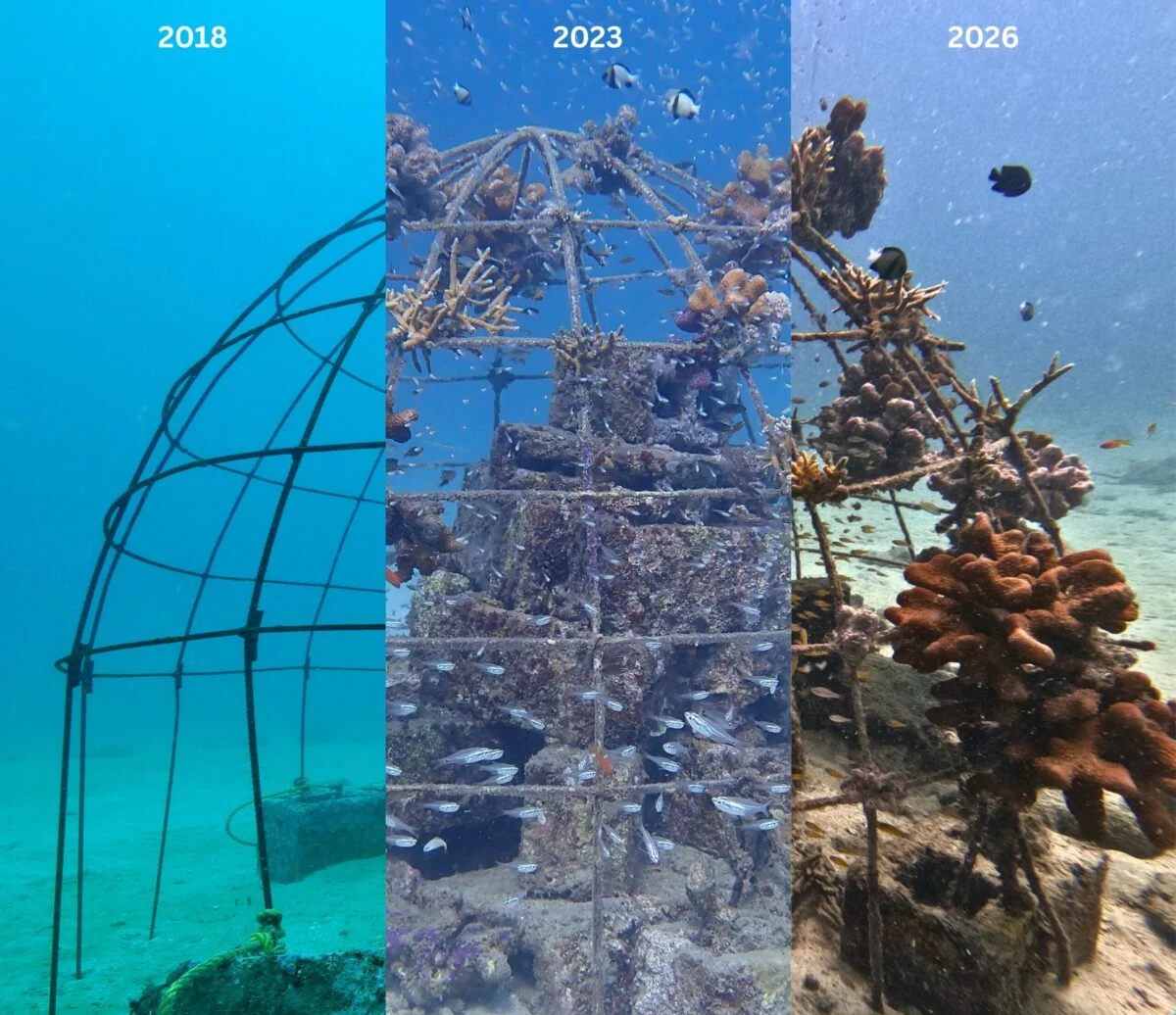
In India, the situation is mirrored by local pressures. Pollution from land-based runoff, destructive fishing practices (such as bottom trawling), coastal industrialization, and sedimentation have placed immense stress on the country’s 2,375 square kilometers of reef area. To combat this decline, a multi-decade, multi-regional restoration effort has been mobilized across India’s maritime boundaries, utilizing everything from traditional transplantation to cutting-edge "Biorock" technology.
Chronology: From Recognition to Active Recovery
The evolution of coral restoration in India has moved from small-scale academic experiments to large-scale, multi-stakeholder conservation programs.
![How are degraded coral reefs restored in India? [Explainer]](https://imgs.mongabay.com/wp-content/uploads/sites/30/2026/05/26090949/Creation-of-coral-garden_Mithapur-768x512.jpg)
- The 1970s: Globally, the concept of active reef restoration began to take root as scientists realized that passive protection was no longer sufficient to counter the rate of degradation.
- 2002: India’s most significant restoration journey began in the Gulf of Mannar. Led by the Suganthi Devadason Marine Research Institute (SDMRI), this marked the first systematic attempt to rebuild degraded fringing reefs using artificial substrates.
- 2008–2012: The focus expanded to the West Coast. The Mithapur Coral Reef Recovery Project was launched as a joint venture between the Wildlife Trust of India (WTI) and the Gujarat Forest Department. By 2012, the project shifted toward the creation of massive artificial reef structures using limestone and basalt.
- 2016: Restoration efforts reached the remote Lakshadweep Archipelago, where a coral nursery was established in the Kavaratti atoll to salvage fragments from the lagoon.
- 2018: ReefWatch Marine Conservation initiated restoration in the Andaman and Nicobar Islands, focusing on "corals of opportunity"—naturally broken fragments that are rescued and stabilized.
- 2020–2024: Technological sophistication increased with the deployment of "Biorock" technology off the coast of Mithapur, Gujarat. Simultaneously, the National Centre for Coastal Research (NCCR) began experimental restoration in Palk Bay.
- 2024–2026: Recent data indicates an expansion of these programs, with the Gulf of Mannar project moving into adjacent Palk Bay and long-term monitoring providing the first comprehensive evidence of fish biomass recovery.
Supporting Data: Regional Successes and Methodologies
India’s restoration efforts are spread across four primary reef regions, each presenting unique ecological challenges and rewarding scientists with varying success rates.
The Gulf of Mannar and Palk Bay: The Pioneer Frontier
The Gulf of Mannar, containing 21 islands, holds approximately 76 sq km of reef. The SDMRI’s 20-year longitudinal study is a testament to the efficacy of long-term intervention.
![How are degraded coral reefs restored in India? [Explainer]](https://imgs.mongabay.com/wp-content/uploads/sites/30/2026/05/26123127/Upputhanni-Island-Aerial-View-768x512.jpg)
- Scale: Over 51,000 coral fragments representing 20 native species have been transplanted across 40,000 square meters.
- Survival and Growth: Survival rates range from 55% to 80%. Notably, transplanted Acropora (branching corals) grew at 10 cm per year, outperforming natural reefs (8 cm/year).
- Biodiversity Impact: Live coral cover increased sevenfold between 2006 and 2020. Most strikingly, fish density in these restored zones soared 21-fold, directly replenishing local fishing grounds.
In the nearby Palk Bay, NCCR’s experimental sites at Thonithurai and Munaikadu have shown that branching species like Acropora muricata (staghorn coral) can achieve monthly growth rates of 0.67 cm. Within just nine months of transplantation, researchers recorded over 1,000 individual fish from seven families, including rabbitfish and damselfish.
Mithapur, Gujarat: Innovation Through "Biorock"
The Gulf of Kachchh is a high-stress environment characterized by heavy sediment and extreme tidal ranges. Here, the Mithapur project has deployed 2,310 artificial reefs.
![How are degraded coral reefs restored in India? [Explainer]](https://imgs.mongabay.com/wp-content/uploads/sites/30/2026/05/26125429/After-a-year-Acropora-muricata-768x512.jpg)
- Biorock Technology: Between 2020 and 2024, five Biorock structures were installed. This technology uses low-voltage solar or battery electricity to trigger mineral accretion (calcium carbonate) on steel frames. This "electrified" skeleton allows corals to divert energy from building skeletons to growth and reproduction, making them more resilient to temperature spikes.
- Fisheries Recovery: The "catch per unit effort" for local fishers—a key metric of economic health—increased tenfold by the end of 2025. Live coral cover on natural reefs in the area rose from 11% in 2008 to 19% by late 2025.
The Islands: Andaman, Nicobar, and Lakshadweep
The Andaman and Nicobar Islands hold India’s largest coral area (1,021 sq km). Here, ReefWatch has focused on semi-spherical artificial structures. By March 2026, these reefs showed a survival rate of 55% and an annual growth of 9.4 cm. While the number of species fluctuated, the total number of individual marine organisms surged to over 3,000 by 2026.
In the Lakshadweep atolls, the focus has been on the lagoon of Kavaratti. Survival rates here have been among the highest in the country, ranging from 64% to a staggering 99%. Fast-growing Acropora species reached lengths of 31.1 cm within the study period, while massive corals like Pocillopora damicornis showed significant volumetric expansion.
![How are degraded coral reefs restored in India? [Explainer]](https://imgs.mongabay.com/wp-content/uploads/sites/30/2026/05/26091643/Creating-artificial-reefs-PC-Charan-Kumar-PaidiWTI-1200x900.jpg)
Official Responses: Policy and Scientific Perspectives
The success of these projects is underpinned by India’s stringent legal framework. Corals are afforded the highest level of protection under Schedule I of the Wildlife (Protection) Act, 1972. This places them on par with the Bengal Tiger, making the collection or trade of even dead coral a criminal offense punishable by up to seven years in prison.
Dr. Edward Patterson, Director of SDMRI, emphasizes the reproductive success of these efforts. "Restored corals become sexually mature within four years, helping to expedite the natural recovery rate. We have recorded successful coral spawning and gamete development among the restored colonies," he stated. He also noted that healthy reefs act as "sand factories," providing the sediment necessary to stabilize the coastlines of low-lying islands against sea-level rise.
![How are degraded coral reefs restored in India? [Explainer]](https://imgs.mongabay.com/wp-content/uploads/sites/30/2026/05/26130514/After-four-years-Acropora-spp-1200x900.jpg)
Koushik Sadhukhan, a scientist with the NCCR, points out that restoration is about more than just coral. "The high abundance of fish recorded just nine months after transplantation suggests that coral restoration supports reef-associated fisheries and broader biodiversity recovery," Sadhukhan explained.
From the technical side, B.M. Praveen Kumar of the Mithapur project highlights the shift in ecosystem health: "Slowly, the reef is transforming from an algal-dominated system to a more resilient reef system." This shift is crucial, as algae often outcompete corals in polluted or overfished waters where herbivorous fish are absent.
![How are degraded coral reefs restored in India? [Explainer]](https://imgs.mongabay.com/wp-content/uploads/sites/30/2026/05/26130001/Palk-Bay-1d-768x512.jpg)
Implications: Resilience in a Warming World
The implications of India’s coral restoration journey are profound for the future of marine conservation in the Global South.
- Climate Adaptation: As the Indian Ocean continues to warm, the success of "Biorock" and the selection of heat-resilient genotypes for nurseries provide a blueprint for "climate-proofing" marine ecosystems.
- Food Security: The 21-fold increase in fish density in the Gulf of Mannar proves that coral restoration is a viable strategy for sustainable fisheries management. By creating "no-take" zones around restoration sites, the "spillover effect" ensures that adjacent fishing grounds remain productive.
- Coastal Protection: With rising sea levels, the role of reefs as natural breakwaters is irreplaceable. Mechanical seawalls are expensive and environmentally damaging; living reefs, conversely, are self-repairing barriers that grow with the sea level.
- Economic Potential: Beyond fisheries, restored reefs offer significant potential for sustainable eco-tourism. The clarity of water and the return of "cryptofauna" and colorful fish species create high-value diving and snorkeling destinations, providing alternative livelihoods for coastal communities.
However, scientists warn that restoration is not a "get out of jail free" card for carbon emissions. While human-led efforts can bridge the gap and prevent total extinction, the long-term survival of India’s reefs depends on global success in limiting atmospheric warming. For now, the concrete frames, Biorock structures, and nursery tables scattered across India’s seabed serve as a vital, high-tech life-support system for the "rainforests of the sea."