In the mist-shrouded ridges of the Darjeeling district, where the Singalila National Park meets the ancient, oak-dominated forests of West Bengal, a peculiar sound often pierces the heavy, humid air. It is a rhythmic, descending series of notes—a sound many locals describe as "maniacal, falling laughter." For the communities of Sirikhola and Gurdum, this is not merely the song of a bird; it is a meteorological forecast more reliable than any satellite-derived data.
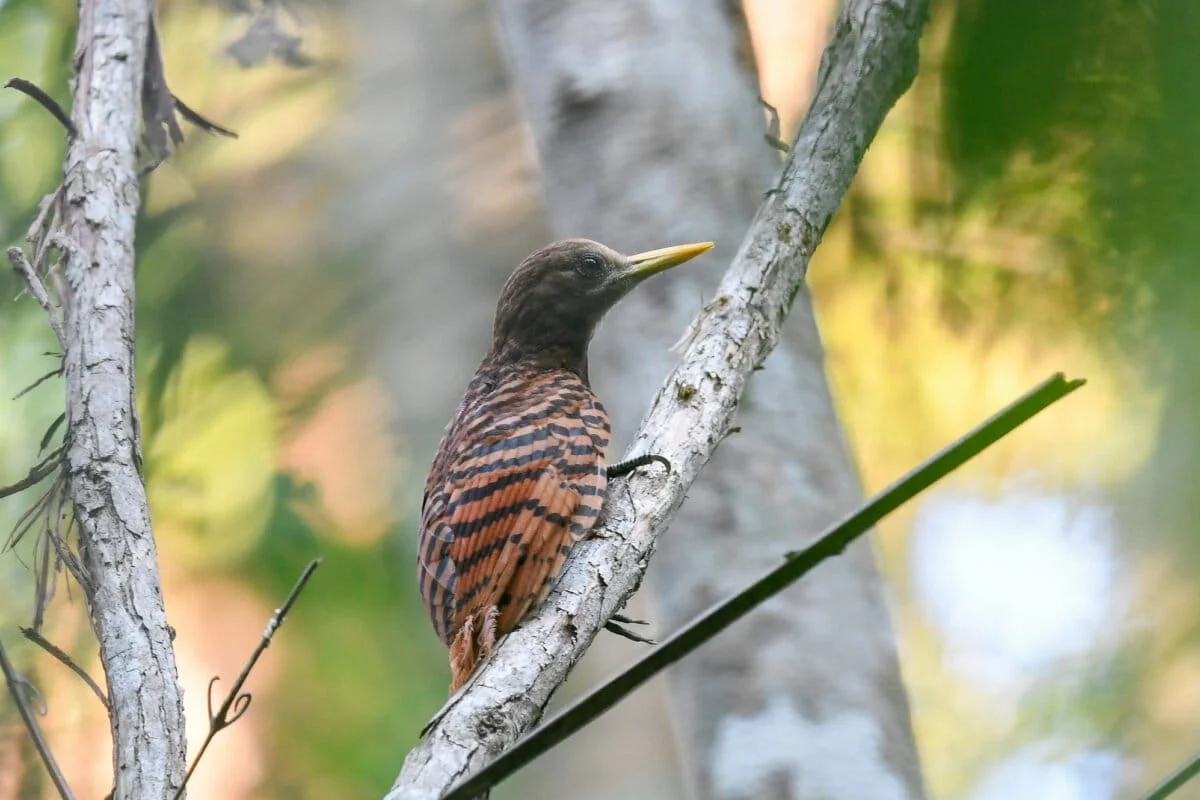
The Bay Woodpecker (Blythipicus pyrrhotis), a bird of deep chestnut plumage and elusive habits, has long occupied a central place in the cultural landscape of the Eastern Himalayas. Known as the "rain-calling bird," its vocalizations are believed by village elders to signal imminent downpours. While once dismissed by some as mere superstition, recent ecological research suggests that this indigenous wisdom is rooted in a sophisticated observation of nature’s rhythms.
Main Facts: The Bird and the Belief
The Bay Woodpecker is a medium-sized specialist of the dense, mature forests of Southeast Asia and the Himalayas. Measuring approximately 30 centimeters in length, it is characterized by its rich, velvety red-brown or rufous-chestnut plumage. Unlike many of its more flamboyant cousins, the Bay Woodpecker is notoriously shy, preferring the dark, mossy mid-canopy of primary forests where it forages for larvae and insects.
In the rural villages of Darjeeling and North Sikkim, particularly among the Lepcha and Tamang communities, the bird is a harbinger of change. The belief holds that when the bird’s distinctive call—a rapid series of notes that drops in pitch and slows down as it progresses—is heard during the day, rain will follow within hours. If heard in the evening, the following morning is guaranteed to be wet.
This belief has practical implications for the agrarian life of the hills. For the Lepcha people, considered the indigenous inhabitants of the Darjeeling-Sikkim region, the bird’s call is often met with a sense of urgency or even mild frustration. In villages like Dzongu in North Sikkim, hearing the "rain-caller" while working in the fields is a signal to pack up tools and secure crops before the agricultural work is cut short by the elements.
![A bird call that signals rains [Commentary]](https://imgs.mongabay.com/wp-content/uploads/sites/30/2026/05/25095719/Blythipicus_pyrrhotis_545764671-1200x800.jpg)
Chronology: From Village Legend to Field Discovery
The journey of documenting this intersection of folklore and science began not in a laboratory, but on the forest trails of the Singalila fringe. Aditya Pradhan, a conservation biologist and project leader at the Ashoka Trust for Research in Ecology and the Environment (ATREE), first encountered the legend through Mingma Tamang, an experienced field technician.
The Childhood Memory
Mingma Tamang grew up in the deep forest villages near Singalila. He recalled his father and the village elders stopping in their tracks whenever the "tumbling" sound of the bird echoed through the valley. "The bird has called," they would say with a quiet certainty. "Rain will come." For years, the bird remained a ghost—a voice without a face—until Pradhan’s doctoral research brought them into the heart of the woodpecker’s habitat.
The First Sighting
The transition from legend to observation occurred during an early morning field excursion along the fringes of Singalila National Park. After months of hearing the "rain-calling" story, Pradhan and Tamang finally located the source of the sound: a deep chestnut bird clinging to the mossy trunk of a Nepalese alder (Alnus nepalensis). It was the Bay Woodpecker.
For Tamang, it was the first time he could match the sound of his childhood stories to a physical form. For Pradhan, it was the beginning of a years-long inquiry into why this specific bird had become the focus of such precise local weather predictions.
The Consistency of the Pattern
Throughout his Ph.D. fieldwork, Pradhan began to test the "superstition" against the reality of the mountain weather. He noted a curious and unsettling consistency: whenever the Bay Woodpecker called during his evening surveys, he found himself packing rain gear for the next morning. The pattern repeated itself with such frequency that it ceased to be a coincidence and became a reliable field indicator for the research team.
![A bird call that signals rains [Commentary]](https://imgs.mongabay.com/wp-content/uploads/sites/30/2026/05/25100516/Photo-4-768x512.jpg)
Supporting Data: Why the "Rain-Caller" Predicts the Storm
To understand why the Bay Woodpecker might "bring" the rain, one must look at the intersection of avian physiology, acoustics, and entomology. Science suggests several plausible explanations for why this bird becomes more vocal before a storm.
1. Acoustic Propagation and Humidity
Dense, temperate oak forests undergo significant micro-climatic shifts in the hours preceding a rain event. As humidity rises, the density of the air changes, which can alter the way sound waves travel through the thick canopy. High moisture content in the air can amplify certain frequencies, making the Bay Woodpecker’s call carry further and sound more resonant. It is possible that the bird calls regularly, but its "rain-calling" vocalization is simply more audible to human ears when the atmosphere is primed for rain.
2. The Response to Barometric Pressure
Many bird species are sensitive to changes in barometric pressure. A drop in pressure, which typically precedes a storm, may trigger specific behavioral responses. For a specialist like the Bay Woodpecker, these changes might signal a "last call" for foraging or a territorial advertisement before the heavy rains force the bird into a period of inactivity.
3. Insect Activity and Foraging
The Bay Woodpecker’s primary food source—insects and larvae—often becomes more active or moves toward the surface of tree bark as humidity increases and pressure drops. This surge in prey activity can trigger heightened foraging behavior and, by extension, increased vocalization as birds interact or defend their foraging patches.
4. Habitat Specificity
Pradhan’s research highlighted that the Bay Woodpecker is an "interior forest specialist." It is strongly associated with mature forests characterized by high tree density, large diameters, and a closed canopy. These environments are the most sensitive to moisture retention and are the first to exhibit the "pre-rain" atmospheric shifts that the bird seems to react to.
![A bird call that signals rains [Commentary]](https://imgs.mongabay.com/wp-content/uploads/sites/30/2026/05/25100950/Photo-1-768x512.jpg)
Official Responses and Expert Perspectives: Woodpeckers as Ecosystem Sentinels
Ecologists at ATREE and other conservation organizations argue that the importance of the Bay Woodpecker extends far beyond its role as a local weather vane. Woodpeckers are increasingly recognized as "indicator species" for forest health.
The Health of the Forest
"Woodpeckers do more than survive in these landscapes; they signal how well forests are functioning," Pradhan notes. His research indicates that areas supporting the Bay Woodpecker are usually "hotspots" for avian diversity. Because woodpeckers are primary cavity nesters, they create homes for dozens of other species—from owls to squirrels—making them keystone engineers of the Himalayan woods.
The Darjeeling Hotspot
The Darjeeling region is a critical global hub for woodpecker diversity. It hosts 21 distinct species locally, contributing significantly to India’s total of 32 species. Of these, 25 are found in the Indian Himalayan region. However, despite this richness, woodpeckers remain one of the least-studied bird groups in India. Most research has historically focused on the Western Ghats or the Western Himalayas, leaving the Eastern Himalayas—a landscape of tea gardens, community-managed forests, and agroforests—largely overlooked.
The Importance of Non-Protected Areas
A significant finding from recent studies is the role of human-managed landscapes. While the Bay Woodpecker requires mature forest, other species thrive in the "mosaic" landscapes of Darjeeling. Pradhan’s research reveals that non-protected, community-managed forests often support surprisingly high abundances of woodpeckers, provided there is a mix of tree sizes and standing deadwood. This suggests that conservation efforts must move beyond the boundaries of National Parks to include the "agroforests" managed by local communities.
Implications: Safeguarding Resilience and Indigenous Knowledge
The story of the Bay Woodpecker carries profound implications for how we approach conservation in the 21st century. It highlights the necessity of integrating "Traditional Ecological Knowledge" (TEK) with modern biological research.
![A bird call that signals rains [Commentary]](https://imgs.mongabay.com/wp-content/uploads/sites/30/2026/05/25095939/Photo-3-768x512.jpg)
Validating Indigenous Wisdom
The "rain-calling" bird serves as a reminder that local communities possess a "finely tuned reading of nature’s cues" that science is only beginning to quantify. By acknowledging the accuracy of these folk beliefs, conservationists can build better rapport with indigenous groups, turning them into active partners in forest protection.
The Threat of Landscape Homogenization
As the Eastern Himalayas face pressure from development, infrastructure projects, and the conversion of diverse forests into monoculture plantations, the specialists like the Bay Woodpecker are the first to disappear. When a forest loses its "rain-caller," it isn’t just losing a bird; it is losing a piece of its ecological "early warning system." The disappearance of these birds signals a breakdown in forest complexity—a thinning of the canopy and a loss of the deadwood necessary for the ecosystem to function.
A Bridge Between Two Worlds
For the people of Sirikhola-Gurdum, the Bay Woodpecker remains a messenger. For the scientist, it is a data point in a larger study of biodiversity. Both perspectives lead to the same conclusion: the health of the Darjeeling forests is inextricably linked to the survival of the birds that live within them.
In the end, whether the bird "calls" the rain or simply reacts to its approach is a matter of semantics. The true value lies in the listening. As Pradhan concludes, listening to the woodpecker—as local communities have done for generations—is ultimately a way of listening to the pulse of the forest itself. In a world of rapidly changing climates, these ancient signals may be more important than ever for safeguarding the resilience of the Himalayan landscape.