

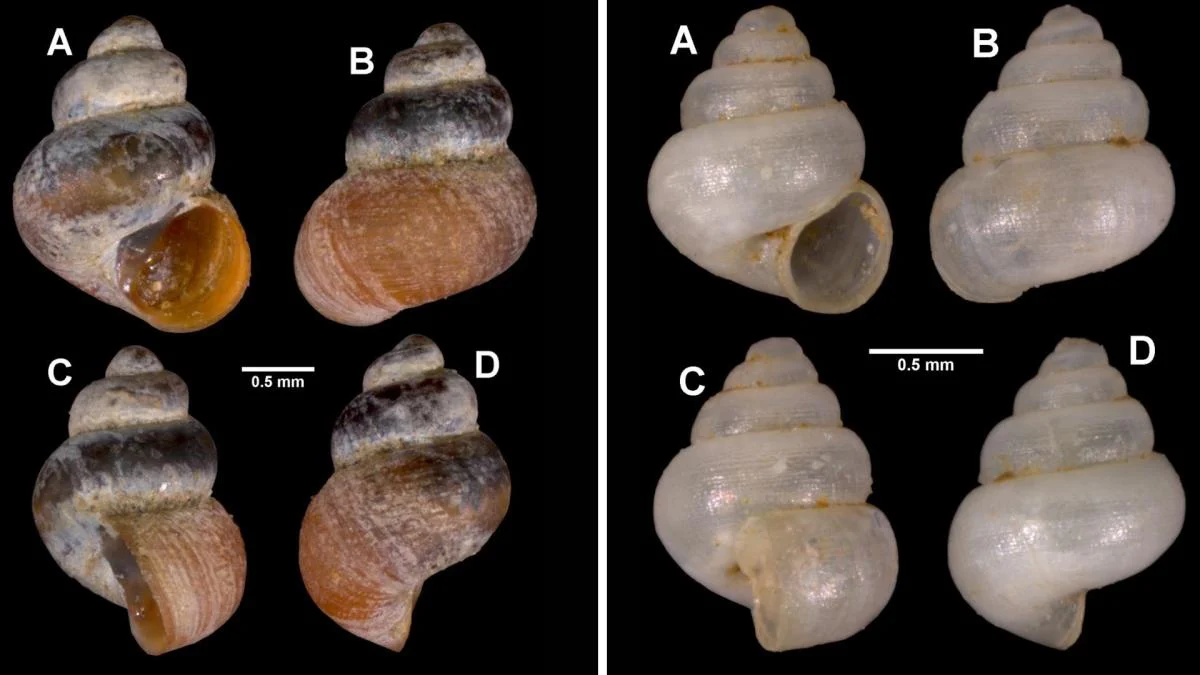
SHILLONG, MEGHALAYA — In the damp, labyrinthine depths of Northeast India’s limestone corridors, a scientific breakthrough has illuminated the "unseen" biodiversity of one of the world’s most critical ecological zones. Researchers have announced the discovery of two new species of cave-dwelling micro-snails, Georissa meghalayaensis and Acmella bensoni, found within the ancient cave systems of Meghalaya.
The discovery, published in the prestigious European Journal of Taxonomy, was spearheaded by scientists Nipu Kumar Das and Neelavar Ananthram Aravind from the Ashoka Trust for Research in Ecology and the Environment (ATREE). These findings underscore the biological richness of the Indo-Burma biodiversity hotspot while simultaneously sounding an alarm regarding the impact of unregulated cave tourism on fragile subterranean ecosystems.
Main Facts: A Glimpse into the Miniature World
The discovery centers on two distinct species of mollusks that are so small they often evade the naked eye. Found in the Krem Puri and Arwah cave systems, these micro-snails represent a specialized evolution adapted to the high-calcium, high-humidity environments of Meghalaya’s limestone formations.
Georissa meghalayaensis
Named after the state of Meghalaya, this species was located primarily near the entrance of the Krem Puri cave. It is characterized by its vibrant orangish-red coloration and an intricate, mesh-like pattern of ridges that cover its shell. Unlike its closest relatives, which typically feature yellowish shells and widely spaced spiral lines, G. meghalayaensis exhibits a level of morphological complexity that suggests a long period of isolated evolution within the region.

Acmella bensoni
The second species, Acmella bensoni, was discovered deeper within the recesses of both Krem Puri and Arwah caves. This snail is notably smaller and possesses a semi-transparent, whitish shell. Its surface is marked by deeply impressed grooves and a fine, dense pattern of ribs that give it a polished, almost smooth appearance under magnification. The species was named in honor of William H. Benson, a 19th-century pioneer whose work laid the foundation for Indian malacology (the study of mollusks).
Chronology of the Discovery
The journey to identifying these species began with a series of expeditions into the extensive cave networks of the Jaintia and Khasi Hills. While Meghalaya is home to over 1,200 documented caves, many remain biologically unexplored due to their difficult terrain and the specialized equipment required for subterranean research.
- Field Exploration (Early 2024–2025): Researchers from ATREE conducted systematic surveys of the Krem Puri (known as the world’s longest sandstone cave, though containing significant limestone deposits) and Arwah cave systems. The team focused on the "twilight zones" and "dark zones" of the caves, where humidity remains constant.
- Sample Collection: Using fine brushes and magnifying lenses, the researchers collected specimens from cave walls and floor debris. Given their microscopic size—often less than 2-3 millimeters—the collection process required extreme precision.
- Laboratory Analysis: Back at the ATREE laboratories, the specimens underwent rigorous morphological analysis. Scientists used Scanning Electron Microscopy (SEM) to document the intricate shell patterns, which are the primary diagnostic features used to distinguish micro-snail species.
- Comparative Study: The team compared the new specimens with existing records of malacofauna from across Southeast Asia, China, and mainland India.
- Publication (June 20, 2026): The findings were formally peer-reviewed and published, establishing G. meghalayaensis and A. bensoni as new additions to the global taxonomic record.
Supporting Data: The Indo-Burma Biodiversity Hotspot
The discovery of these snails is significant not just for malacology, but for our broader understanding of the Indo-Burma biodiversity hotspot. This region is a "melting pot" of species where the fauna of the Indian subcontinent meets that of Southeast Asia and Southern China.
The Role of Calcium-Rich Environments
Meghalaya’s geology is dominated by limestone, a sedimentary rock composed largely of calcium carbonate. For mollusks, this is an essential resource. Snails require calcium to build and maintain their shells; consequently, limestone-rich regions often host a disproportionately high diversity of snail species compared to non-calcareous landscapes.

Regional Records and Expansion
Beyond the two new species, the ATREE study also documented new regional records of other micro-snails in the neighboring states of Manipur and Mizoram. This suggests that the entire Northeastern corridor of India may be home to hundreds of undiscovered invertebrate species that play vital roles in the decomposition process and the cave food web.
Taxonomic Context
The genus Georissa is known for its wide distribution across the Indo-Pacific, yet many of its species are endemic to very small geographic ranges—sometimes a single cave or hill. This high level of "site-specific endemism" makes them particularly vulnerable to extinction, as the destruction of a single cave could mean the total loss of a species.
Official Responses and Expert Insight
In the wake of the publication, members of the scientific community have emphasized the dual nature of this discovery: it is a celebration of nature’s complexity and a warning of its fragility.
Nipu Kumar Das, one of the lead researchers, noted that while the discovery of new species is exciting, the environmental conditions within these caves are changing rapidly. "These snails are indicators of a healthy, undisturbed cave ecosystem," Das stated. "The fact that we are finding them now, even as human activity in these caves increases, is a testament to the hidden resilience of these environments—but that resilience has limits."

Conservationists have pointed out that the naming of Acmella bensoni after William H. Benson is a symbolic bridge between the classical era of natural history and modern conservation science. Benson’s work in the 1800s described many of India’s large land snails, but he lacked the technology to fully explore the "micro-world" that modern researchers are only now beginning to map.
Implications: Tourism and the Threat to Fragile Ecosystems
The most pressing concern raised by the ATREE researchers involves the rise of "adventure tourism" in Meghalaya. Caves like Arwah and Krem Puri have become popular destinations for both domestic and international tourists, leading to significant structural and environmental modifications.
The Impact of Infrastructure
To accommodate tourists, many caves have been outfitted with:
- Artificial Lighting: Constant light in naturally dark environments promotes the growth of "lampenflora" (algae and mosses that do not belong in caves), which can overgrow the rock surfaces where micro-snails live and feed.
- Concrete Staircases and Walkways: These structures destroy the natural floor substrate and alter the humidity levels of the cave.
- Heavy Foot Traffic: The physical presence of hundreds of visitors daily can inadvertently crush microscopic life forms and disturb the delicate "cave breath" (the natural airflow and moisture exchange).
Ecological Risks
Micro-snails are often the primary consumers of biofilm and fungi in cave systems. Their removal or decline could trigger a "bottom-up" ecological collapse, affecting the larger cave-dwelling organisms such as spiders, crickets, and bats that rely on a functioning subterranean food chain.

Conclusion: A Call for Sustainable Speleology
The discovery of Georissa meghalayaensis and Acmella bensoni serves as a powerful reminder that much of Earth’s biodiversity remains hidden beneath our feet. As Meghalaya continues to position itself as a global hub for eco-tourism, the findings by ATREE suggest that "eco-tourism" must be strictly defined and managed.
Experts recommend a shift toward "low-impact speleology," which includes:
- Limiting the number of daily visitors to sensitive cave systems.
- Using "cold" lighting or motion-sensor lights to prevent the growth of invasive flora.
- Designating specific caves as "scientific reserves" where tourism is prohibited to allow for long-term biological monitoring.
As the scientific community continues to peel back the layers of the Indo-Burma hotspot, the tiny residents of the Krem Puri and Arwah caves stand as silent witnesses to the need for a more balanced relationship between human curiosity and environmental preservation. The survival of these "chemical sponges" and "miniature architects" depends entirely on our willingness to protect the dark, damp corners of the world that they call home.
