

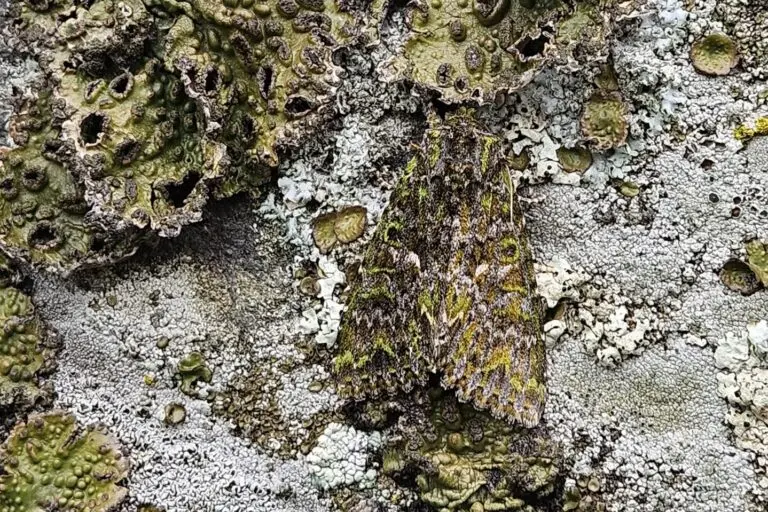
CHAMBA, HIMACHAL PRADESH — In the high-altitude reaches of the Western Himalayas, where the air thins and the landscape is dominated by rugged rock faces and resilient flora, a subtle evolutionary drama has been unfolding, unnoticed by science until now. A groundbreaking study published in the prestigious journal Arthropod-Plant Interactions has documented the first known instance of a moth utilizing the umbilicate lichen, Lasallia pertusa, as a primary camouflage substrate.
The discovery, made in the remote Kugti Wildlife Sanctuary of Himachal Pradesh, marks a significant shift in our understanding of insect-lichen associations. While moths have long been known to mimic the textures of bark and crustose lichens, this new record involves a more complex growth form—the umbilicate lichen—expanding the known visual and survival strategies of montane lepidoptera.
Main Facts: A Breakthrough in Crypsis
The core of this discovery lies in the concept of "crypsis," a form of camouflage where an organism matches the visual characteristics of its immediate environment to avoid detection by predators. While crypsis is a well-documented survival mechanism across the animal kingdom, the specific relationship between the moth and Lasallia pertusa is unprecedented.
The Subject and the Substrate
The moth in question belongs to the family Noctuidae, commonly known as owlet moths. This family is one of the largest in the order Lepidoptera, characterized by their robust bodies and often dull, cryptic forewings that allow them to blend into their surroundings during daylight hours. However, the exact species of the moth remains a mystery. Because the researchers were unable to collect a physical specimen at the time of observation, identification was limited to high-resolution photographic analysis and expert consultation.
The lichen, Lasallia pertusa, is an "umbilicate" lichen. Unlike crustose lichens that grow flat against a surface like a coat of paint, or fruticose lichens that are shrub-like, umbilicate lichens are "foliose" (leaf-like) and are attached to their rocky substrate at a single central point, known as an umbilicus. L. pertusa is particularly distinctive due to its large, perforated, and highly irregular thallus (the vegetative body of the lichen). This creates a complex, heterogeneous visual field of shadows, holes, and varying textures.
Geographical Significance
The observation occurred at an elevation of approximately 3,200 meters (10,500 feet) in the Duggi area of the Kugti Wildlife Sanctuary. This region is part of the Chamba district in Himachal Pradesh, an area renowned for its high levels of endemism and specialized alpine biodiversity. At such altitudes, the survival of small ectotherms like moths depends heavily on their ability to remain invisible to sharp-eyed avian and reptilian predators.
Chronology: From Field Observation to Scientific Record
The journey of this discovery began in the peak of the Himalayan summer, a time when the brief window of warmth triggers a flurry of biological activity in the alpine zones.
- July 2025: During a field survey in the Kugti Wildlife Sanctuary, researcher Sanjay Kumar Unniyal and his team were exploring the rocky outcrops of Duggi. It was here that they noticed a seemingly anomalous shape on a patch of Lasallia pertusa. Upon closer inspection, the "anomaly" revealed itself to be a Noctuidae moth, perfectly aligned with the lichen’s irregular perforations and grey-green hues.
- Late 2025 – Early 2026: Following the field observation, the team conducted a thorough literature review. They analyzed existing records of lichen-associated camouflage in insects, specifically looking for mentions of umbilicate forms. Finding none, they moved toward formalizing their findings.
- Publication (2026): The study underwent rigorous peer review and was eventually published in Arthropod-Plant Interactions. The paper, titled to reflect the novelty of the umbilicate association, highlighted the importance of visual heterogeneity in crypsis.
Supporting Data: The Science of Visual Matching
The research emphasizes that the effectiveness of the moth’s camouflage is rooted in the physical structure of Lasallia pertusa.
The Complexity of the Thallus
The thallus of L. pertusa is not a uniform surface. It is riddled with "perforations"—natural holes—and irregular lobes. For a moth, this provides a "high-frequency" visual background. According to the study, the moth’s wing patterns effectively mimic the shadows cast by these perforations and the mottled texture of the lichen’s surface. This reduces the "signal-to-noise" ratio for any predator scanning the rock face, making the moth nearly indistinguishable from the lichen.
Predator Dynamics
While the study was primarily observational, the researchers identified the most likely "selection pressures"—the predators that drive the evolution of such camouflage. In the high-altitude environment of Chamba, these include:
- High-altitude Birds: Species such as redstarts and accentors that frequent rocky slopes and rely on keen eyesight to spot insects.
- Montane Lizards: Predators that hunt based on movement and contrast.
The paper argues that by choosing L. pertusa over more uniform rock surfaces or simpler crustose lichens, the moth gains a significant advantage in "background matching," one of the most widespread but difficult-to-master camouflage strategies.

Technical Limitations
The authors are transparent about the study’s limitations. As a purely observational record, it did not involve "blue-jay experiments" or computer-modeled predator vision tests to quantify exactly how much the camouflage improves survival rates. Furthermore, the lack of a specimen means the exact species of the Noctuidae moth remains unconfirmed, leaving a gap for future entomological surveys.
Official Responses and Expert Insight
Sanjay Kumar Unniyal, one of the primary authors of the study, spoke with Mongabay-India to provide context on the discovery’s importance.
"Though there have been similar observations of moths mimicking lichens in the past, this particular lichen species has been documented for the first time in this context," Unniyal stated. He emphasized that the discovery is more than just a natural history footnote. "This might have an evolutionary consequence which can only be understood through further studies."
Unniyal’s comments suggest that the relationship between moths and umbilicate lichens might be an example of specialized evolution. If certain moth populations are specifically selecting L. pertusa over other substrates, it could indicate a deep-seated evolutionary tie that influences the distribution of both the insect and the lichen.
Other experts in Himalayan ecology have noted that the study highlights the "unseen" biodiversity of the region. While large mammals like the snow leopard or Himalayan brown bear garner most of the conservation attention in Kugti Wildlife Sanctuary, the intricate relationships between fungi (lichens) and insects are equally vital to the ecosystem’s health and complexity.
Implications: Why an Inconspicuous Lichen Matters
The discovery of this moth-lichen association has several far-reaching implications for ecology, evolutionary biology, and conservation.
1. Expanding the Scope of Crypsis
Until now, most studies on lichen camouflage in moths focused on bark-dwelling species (famously the Peppered Moth) or those on flat, crustose lichens. By proving that umbilicate lichens—with their three-dimensional, leaf-like structures—also serve as camouflage backgrounds, this study expands the known "visual vocabulary" of insect survival. It suggests that lepidopterists and ecologists should look more closely at foliose lichens as critical micro-habitats.
2. The Importance of Micro-Habitats
The study underscores the fact that seemingly "inconspicuous" organisms like Lasallia pertusa play a disproportionately large role in the survival of other species. In the harsh 3,200m environment, these lichens are not just organisms; they are essential infrastructure. They provide the "visual environment" that allows prey species to persist in the presence of predators.
3. Conservation of High-Altitude Ecosystems
Kugti Wildlife Sanctuary is a protected area, but its management often focuses on larger fauna. This research argues for a more holistic approach to conservation that includes "lower" life forms. If lichen populations are affected by climate change or air pollution (as lichens are notoriously sensitive to air quality), the cascading effects could deprive moths and other insects of their primary defense mechanisms, leading to a decline in biodiversity that might go unnoticed until it is too late.
4. Future Research Directions
The findings open the door for several new lines of inquiry:
- Species Identification: Future expeditions to Duggi will aim to collect a specimen of the moth for DNA barcoding and formal description.
- Experimental Testing: Biologists may now use clay moth models placed on different lichen types to experimentally verify whether L. pertusa provides a statistically significant survival advantage compared to other backgrounds.
- Climate Change Impact: As alpine treelines shift and temperatures rise, the distribution of L. pertusa may change. How this will affect the cryptic insects that rely on them remains a critical question for the coming decades.
Conclusion
The discovery in the Chamba district is a reminder that even in the 21st century, the natural world holds secrets that can be found simply by looking closer at a rock. The moth camouflaged against Lasallia pertusa is a masterpiece of natural selection—a testament to the infinite ways in which life adapts to the rigors of the high Himalayas. As Sanjay Kumar Unniyal and his colleagues have shown, understanding these tiny interactions is key to grasping the larger, complex tapestry of life on our planet.
