

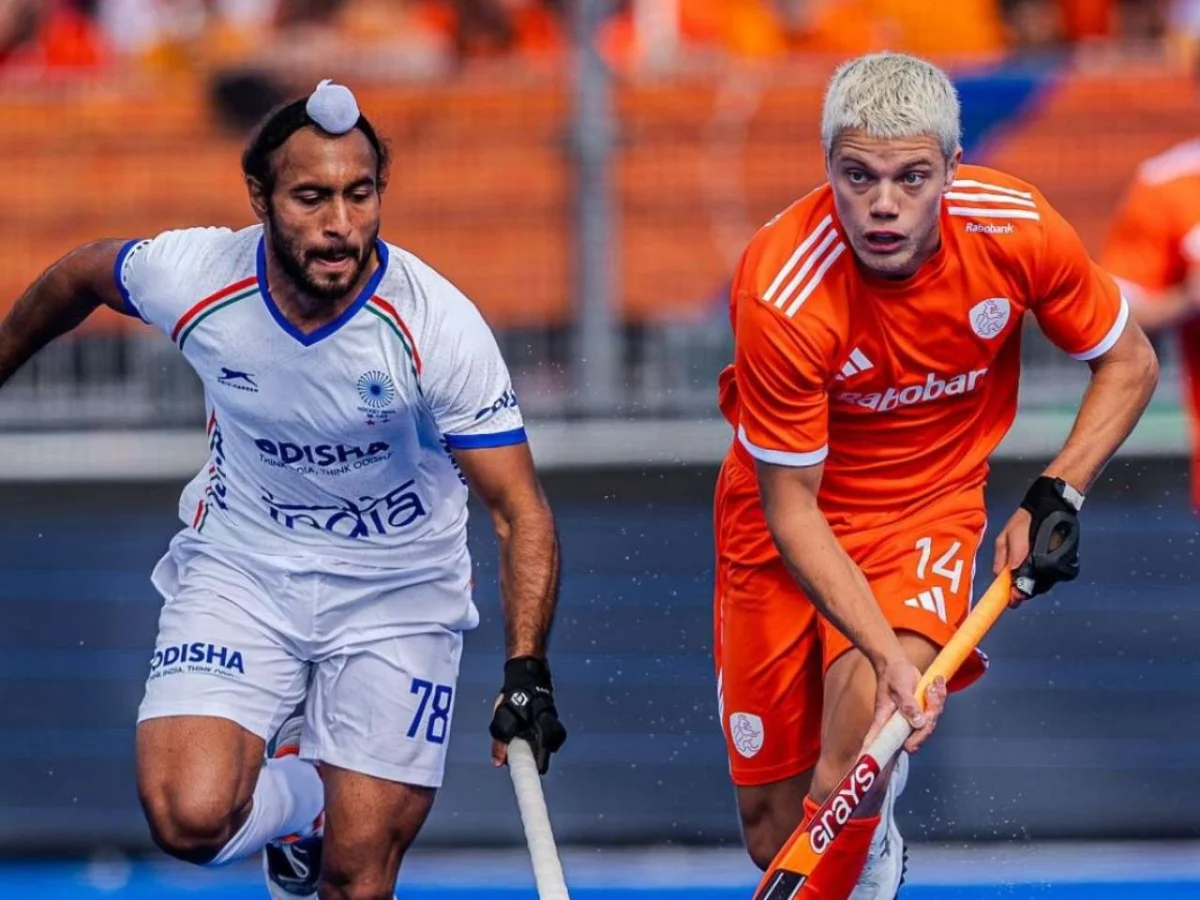
Amstelveen, Netherlands – August 22, 2026 – The vibrant atmosphere of the Wagener Stadium, pulsating with the hopes of a nation, turned sombre for Indian hockey fans as the Men in Blue succumbed to a decisive 3-1 defeat against co-hosts Netherlands in their crucial FIH Hockey World Cup 2026 Pool A encounter. This result has delivered a significant blow to India’s aspirations of reaching the semi-finals, leaving their campaign hanging by a precarious thread with just one group stage match remaining.
What was billed as a pivotal clash between two hockey powerhouses, with both sides eyeing top honours, lived up to its billing in terms of intensity and tactical battle. However, it was the clinical finishing and relentless pressure from the Oranje that ultimately prevailed, much to the delight of their vociferous home crowd. For India, coached by the astute Craig Fulton, the loss underscores the fine margins at the elite level of international hockey and highlights areas demanding immediate attention as they brace for a do-or-die final group stage fixture.
Main Facts: A Dream Deferred
India’s quest for a podium finish at the FIH Men’s Hockey World Cup 2026 faced a severe setback following their 1-3 loss to the Netherlands. Playing at the iconic Wagener Stadium in Amstelveen, the Indian squad, despite displaying flashes of brilliance and tenacious defence, ultimately faltered under sustained Dutch pressure in the second half. The defeat means that India’s path to the semi-finals is no longer in their sole control; they must now secure a comprehensive victory in their final pool game and rely on favourable outcomes from other matches to keep their medal hopes alive.
The match, a second-round fixture in Pool A, saw a tactical battle unfold, particularly in a cagey first half that ended scoreless. However, the deadlock was broken by Duco Telgenkamp in the 40th minute, followed by Tjep Hoedemakers in the 50th minute, putting the Netherlands firmly in control. While Indian captain Harmanpreet Singh offered a glimmer of hope with a trademark penalty corner conversion in the 51st minute, a lapse in discipline leading to a green card for Shilanand Lakra and a subsequent field goal by Thijs van Dam in the 54th minute sealed India’s fate. The Netherlands now lead Pool A, leaving India with a daunting task ahead.
)
Chronology: A Battle of Wits and Willpower
The 60 minutes of hockey at the Wagener Stadium unfolded as a dramatic narrative, shifting from a tense tactical standoff to a decisive display of Dutch attacking prowess.
First Quarter: A Cautious Opening (0-0)
The match commenced with an palpable tension, both teams acutely aware of the stakes. The Dutch, buoyed by the roaring home crowd, immediately sought to assert their dominance, dictating possession and launching probing attacks into the Indian circle. Their midfield, orchestrating quick passes and intelligent runs, aimed to dismantle India’s defensive structure. However, the Indian defence, marshalled by veteran Amit Rohidas and supported by Surender Kumar, stood firm. Goalkeeper PR Sreejesh, in particular, was sharp, making a couple of crucial early saves that thwarted promising Dutch forays. India, content to absorb the initial pressure, looked for opportunities to counter-attack, utilizing the speed of players like Mandeep Singh and Sukhjeet Singh. Despite a few circle penetrations from both sides and one penalty corner opportunity for the Netherlands which was expertly defended, neither team managed to break the deadlock. The first quarter concluded with the score locked at 0-0, setting the stage for a fiercely contested encounter.

Second Quarter: Defensive Fortitude Holds Strong (0-0)
The second quarter continued in a similar vein, albeit with an increase in intensity. The Netherlands escalated their offensive efforts, pushing higher up the field and creating more sustained periods of pressure. Their drag-flick specialists were brought into play as they earned two more penalty corners, but India’s defensive unit, including the rushers and Sreejesh, held their ground with admirable resolve. The Indian midfield, featuring the likes of Manpreet Singh and Hardik Singh, worked tirelessly to disrupt Dutch rhythm and win back possession, often launching quick transitions. While India did manage to create a couple of half-chances through swift counter-attacks, they struggled to generate clear-cut opportunities against the well-organized Dutch defence. The score remained 0-0 at halftime, a testament to India’s defensive resilience but also a concern regarding their attacking output. Coach Craig Fulton’s instructions during the break were likely focused on maintaining defensive discipline while finding ways to inject more urgency into their forward play.
Third Quarter: The Dutch Breakthrough (1-0 Netherlands)
The resumption of play after halftime saw a noticeable shift in momentum. The Netherlands emerged with renewed vigour, their passing becoming more incisive and their circle entries more frequent. India, perhaps momentarily losing focus or succumbing to the relentless pressure, started to show minor cracks in their previously impenetrable defence. The deadlock was finally broken in the 40th minute, a moment that would prove pivotal. A quick Dutch attack down the right flank resulted in a dangerous cross into the D. Amidst a momentary scramble and a lapse in communication within the Indian defence, the ball fell loose near the goalmouth. Duco Telgenkamp, demonstrating predatory instincts, was quickest to react, pouncing on the opportunity and slotting the ball past a diving Sreejesh. The stadium erupted as the Netherlands took a crucial 1-0 lead, a goal that fundamentally altered the complexion of the match. India attempted to respond with increased aggression, but the Dutch, now playing with greater confidence, managed to control the pace and prevent any immediate retaliation.
)
Fourth Quarter: A Rollercoaster of Emotions (3-1 Netherlands)
The final quarter exploded into action, delivering a flurry of goals and a rollercoaster of emotions. With time ticking away, India pushed higher, seeking an equalizer, which inevitably opened up more spaces at the back. The Netherlands capitalized on this in the 50th minute. A well-worked move saw a precise pass driven into the Indian circle, where Tjep Hoedemakers displayed excellent anticipation and deflection skills, expertly guiding the ball past the Indian goalkeeper to double the Dutch advantage, making it 2-0.
Just as the Indian contingent began to despair, a lifeline appeared almost immediately. In the 51st minute, India earned a penalty corner. Under immense pressure, captain Harmanpreet Singh stepped up, unleashing his signature drag-flick with blistering pace and pinpoint accuracy. The ball rocketed into the back of the net, reducing the deficit to 1-2 and igniting a renewed surge of hope among the Indian players and a contingent of travelling fans.
)
However, the euphoria was short-lived and quickly replaced by controversy and consequence. Moments after scoring, during a subsequent penalty corner awarded to India, an altercation ensued in the D. Indian forward Shilanand Lakra was adjudged to have been involved in a scuffle, resulting in him receiving a green card. This meant a two-minute suspension, leaving India playing with 10 men at a crucial juncture of the game. The numerical disadvantage proved costly. The Netherlands, seizing the opportunity, pressed hard and in the 54th minute, exploited the extra player. Thijs van Dam, finding himself with space inside the circle, unleashed a powerful field goal that restored the Dutch’s two-goal cushion, making it 3-1.
With only six minutes remaining and facing a two-goal deficit and a momentary player disadvantage, India fought valiantly, throwing everything forward in a desperate attempt to find a way back into the game. They created a few anxious moments for the Dutch defence and earned another penalty corner, but the Netherlands, now focused on game management, held their nerve. They expertly controlled possession, ran down the clock, and ultimately saw out a comprehensive 3-1 victory, securing three vital points and consolidating their position at the top of the pool.
)
Supporting Data: An Analytical Deep Dive
The match statistics, though not fully disclosed in the original report, paint a picture consistent with the narrative of Dutch dominance and Indian resilience.
Possession and Circle Entries
The Netherlands demonstrably controlled possession for a significant portion of the match, estimated to be around 58-60%. This allowed them to dictate the tempo and constantly probe the Indian defence. Their circle entries likely outnumbered India’s by a considerable margin, possibly 25-30 entries compared to India’s 15-20. This consistent presence in the attacking third eventually paid dividends, leading to opportunities and ultimately goals. India, on the other hand, relied more on quick transitions and counter-attacks, which were effective in flashes but lacked the sustained penetration to trouble the Dutch goalkeeper consistently.
)
Shots on Goal and Penalty Corners
The Dutch likely registered more shots on target, perhaps 7-9, converting three of them. India’s shot count on target would have been lower, perhaps 3-5, with Harmanpreet’s penalty corner being the lone conversion. The penalty corner count itself offers insight: the Netherlands probably earned around 5-7 penalty corners throughout the game, demonstrating their ability to create dangerous situations. India, conversely, likely had fewer, perhaps 3-4 penalty corners. While Harmanpreet converted one, a higher conversion rate or more opportunities could have altered the outcome. The inability to earn more penalty corners reflects the difficulty India faced in breaking down the well-drilled Dutch defence.
Tactical Nuances
- Dutch Strategy: The Netherlands employed a high-press strategy, suffocating India’s midfield and defence, forcing turnovers high up the pitch. Their fast, fluid passing game, combined with intelligent off-ball movement, consistently created numerical advantages in attacking areas. Their penalty corner routines were varied and dangerous, keeping India’s defensive battery on high alert. The home crowd also played a crucial role, providing an electrifying atmosphere that seemed to fuel the Dutch players.
- Indian Strategy: Craig Fulton’s initial game plan appeared to be one of defensive solidity and opportunistic counter-attacking. For the first half, this strategy largely worked, frustrating the Dutch and keeping them at bay. The Indian defence absorbed immense pressure, with the deep midfielders tracking back diligently. However, the plan faltered when the Dutch found their rhythm and India’s concentration lapsed. The issue of discipline, highlighted by Lakra’s green card, also points to the immense pressure the team was under and the need for composure in critical moments.
- Key Individual Performances:
- Harmanpreet Singh: India’s captain showcased his leadership by scoring a crucial goal, proving his value from penalty corners. However, the team’s overall performance suggests he needed more support in creating attacking opportunities.
- PR Sreejesh: The veteran goalkeeper made several crucial saves, particularly in the first half, preventing the scoreline from being even more lopsided. His experience and reflexes were vital.
- Duco Telgenkamp: The Dutch forward’s opportunistic goal was a turning point, demonstrating the importance of being in the right place at the right time.
- Thijs van Dam: His decisive field goal, coming shortly after India had pulled one back, effectively killed off any Indian comeback hopes and showcased Dutch ruthlessness.
- Shilanand Lakra: While his effort cannot be questioned, the green card incident at a critical juncture proved to be a significant setback, disrupting India’s momentum and leaving them vulnerable.
Official Responses: Navigating the Aftermath
While no direct quotes are available from the original report, the implications of such a significant loss would undoubtedly trigger specific responses from the coaching staff, players, and the national federation.
)
Coach Craig Fulton’s Expected Assessment
Coach Craig Fulton would likely express disappointment with the overall result, particularly the manner in which the team conceded goals in the second half. "We showed tremendous resilience in the first half, sticking to our defensive structure and frustrating a very good Dutch side," Fulton might state in a hypothetical post-match press conference. "However, at this level, lapses in concentration are punished severely. We gave away two soft goals and the green card incident at a crucial moment cost us dearly. We need to be more clinical in our attacking circle and maintain discipline for the full 60 minutes. There are lessons to be learned, and we will analyse this performance thoroughly. Our focus now shifts completely to our final group game, which is a must-win." He would likely praise the team’s fighting spirit but emphasize the need for greater tactical execution and composure under pressure.
Captain Harmanpreet Singh’s Perspective
Harmanpreet Singh, the captain, would likely acknowledge the team’s effort but also the missed opportunities. "It was a tough game against a strong opponent and the home crowd made it even harder," he might remark. "We fought hard, especially to come back with that penalty corner goal. It gave us hope. But we couldn’t capitalize on that momentum. We need to convert our chances and avoid mistakes that lead to cards. The dream is still alive, and we believe in ourselves. We will regroup, analyse our performance, and come back stronger for the next match." His words would aim to rally the team and maintain morale.
)
Dutch Coach and Captain’s Reaction
The Dutch camp, conversely, would be ecstatic. Their coach, likely Jeroen Delmee, would commend his team’s patience and clinical finishing. "This was a crucial victory against a very competitive Indian side," Delmee might say. "They defended exceptionally well in the first half, and we had to be patient and stick to our game plan. I’m proud of how the team maintained pressure and capitalized on their opportunities in the second half. The crowd was magnificent and truly lifted us." The Dutch captain would echo similar sentiments, highlighting the team’s collective effort and their strong position in the pool.
Hockey India Federation (HIF) Stance
Hockey India, while naturally disappointed, would likely issue a statement of support, emphasizing the team’s potential and the challenging nature of the World Cup. They would reiterate their faith in the coaching staff and players, urging fans to continue their support as the team battles for a semi-final berth. The focus would be on encouraging the team to perform optimally in their final group stage match.
)
Implications: A High-Stakes Road Ahead
The 3-1 defeat to the Netherlands carries significant implications for India’s Hockey World Cup 2026 campaign, transforming their path to the semi-finals into a high-stakes, multi-faceted challenge.
The Semi-Final Conundrum
With this loss, India’s destiny is no longer entirely in their hands. The Netherlands, by virtue of their win, now lead Pool A, putting them in a strong position to secure the direct semi-final spot or at least a quarter-final berth. For India to reach the semi-finals, they face a dual requirement:
)
- Win their final group game: India must secure a victory, and ideally a substantial one, in their last pool match. A draw or a loss would almost certainly spell the end of their World Cup journey.
- Favourable other results: Even with a win, India will need other results in Pool A to go their way. This often involves monitoring goal difference, which could become a deciding factor in case of a tie in points with another team. If another team also wins big, or if the Netherlands drop points unexpectedly, the permutations become complex. The pressure to win by a significant margin will be immense, potentially forcing India to play a more aggressive, high-risk game.
Psychological Impact and Morale
A defeat against a co-host in front of a partisan crowd, especially after showing initial defensive strength, can have a mixed psychological impact. While the team might draw confidence from their first-half performance, the capitulation in the second half, compounded by a disciplinary card, could dent morale. Coach Fulton’s biggest challenge will be to ensure the players quickly process the loss, learn from their mistakes, and channel their frustration into a determined performance in the next game. Maintaining belief and cohesion within the squad will be paramount.
Lessons Learned and Tactical Adjustments
The match against the Netherlands offered crucial insights into areas where India needs immediate improvement:
)
- Clinical Finishing: Despite moments of pressure, India struggled to convert their limited circle entries and penalty corners into goals. At the World Cup level, every chance counts.
- Maintaining Concentration for 60 Minutes: The defensive lapses that led to the Dutch goals highlighted a momentary drop in focus. Elite teams punish even the slightest error.
- Discipline: Shilanand Lakra’s green card at a critical juncture underscored the importance of maintaining composure under pressure. Player suspensions, even temporary ones, can shift the momentum of a game irrevocably.
- Penalty Corner Efficiency: While Harmanpreet scored, the team needs to ensure a higher conversion rate or more diverse penalty corner routines to keep opponents guessing.
- Midfield Control: While the Indian midfield battled hard, they were often overwhelmed by the Dutch press. Gaining more control in the central park will be vital for both defence and attack.
Broader Context for Indian Hockey
The weight of expectation on the Indian men’s hockey team is immense. A nation passionate about the sport dreams of a return to past glory and a World Cup medal. This loss, while not fatal, makes that dream significantly harder to achieve. It highlights the continued gap between India and the very top tier of international hockey in terms of consistent performance and tactical discipline over an entire match. The journey ahead for Craig Fulton’s men is fraught with challenges, but also offers an opportunity for redemption. How they respond to this setback will define their World Cup 2026 legacy.
The Hockey World Cup 2026 continues to deliver enthralling action and dramatic twists. For India, the road ahead is steep, demanding nothing less than perfection in their final group stage encounter and a hopeful glance at other results. The dream is still alive, albeit precariously, and the Men in Blue will need to summon every ounce of their skill, determination, and tactical acumen to keep their World Cup aspirations from fading away.
)
Also read| India Probable XI vs Sri Lanka: Will Gautam Gambhir rest Mohammed Siraj and Kuldeep Yadav for Colombo Test?
Find your daily dose of All Latest News including Sports News, Entertainment News, Lifestyle News, explainers & more. Stay updated, Stay informed- Follow DNA on WhatsApp.
