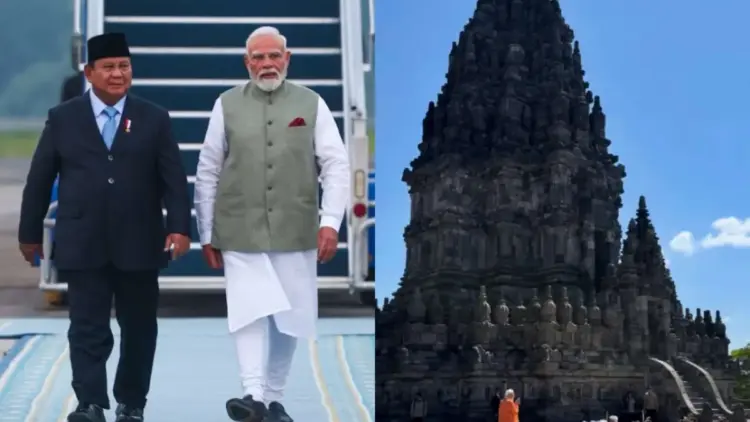
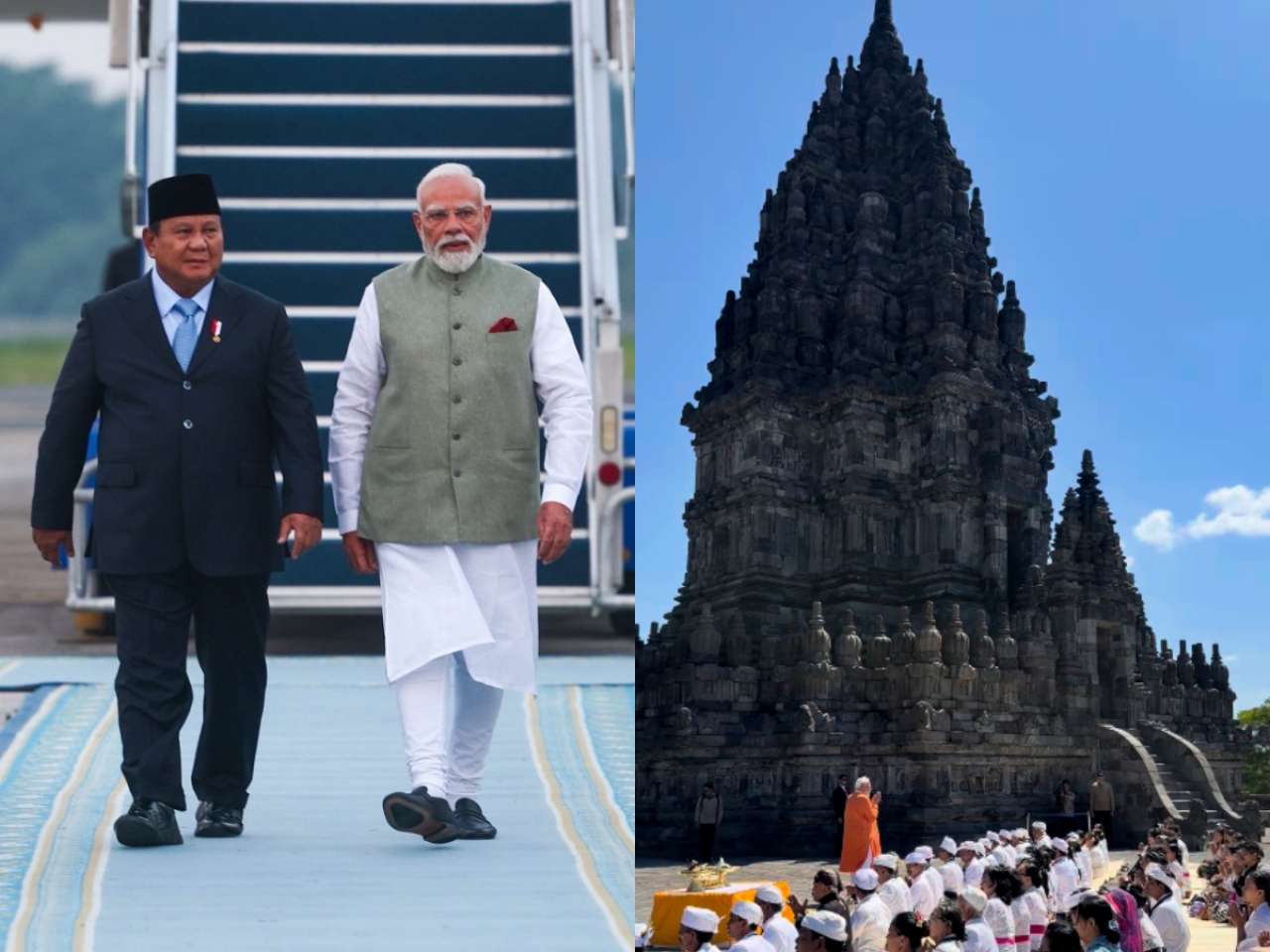
Yogyakarta, Indonesia – In a significant moment during his state visit to Indonesia, Prime Minister Narendra Modi paid homage to the ancient and majestic Prambanan Temple complex in Yogyakarta, a UNESCO World Heritage Site that stands as a profound testament to the deep-rooted cultural and historical connections between India and Indonesia. The visit, laden with symbolic significance, underscores the enduring spiritual and civilizational bonds that have shaped the relationship between the two nations for centuries.
Prime Minister Modi’s exploration of the thousand-year-old temple complex not only highlighted the enduring legacy of Hinduism in Indonesia, a nation now predominantly Muslim, but also paved the way for potential collaborative efforts in the conservation of this invaluable historical treasure. The presence of the Indian Prime Minister at Prambanan, a site that eloquently narrates tales from the Ramayana and embodies the essence of Hindu philosophy, resonated deeply, bridging geographical distances with shared cultural narratives.
A Beacon of Hindu Heritage in Southeast Asia
Prambanan, situated near the culturally rich city of Yogyakarta in Central Java, is not merely a temple; it is the largest Hindu temple complex in Indonesia and ranks among the most significant in all of Southeast Asia. Its grandeur and historical import place it as the second-largest Hindu temple complex in the region, following closely behind the iconic Angkor Wat in Cambodia.
The architectural marvel of Prambanan dates back to the 9th and 10th centuries, a period when the ancient Mataram Kingdom, under the Sanjaya dynasty, flourished. This era witnessed the construction of this magnificent edifice, meticulously dedicated to the supreme deities of the Hindu Trimurti: Lord Shiva, the Destroyer; Lord Vishnu, the Preserver; and Lord Brahma, the Creator. The very existence of such a monumental Hindu complex in Indonesia, the world’s most populous Muslim-majority nation, speaks volumes about the historical tapestry of religious and cultural confluence that has characterized the archipelago.
Often juxtaposed with the nearby Borobudur Temple, which represents Indonesia’s rich Buddhist heritage, Prambanan together with Borobudur, offers a comprehensive narrative of Java’s ancient religious and cultural pluralism. This harmonious coexistence of Hindu and Buddhist monumental architecture serves as a powerful reminder of Indonesia’s multifaceted historical identity. Recognizing its profound historical and architectural significance, the United Nations Educational, Scientific and Cultural Organization (UNESCO) officially designated the Prambanan Temple Compound as a World Heritage Site in 1991, further cementing its global importance.
Architectural Grandeur and Spiritual Significance
The sheer scale and intricate design of Prambanan are immediately striking to any visitor. The complex is dominated by soaring, elegantly crafted towers that pierce the Javanese sky. At its heart lie three colossal temples, each dedicated to one of the principal deities of the Trimurti. The temple dedicated to Lord Shiva stands as the tallest, reaching an impressive height of approximately 47 meters, a testament to the engineering and artistic prowess of its builders.

Within the sanctum of the Shiva temple, visitors are greeted by revered statues of Lord Shiva, Goddess Durga, Lord Ganesha, and the sage Agastya. The entire complex is laid out in a precise square formation, a design deeply rooted in Hindu cosmology, symbolizing the universe and the divine order. Historically, the Prambanan complex was even more expansive, originally comprising around 240 temples spread across an area of nearly 40 hectares. While time and natural calamities have reduced many of the smaller ancillary temples to ruins, the main shrines have undergone meticulous restoration, preserving their majestic presence for posterity.
The Ramayana Unveiled: Carvings that Tell a Timeless Tale
Beyond its imposing architecture, Prambanan is renowned for its extraordinarily detailed stone carvings. The inner walls of the temples are adorned with exquisite bas-reliefs that meticulously narrate the epic saga of the Ramayana, one of Hinduism’s most sacred and influential epics. It is a tradition for visitors to circumambulate the temple in a clockwise direction, mirroring the narrative progression of the Ramayana etched in stone. These intricate carvings not only showcase the profound influence of Indian culture but also bear the distinct artistic imprint of Javanese craftsmanship, illustrating a unique synthesis of traditions.

The cultural resonance of the Ramayana at Prambanan extends beyond its static depictions. The temple complex continues to be a vibrant venue for open-air Ramayana ballet performances. These captivating spectacles, blending traditional dance, evocative music, and dramatic theatre, are staged against the dramatic backdrop of the illuminated temple complex, offering a truly immersive cultural experience that brings the ancient epic to life.
The Legend of Princess Roro Jonggrang: Folklore and Reality
Prambanan is inextricably linked with a captivating Javanese legend that adds a layer of mystique to its historical narrative: the story of Princess Roro Jonggrang. According to folklore, the beautiful princess agreed to marry the formidable warrior Bandung Bondowoso on the condition that he would construct a thousand temples within a single night. Empowered by supernatural abilities, the prince was on the cusp of fulfilling this monumental task. However, the resourceful princess, fearing the union, devised a cunning plan to thwart his efforts. She commanded villagers to light fires and pound rice, creating the illusion of dawn. Fooled into believing that the night had ended, the spirits aiding the prince vanished, leaving the thousandth temple incomplete.

Enraged by this perceived deception, Bandung Bondowoso, in his fury, cursed Roro Jonggrang, transforming her into stone. Local tradition holds that the statue of Goddess Durga within the Shiva temple is, in fact, the petrified form of Princess Roro Jonggrang. While historians generally consider this tale to be folklore, it remains an integral part of the cultural identity and oral traditions associated with the Prambanan complex.
From Ancient Ruins to a Protected World Heritage Site
The decline of Prambanan began following significant political shifts in the 10th century. Over centuries, the majestic complex gradually succumbed to the ravages of time and nature. Volcanic eruptions, seismic activities, and prolonged periods of neglect led to widespread destruction, burying many of its structures under layers of volcanic ash and dense vegetation.

The site lay in a state of disrepair until its rediscovery in the 19th century, which marked the beginning of dedicated restoration efforts. Despite its resilience, the temple suffered damage once again during the devastating 2006 Yogyakarta earthquake. Nevertheless, ongoing and sustained restoration projects have been instrumental in preserving this architectural marvel, ensuring its survival for future generations. Today, while the painstaking work of rebuilding several smaller temples continues, the main shrines stand restored, attracting countless tourists and serving as a powerful symbol of Indonesia’s rich cultural heritage.
A Resilient Symbol of Indonesia’s Enduring Hindu Past
Even in contemporary Indonesia, where the population is predominantly Muslim, the echoes of Hindu traditions continue to resonate as a vital component of the nation’s historical and cultural fabric. The influence of Hinduism first permeated the Indonesian archipelago over 1,500 years ago, primarily through thriving trade routes and extensive cultural exchanges with India.

This historical engagement led to the rise of numerous powerful Hindu and Hindu-Buddhist kingdoms across Java, Sumatra, and Bali, leaving behind an indelible legacy in the form of magnificent temples, ancient inscriptions, and enduring cultural practices. While Bali remains the spiritual heartland of Hinduism in Indonesia today, monumental sites like Prambanan stand as proud custodians of the nation’s profound and diverse Hindu past, a past that continues to inform and enrich its present.
Chronology of Prambanan’s Legacy:
- 9th-10th Centuries CE: Construction of the Prambanan Temple complex under the Sanjaya dynasty of the ancient Mataram Kingdom. The temples are dedicated to the Hindu Trimurti: Shiva, Vishnu, and Brahma.
- 10th Century CE onwards: Gradual decline and eventual ruin of the complex due to political changes, natural disasters (volcanic eruptions, earthquakes), and neglect. Many smaller temples fall into disrepair or are buried.
- 19th Century: Rediscovery of the Prambanan site by European explorers. Initial efforts at understanding and documenting the complex begin.
- Early 20th Century onwards: Commencement of systematic restoration work on the main temples, aiming to preserve and reconstruct the damaged structures.
- 1991: The Prambanan Temple Compound is officially inscribed as a UNESCO World Heritage Site, recognizing its outstanding universal value.
- 2006: The complex suffers significant damage from a major earthquake in Yogyakarta, necessitating further restoration and preservation efforts.
- Present Day: Prambanan stands as a fully restored major tourist attraction and a vital symbol of Indonesia’s Hindu heritage, with ongoing conservation work on some of the ancillary structures.
Supporting Data and Context:
- Size and Scale: Prambanan is the largest Hindu temple complex in Indonesia and the second-largest in Southeast Asia, covering approximately 40 hectares and originally featuring around 240 temples.
- Architectural Height: The central Shiva temple reaches a height of approximately 47 meters, showcasing advanced architectural techniques for its time.
- UNESCO Recognition: Its inscription as a World Heritage Site in 1991 highlights its "outstanding universal value" for its historical, artistic, and architectural significance.
- Ramayana Influence: The detailed bas-reliefs depicting the Ramayana span hundreds of meters around the main temples, serving as a narrative and artistic masterpiece.
- Religious Demographics: While Indonesia is the world’s most populous Muslim-majority country, Prambanan stands as a powerful symbol of its historical Hindu past, with Bali remaining the primary center of Hinduism in the archipelago.
Official Responses and Collaborative Potential:
Prime Minister Modi’s visit to Prambanan, alongside Indonesian dignitaries, signifies a renewed commitment to fostering cultural exchange and historical understanding between the two nations. The shared heritage represented by Prambanan provides a fertile ground for enhanced cooperation. Discussions during the visit are understood to have touched upon the potential for joint initiatives in heritage conservation, drawing upon India’s expertise in historical site management and restoration.

Indonesian officials have consistently expressed pride in their nation’s diverse cultural heritage, including its significant Hindu past. The visit by Prime Minister Modi is viewed as an affirmation of this heritage and a positive step towards strengthening bilateral ties through cultural diplomacy. The potential for collaborative projects at Prambanan could involve not only physical restoration but also academic research, cultural exchange programs, and joint tourism promotion, further solidifying the India-Indonesia partnership.
Implications for Bilateral Relations and Cultural Diplomacy:
The visit of Prime Minister Modi to Prambanan is far more than a mere diplomatic photo opportunity; it is a powerful statement about the enduring strength of civilizational ties that transcend modern political boundaries. It underscores the shared cultural DNA that binds India and Indonesia, rooted in millennia of trade, migration, and the dissemination of spiritual and artistic traditions.

In an increasingly interconnected world, the emphasis on shared heritage and cultural understanding becomes even more crucial. By highlighting Prambanan, Prime Minister Modi has not only acknowledged Indonesia’s rich historical tapestry but also reinforced India’s commitment to preserving and celebrating its own cultural roots and their global connections. This focus on cultural diplomacy has the potential to:
- Deepen People-to-People Connections: Shared cultural experiences and historical narratives foster a stronger sense of connection and mutual respect between the citizens of India and Indonesia.
- Enhance Tourism and Economic Cooperation: The prominence given to Prambanan can boost tourism to Indonesia from India and vice versa, creating economic opportunities.
- Promote Intercultural Dialogue: Highlighting shared heritage encourages a broader dialogue about cultural diversity, religious tolerance, and the peaceful coexistence of different traditions.
- Strengthen Soft Power: India’s engagement with such significant cultural sites in its neighborhood and beyond enhances its global image as a nation that values its heritage and respects that of others.
Prime Minister Modi’s visit to the historic Prambanan Temple is a powerful affirmation of the enduring spiritual and cultural bonds between India and Indonesia. It serves as a poignant reminder that history, in its grandest monuments, continues to shape contemporary relationships, fostering understanding, respect, and a shared vision for the future. As both nations look towards greater collaboration, the timeless stones of Prambanan stand as a silent, yet eloquent, witness to a legacy that continues to inspire and connect.