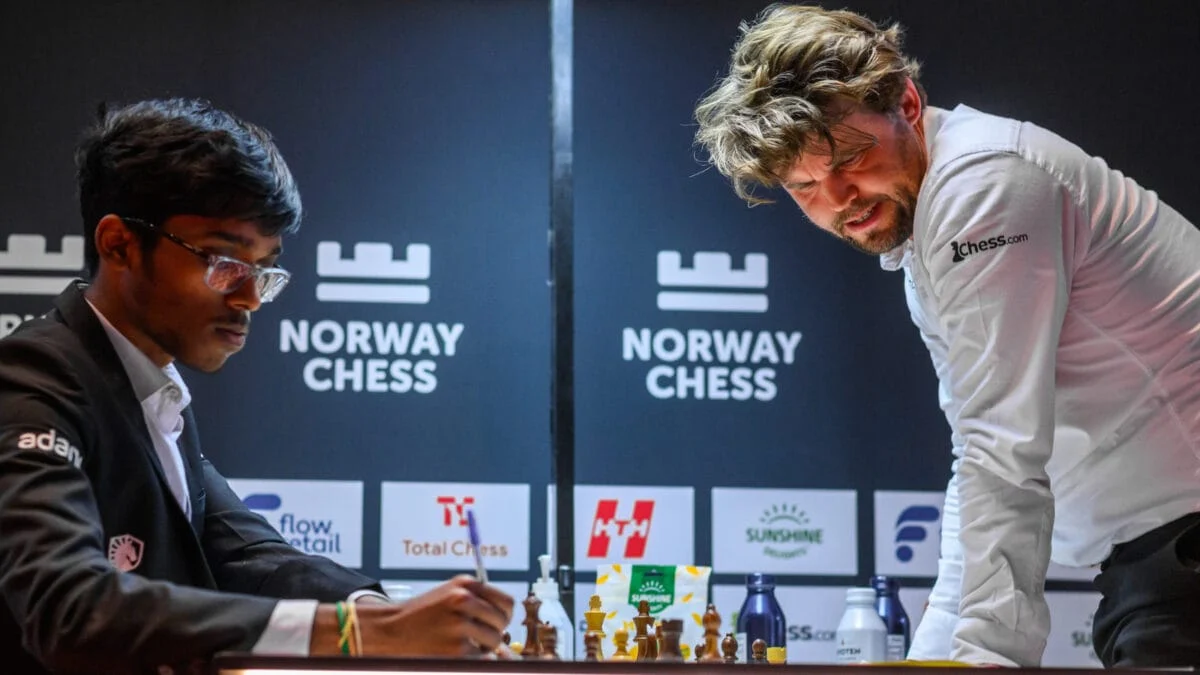
Stavanger, Norway – In a seismic event that sent shockwaves through the elite chess world, Indian Grandmaster R Praggnanandhaa, affectionately known as "Pragg," delivered a stunning blow to World No. 1 Magnus Carlsen, defeating him in a classical game at the prestigious Norway Chess tournament. This pivotal victory on Wednesday, May 28, 2026, not only propelled the 20-year-old Indian prodigy into second place in the tournament standings but also, remarkably, relegated the five-time world champion and home favourite to the unfamiliar territory of the bottom spot.
The upset marks Praggnanandhaa’s second classical-format victory over Carlsen at Norway Chess, a testament to his burgeoning talent and fearless approach. The first came during the 2024 edition, signalling an emerging rivalry that continues to captivate chess enthusiasts globally. Carlsen, who has historically treated Norway Chess as his personal playground, securing seven victories in its 13 previous editions, now faces an unprecedented challenge to his dominance on home soil. His current predicament – two losses in his opening three classical games – is a rarity, a statistical anomaly not seen since 2020, and underscores a potential shift in the echelons of professional chess.
A Seismic Shift in Stavanger: Praggnanandhaa’s Dominance Over Carlsen
The atmosphere in Oslo was charged with anticipation even before the first move was made. Magnus Carlsen, a titan of the game whose name is synonymous with modern chess excellence, found himself in an unusual position: under pressure early in a tournament he has so frequently dominated. His two prior losses, uncharacteristic for a player of his calibre, had already set a nervous tone among his legion of fans. For R Praggnanandhaa, however, the stakes were equally high. Entering the round in last place with a solitary point, he desperately needed a victory to regain momentum and assert his presence among the world’s best. What unfolded was not just a game of chess, but a declaration of intent, a symbolic passing of the torch that resonates far beyond the 64 squares.
Praggnanandhaa’s triumph is more than just another notch on his belt; it’s a profound statement that the established order is under siege. At just 20 years old, he embodies a new wave of exceptionally talented young Grandmasters from India who are rapidly ascending the global rankings, challenging the long-held supremacy of European and American players. This victory against Carlsen, particularly on his home turf and with such significant implications for the tournament standings, serves as a powerful testament to the shifting dynamics within elite chess. Carlsen’s fall to the bottom, while perhaps temporary, is a stark reminder that even the greatest can be humbled, and that the competitive landscape of chess is more vibrant and unpredictable than ever.
Chronology of a Shifting Landscape
The narrative of this particular encounter is steeped in tension, historical context, and the raw ambition of a rising star facing a legend. It’s a story that began long before the pieces were set on the board, rooted in Carlsen’s unparalleled history at Norway Chess and Praggnanandhaa’s meteoric ascent.
Pre-Game Tensions and Carlsen’s Unfamiliar Territory
Heading into Round 3, the air in Stavanger was thick with an unusual sense of unease surrounding Magnus Carlsen. The world champion had already stumbled, suffering two classical losses in his first three games – a rare occurrence that had analysts and fans buzzing. Carlsen, usually a picture of composure and strategic brilliance, seemed to be navigating unfamiliar psychological terrain. The pressure on him, playing in front of a home crowd accustomed to his triumphs, was palpable. Every move, every decision, carried the weight of expectation.
On the other side of the board, Praggnanandhaa faced a different kind of pressure. Despite his immense talent, he found himself languishing at the bottom of the standings with just one point. A loss would have severely hampered his tournament aspirations. For Pragg, this was an opportunity not just to score points, but to make a definitive statement. Instead of adopting a cautious, defensive strategy against the world No. 1, he arrived with a clear intent to play aggressively, to seize the initiative, and to force Carlsen out of his comfort zone. The psychological battle lines were drawn long before the clocks started ticking, setting the stage for a dramatic confrontation.
The 62-Move Marathon: A Tactical Masterclass Under Duress
The game itself unfolded as a tense, tactical marathon, stretching over 62 demanding moves. From the opening, Praggnanandhaa displayed an impressive blend of courage and strategic acumen. He chose an assertive line, pressing Carlsen and preventing him from settling into his preferred positional play. Observers noted Carlsen’s growing frustration as the game progressed, his body language betraying a champion unaccustomed to being on the back foot. His attempts to complicate the position were met with resourceful defence and sharp counter-attacks from the young Indian.
As the game transitioned into a chaotic endgame, the pressure intensified, particularly with both players entering time trouble. This phase, often dubbed a "time scramble," is where nerves and quick calculation are paramount. It was here that Praggnanandhaa truly shone. While Carlsen made uncharacteristic errors under the immense clock pressure, Pragg maintained his composure, executing precise tactical sequences that capitalized on his opponent’s missteps. The board became a volatile landscape, pieces flying, possibilities shifting, until Praggnanandhaa’s relentless pressure proved too much. Carlsen, visibly dejected, eventually resigned, acknowledging the superior play of his younger opponent. It was a rare and poignant sight to witness the world champion throw in the towel, a moment that underscored the magnitude of Praggnanandhaa’s achievement.
Post-Game Repercussions: A Tournament Transformed
The immediate aftermath of the game sent ripples throughout the tournament hall and beyond. The updated standings reflected a dramatic shift: Praggnanandhaa, who had begun the round at the bottom, leaped to an impressive second place, breathing new life into his tournament campaign. Conversely, Magnus Carlsen found himself in an almost unthinkable position – last. This sudden reversal of fortunes not only redefined the narrative of Norway Chess but also injected an unprecedented level of drama and unpredictability into the remaining rounds. Players, commentators, and fans alike began to recalibrate their expectations, recognizing that this year’s edition was shaping up to be anything but typical. The psychological impact on the other contenders, seeing both the rise of a young star and the vulnerability of the undisputed king, was profound, promising even more exciting chess ahead.
Supporting Data: The Statistics Behind the Narrative
The significance of Praggnanandhaa’s victory is magnified when viewed through the lens of historical data and the broader trends within global chess. It’s not merely an isolated upset but a data point in a larger, evolving story.
Carlsen’s Unprecedented Vulnerability at Home
Magnus Carlsen’s record at Norway Chess is nothing short of legendary. With seven titles in 13 editions, he has historically treated the event as a near-guaranteed victory, a demonstration of his unparalleled skill on home turf. This year, however, presents a stark departure from that narrative. His two losses in the first three classical games represent a level of vulnerability rarely seen from the Norwegian maestro, a statistic that hasn’t been recorded since 2020. This raises pertinent questions: Is this a temporary dip in form, perhaps a result of fatigue or a momentary lapse in focus, or does it signal a deeper, more enduring trend? While Carlsen’s dominance has been absolute for over a decade, the relentless march of time and the emergence of fresh talent inevitably pose challenges even to the greatest. His current struggles invite speculation about the immense pressure of defending his legacy and the psychological toll of consistent top-level competition.
The Ascent of R Praggnanandhaa: A Star Forged in Fire
R Praggnanandhaa’s journey from a prodigious child talent to a world-class Grandmaster has been nothing short of meteoric. At just 20 years old, he already boasts an impressive resume, and his repeated victories against Carlsen serve as definitive milestones. His breakthrough classical win against the world champion at the 2024 Norway Chess was a pivotal moment, signaling his arrival on the elite scene. Since then, his ELO rating has steadily climbed, reflecting consistent improvement in all facets of his game. Praggnanandhaa is not an anomaly but a leading figure in the burgeoning Indian chess renaissance. Alongside other young talents like D Gukesh, Arjun Erigaisi, and the formidable Vaishali Rameshbabu (Pragg’s sister), India is rapidly establishing itself as a powerhouse in global chess. These young Grandmasters are characterized by their fearless approach, tactical ingenuity, and unwavering resilience, challenging the established elite with a confidence that belies their age. Praggnanandhaa, with his calm demeanor and aggressive play, is undoubtedly one of the brightest stars spearheading this exciting new era.
Expert Analysis: A Changing of the Guard?
Renowned chess commentators and Grandmaster analysts have been quick to weigh in on the implications of Praggnanandhaa’s latest triumph. Grandmaster Daniel King, speaking on a popular chess broadcast, remarked, "What we’re witnessing here is more than just an upset; it’s a testament to the incredible depth of talent emerging in chess. Praggnanandhaa’s ability to consistently challenge and defeat Magnus, especially in classical format, is a clear indicator that the ‘changing of the guard’ narrative is gaining serious traction."
GM Susan Polgar, a former Women’s World Champion, added, "Praggnanandhaa’s playing style is fascinating. He combines tactical sharpness with an uncanny ability to stay calm under immense pressure. He’s not intimidated by Carlsen’s reputation; he actively seeks to create complicated positions where his calculation skills shine. Carlsen, on the other hand, seems to be struggling with consistency, perhaps a natural consequence of having reigned supreme for so long. The young generation is hungry, and they’re not waiting for an invitation."
These expert opinions underscore the consensus that the top tier of chess is becoming increasingly competitive, with young, fearless players like Praggnanandhaa actively pushing the boundaries and challenging the long-held supremacy of icons like Carlsen.
Official Responses and Psychological Insights
The immediate reactions following such a high-stakes encounter offer a fascinating glimpse into the psychology of elite athletes, revealing the complex interplay of ambition, self-critique, and the relentless pursuit of perfection.
Praggnanandhaa’s Calculated Modesty: A Champion’s Mindset
Despite securing a monumental victory against the world’s best player, Praggnanandhaa’s post-game comments were surprisingly understated, almost self-deprecating. "Yeah, I think (this) win is really crucial for the tournament to try and get back my standings," he told Times Now, acknowledging the practical importance of the points. However, he quickly added, "But, I mean, overall as a game, I am not really satisfied. But, okay, it’s just a street fight. So, anything can happen. And these time scrambles, yeah, I lost control. But, yeah, it was a really interesting game."
Later, in the mixed zone, he even downplayed the significance further, calling it "honestly not that big a win." This calculated modesty offers a fascinating insight into the mind of a top competitor. Is it genuine self-critique, a reflection of his incredibly high standards, where only a flawless performance truly satisfies? Or is it a strategic psychological tactic, designed to keep himself grounded and avoid complacency, even after a triumph of this magnitude? The contrast with his coach’s visible celebration – fist pumps and enthusiastic gestures as they navigated the arena escalators – suggests that Praggnanandhaa’s internal assessment is far more rigorous than external perceptions. His focus remains firmly on the broader tournament narrative, prioritizing overall performance and standings over individual glory, a hallmark of true championship aspiration.
Carlsen’s Silence and Frustration: The Weight of Expectations
Magnus Carlsen, typically candid and articulate, offered no immediate extensive public statement following his defeat. His frustration, however, was visibly apparent throughout the game. His slumped shoulders, occasional head shakes, and the general air of discomfort spoke volumes. For a player who has dominated the chess world for over a decade, accustomed to dictating the terms of engagement and rarely finding himself in genuinely losing positions, such a defeat, particularly on home turf, is undoubtedly a bitter pill to swallow.
The psychological toll of being the world No. 1 is immense. Every move is scrutinized, every loss amplified. Carlsen’s current losing streak, while statistically rare for him, highlights the incredible pressure he operates under. How a champion deals with such rare moments of vulnerability defines their character. While his silence might be interpreted as a desire to process the defeat privately, it also underscores the weight of expectation that rests upon his shoulders. The challenge now for Carlsen is not just to recover points, but to regain his characteristic psychological edge and demonstrate resilience in the face of adversity.
Implications: The Road Ahead for Norway Chess and Beyond
The reverberations of Praggnanandhaa’s victory are set to profoundly influence not only the trajectory of the Norway Chess tournament but also the broader narrative of global chess for the foreseeable future.
Reshaping the Tournament Landscape
For Praggnanandhaa, this win is a massive confidence booster. Moving from last to second place dramatically alters his prospects, transforming him from an underdog fighting to stay afloat into a genuine contender for the title. The momentum is now firmly on his side, and he will undoubtedly carry this psychological advantage into his upcoming matches. For Carlsen, however, the path to recovery looks arduous. Dropping to the bottom of the standings is unprecedented for him at this event, and it raises a critical question: will he play for points, adopting a cautious approach to minimize further losses, or will he unleash his formidable aggression to reclaim lost ground, risking further setbacks? His choices will significantly impact the tournament’s final outcome.
The upset also shakes up the dynamics for other top contenders like Fabiano Caruana, Hikaru Nakamura, Alireza Firouzja, and Carlsen’s fellow countryman, D Gukesh. With Carlsen struggling, the field feels more open, and every game becomes even more critical. The drama and unpredictability for the remaining rounds have escalated, promising an enthralling conclusion to what is already shaping up to be a historic tournament.
A New Era for Global Chess?
Beyond the immediate tournament implications, Praggnanandhaa’s repeated victories over Carlsen contribute significantly to a compelling narrative of a "changing of the guard" in global chess. The consistent rise of young talents, particularly from India, suggests that the landscape of elite chess is undergoing a fundamental transformation. This new generation is not just competing; they are winning against the established titans. This shift promises to inject fresh energy and excitement into the sport, attracting a younger audience and diversifying its global appeal.
The long-term legacy of Carlsen, while undoubtedly secure as one of the greatest of all time, will now increasingly be viewed in conjunction with the challenges posed by these prodigious youngsters. His continued presence at the top, while facing such fierce competition, only serves to highlight the incredible strength of the current generation. This evolving dynamic ensures that the World Championship cycle and other major tournaments will be more hotly contested and thrilling than ever before.
Blockbuster Clashes on the Horizon
The schedule for the upcoming rounds offers a series of highly anticipated encounters. Next up, Praggnanandhaa faces Vincent Keymer in Round 4. This match will be crucial for Pragg to maintain his newfound momentum and solidify his position at the top. All eyes, however, will also be on Magnus Carlsen, who is slated to face another young Indian prodigy, reigning world champion D Gukesh. This blockbuster clash is fraught with narrative tension: Carlsen, at the bottom of the standings, against the current world champion, another young Indian talent. It represents a potential turning point for Carlsen’s tournament – a chance to prove his resilience or face the prospect of further deepening his crisis. The chess world holds its breath, ready for more unpredictable and captivating drama.