

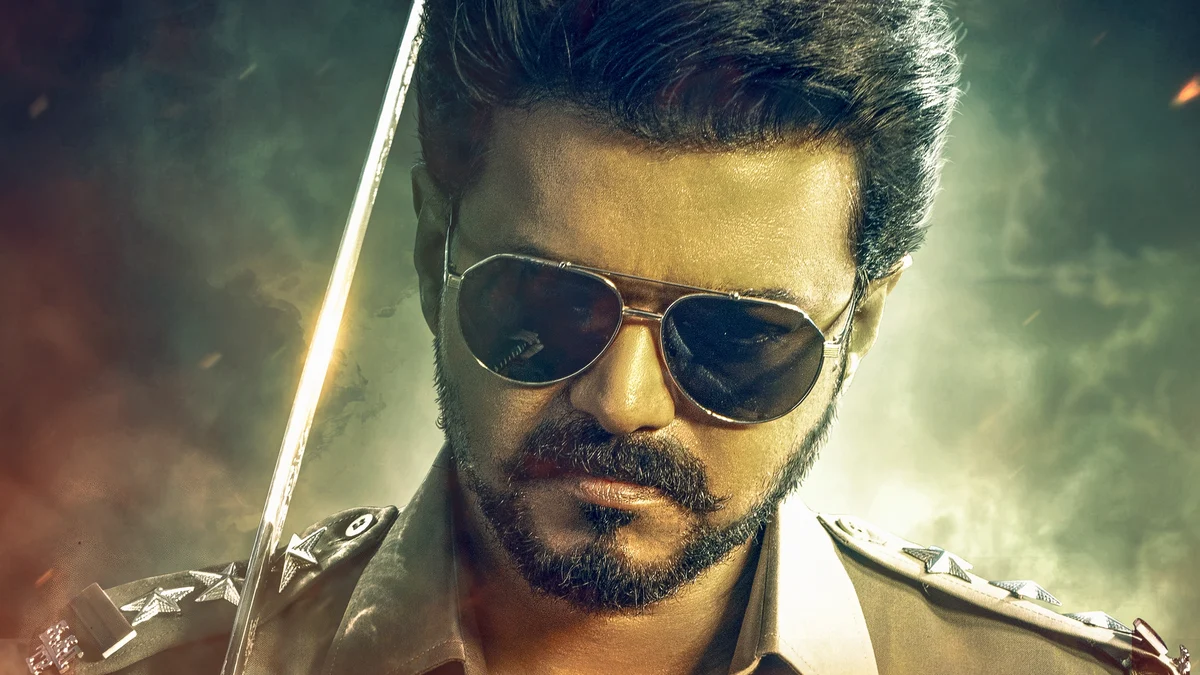
Chennai, India – In the electrifying world of cinema, where dreams are woven into celluloid and stars often transcend the screen to become cultural icons, the release of "Jana Nayagan" marks a pivotal moment. After a tumultuous journey plagued by censor board disputes, legal entanglements, and the pervasive threat of piracy, the film has finally graced the silver screen. More than just a cinematic offering, "Jana Nayagan" serves as a poignant farewell from one of Tamil cinema’s most beloved figures, actor-turned-politician Thalapathy Vijay. His recent announcement during his election campaign solidified this as his final foray into acting, amplifying the anticipation and significance surrounding this release.
The film immediately immerses the audience in a world where fiction blurs with reality. An opening sequence depicts a popular move Vijay executed in the Tamil Nadu Assembly shortly after assuming the mantle of Chief Minister, an act that resonated deeply with the public and underscored the film’s inherent political undertones. This is further emphasized by a powerful visual of Vijay uplifting an elder while holding a copy of the Constitution of India, a symbolic gesture that sets the stage for a narrative steeped in democratic ideals and public service.
Director H. Vinoth, known for his astute political commentary within commercially viable narratives, helms "Jana Nayagan." The film is a remake of the 2023 Telugu hit "Bhagavanth Kesari," starring Nandamuri Balakrishna. While the original told the story of a former cop raising a young girl with aspirations of joining the Indian Army, Vinoth masterfully re-engineers this template to serve as a platform for Vijay’s persona as a political leader. The remake delves into themes of women’s empowerment and the eradication of fear, weaving them into a compelling narrative designed to solidify Vijay’s image as a protector of democracy and a champion of the masses.
A Remake Reimagined: From Telugu Blockbuster to Tamil Political Statement
"Jana Nayagan" is not merely a carbon copy of its Telugu predecessor. Director H. Vinoth has strategically adapted the core narrative of "Bhagavanth Kesari" to resonate with the socio-political landscape of Tamil Nadu and, more significantly, to amplify the real-world political trajectory of its lead actor. The film’s premise centers around Thalapathy Vetri Kondan, a convict who takes on the responsibility of nurturing and empowering Viji (Mamitha Baiju), the daughter of his deceased friend, Inspector Srikanth (Gautham Menon). His mission is to fulfill Srikanth’s dying wish: to transform Viji into an accomplished officer in the Indian Army.
This father-daughter dynamic, a cornerstone of the original film, is retained and imbued with a potent message of female empowerment. However, Vinoth injects a distinctly political flavor. The antagonist, John Himmler (Bobby Deol), a menacing figure driven by a desire to sow religious discord and destabilize India’s democratic fabric, represents a more insidious threat than the corporate machinations of the original film’s villain. This alteration transforms "Jana Nayagan" from a conventional action drama into a political thriller, positioning Vijay’s character as a bulwark against extremism and bigotry.

The film’s engagement with the source material is evident in its retention of key thematic elements. The exploration of overcoming trauma-induced phobias, as seen in Viji’s character, and the overarching narrative of a protector figure guiding a vulnerable individual towards strength and purpose, are directly lifted from "Bhagavanth Kesari." However, Vinoth’s directorial choices aim to elevate these themes, infusing them with a gravitas that aligns with Vijay’s public image and political aspirations.
Weaving a Tapestry of Political Allusion and Fan Service
"Jana Nayagan" is replete with meta-political references, subtle nods to the legendary M.G. Ramachandran (MGR), and ample fan service, all meticulously crafted to celebrate the masala cinema that propelled Vijay to superstardom. The film’s introduction, featuring Vijay’s real-life political maneuver in the Tamil Nadu Assembly, immediately blurs the lines between his on-screen persona and his off-screen political reality. This deliberate choice underscores the film’s ambition to be more than just entertainment; it aspires to be a political statement, a culmination of Vijay’s journey from a charismatic film hero to a significant political figure.
Director Vinoth’s expertise in blending commercial appeal with sharp political insights is on full display. He recognizes the inherent strengths of "Bhagavanth Kesari’s" story and screenplay and re-engineers them into a narrative that is not only entertaining but also serves to bolster Vijay’s image as a formidable political leader. The film’s thematic focus on women’s empowerment and the courage to confront fear directly mirrors the original’s narrative, but within the context of "Jana Nayagan," these themes are amplified to resonate with a broader political message.
The parallel narrative arcs of Viji’s journey of overcoming her phobias and Thalapathy Vetri Kondan’s confrontation with John Himmler’s dangerous ideology are skillfully interwoven. While the original focused on a more grounded threat, Vinoth escalates the stakes by introducing a villain who seeks to dismantle India’s democracy through religious hatred. This strategic shift elevates the film’s political commentary, presenting a more urgent and relevant challenge for the protagonist to overcome. This adaptation, while making the film uniquely its own, also presents its most significant narrative challenge.
Narrative Hurdles: Pacing, Tropes, and an Overstuffed Third Act
Despite its ambitious scope and star power, "Jana Nayagan" encounters several narrative hurdles that temper its overall impact. The screenplay, particularly in the first act, adopts a breakneck pace, rushing through crucial plot points and emotional developments. The adoption of Viji by Thalapathy Vetri Kondan, a pivotal moment that establishes their bond, transpires in a mere few minutes, sacrificing the emotional depth that such a relationship warrants. While Anirudh Ravichander’s poignant song "Kanne Maniye" attempts to inject emotional gravitas into the found father-daughter relationship, and "Thalapathy Katcheri" emerges as a powerful crowd-pleaser, these moments struggle to fully compensate for the rushed exposition.

Furthermore, the film falls prey to certain recurring weak tropes from its source material. Instead of innovating upon the existing template, director Vinoth largely adheres to recreating it. This adherence is most apparent in the lengthy third act, which becomes excessively focused on John Himmler’s character and motivations. This extended climax inflates the film’s runtime to a staggering 183 minutes, leading to narrative bloat and a diluted impact.
The film also struggles with the integration of certain subplots. An awkwardly placed public service announcement about good touch and bad touch, along with a superfluous romantic subplot involving a journalist played by Pooja Hegde, feel unearned and detract from the central narrative. While Hegde’s character eventually finds a more meaningful role, it pales in comparison to the potential of Kajal Aggarwal’s character in the original. It is particularly surprising that Vinoth, a director celebrated for his sharp dialogue, retains much of the original film’s dialogue, which was tailored for a different cinematic sensibility.
The narrative’s tendency to jump between disparate ideas further exacerbates the pacing issues. John Himmler’s internal struggles with a split personality, Thalapathy’s effortless resolution of a myriad of problems—ranging from romantic entanglements to societal injustices—and even a protest under a Kannagi statue, all jostle for screen time. The film attempts to encompass everything under the sun, leading to an overstuffed and often disjointed viewing experience.
The Political Undercurrent and the Spectacle of a Superstar’s Farewell
As the screenplay progresses towards its much-anticipated third act, "Jana Nayagan" reveals its true political intentions. However, this ambition is hampered by a growing ambiguity regarding the precise nature of Vijay’s character’s political adversaries and the film’s overarching message. While Vijay’s performance is commendable, his character’s didactic approach to every challenge can feel somewhat heavy-handed.
The film’s exploration of futuristic warfare, with the introduction of RC robots in political battles, is a bold and imaginative touch. This echoes AR Murugadoss’s prescient warning in "Madharasi" about the potential for gun culture in Tamil Nadu, with Vinoth painting a more technologically advanced, yet equally dangerous, future. The film’s central message—that political enemies exploit India’s diversity for their own gain—is a pertinent one. However, its placement within an already crowded narrative risks diminishing its impact. Moreover, with a real-life political leader at its core, the film treads a fine line, potentially coming across as overtly promotional, a near-blatant advertisement for a political agenda.

Despite these narrative shortcomings, Vijay delivers a captivating performance in his final film appearance. He exudes charisma and commands the screen with his undeniable presence. From his signature on-screen mannerisms, like the chin swipe and the tongue swirl, to moments that are purely "Vijay-esque," the film is packed with elements designed to delight his devoted fanbase. The film is a veritable smorgasbord of fan service, featuring callbacks to his past hits and even a mind-bending interaction with an AI-powered MGR, ensuring ample fodder for social media discussion for weeks to come.
A Dual Legacy: The Film and the Phenomenon
As the credits roll on the lengthy "Jana Nayagan," a realization dawns: there are, in essence, two "Jana Nayagans" present in the cinema today. The first is the film itself, an ambitious attempt to fuse cinematic spectacle with political aspiration. It is a film that perhaps should have served as a launchpad for an actor-turned-politician’s dreams, a dream further amplified by the twist of fate that saw Vijay ascend to the Chief Minister’s chair before the film’s release.
The second, and arguably more profound, "Jana Nayagan" resides not just on the screen but within the hearts of millions of fans. This is the enduring legacy of C. Joseph Vijay, the young boy who debuted in 1992 with "Naalaya Theerpu" and went on to become a cultural phenomenon. For countless ordinary young men and women, Vijay represented a beacon of hope, a figure who defied expectations and provided a language to express joy, celebrate life, and forge their own identities. He danced with unparalleled grace, effortlessly navigated the complexities of comedy and drama, and meticulously built a persona that was uniquely his own.
Regardless of how "Jana Nayagan" fares at the box office or in critical reviews, the narrative of how C. Joseph Vijay transformed into Ilayathalapathy and subsequently, Thalapathy, is a blockbuster for the ages. His journey from a beloved film star to a significant political force is a testament to the power of dreams, the allure of cinema, and the profound connection between an artist and his audience. This enduring story, etched in the annals of Tamil cinema and beyond, is a legacy that will undoubtedly outlive any single film.
Jana Nayagan (Tamil)

Director: H. Vinoth
Cast: Vijay, Mamitha Baiju, Bobby Deol, Pooja Hegde, Gautham Menon, and others
Runtime: 183 minutes
Storyline: A convict assumes guardianship of his late friend’s daughter and embarks on a mission to protect her and confront a formidable antagonist threatening the very foundation of India’s democracy.
