

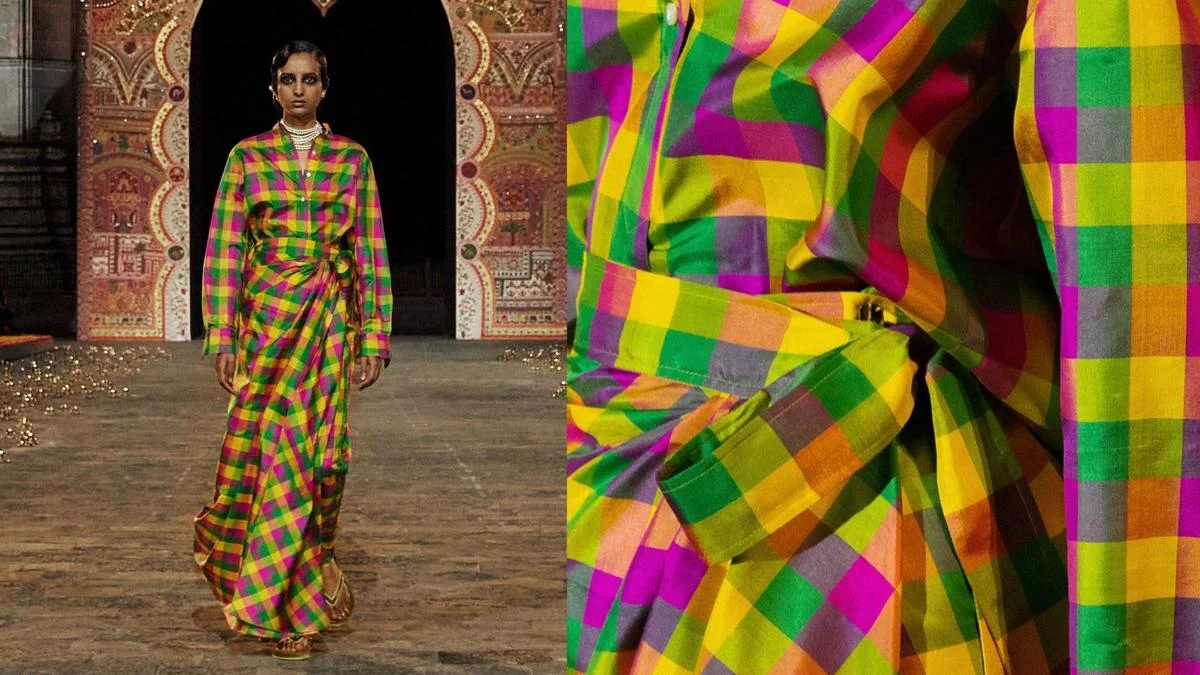
Chennai, India – The vibrant, intersecting lines of Madras checks, a fabric deeply woven into the cultural tapestry of India and beyond, are experiencing a significant resurgence. Once relegated to the realm of everyday wear for the less affluent, this distinctive plaid is now gracing international runways, inspiring contemporary designers, and being championed by heritage revivalists who are determined to preserve its rich history and artisanal roots. What began as a simple, breathable cotton woven along the Coromandel coast has journeyed through centuries of trade, cultural exchange, and evolving fashion, proving its enduring appeal and multifaceted identity.
A Personal Encounter and a Societal Re-evaluation
The author’s own introduction to Madras checks in 2010 on Velankanni beach was marked by an immediate appreciation for its "remarkable lightness" and "effortless elegance" in the lungis worn by local men. This admiration was met with a dismissive, albeit genuinely puzzled, response from a family friend: "Why would you want to make a shirt out of it? It’s worn by the poor." This comment, though seemingly trivial, underscored a pervasive societal bias that often undervalues a textile based on the socio-economic status of its wearers. It highlighted a missed opportunity to recognize the inherent beauty and versatility of a fabric that possessed both vibrant character and practical utility, regardless of who adorned it. This reductive perspective now stands in stark contrast to the fabric’s contemporary embrace by high fashion and its recognition as a symbol of heritage and craftsmanship.

The Genesis of Revival: Original Madras Trading Company
For the Original Madras Trading Company, the renewed focus on Madras checks is not a fleeting trend but a continuation of a deeply entrenched family legacy. Led by Chennai-based Ranvir Shah, whose family has been involved with the fabric for over half a century, the initiative seeks to reclaim and redefine the narrative surrounding this iconic textile. Shah’s father, a pioneer in exporting Madras check garments to major American labels, eventually questioned India’s role as a mere "garment coolie" in the global supply chain. This realization spurred a pivotal shift: the need to create something authentically their own.
The company’s approach is rooted in returning to the source. Beginning with just two handlooms in Chennai, they embarked on a mission to revive traditional weaving practices that had been steadily eroded by the proliferation of machine-made imitations. "We realised that Madras made on looms in China and elsewhere is not real Madras," Ranvir Shah explains. "If the craft was to survive, we had to go back to the origin." This commitment to authenticity is paramount, ensuring that the fabric retains its unique character and the integrity of its production.

Developed in collaboration with his son, Prasan Shah, who manages the company’s New York operations, the initiative harmoniously blends traditional weaving techniques with contemporary design sensibilities. Designers work in close partnership with weavers, maintaining the familiar color palettes and iconic checks while experimenting with sustainable practices. This includes the use of organic yarns, natural dyes, and lower-impact fibers. For Shah, the ultimate objective transcends chasing ephemeral fashion trends; it is about the sustainable survival and flourishing of a craft for generations to come. "Madras comes in and out of fashion," he states, "We’re not interested in trends. We want Madras to survive and flourish for generations."
A Tapestry of History: The Global Journey of Madras Checks
The distinctive plaid derives its name from the historic port city of Madras (now Chennai), the primary hub for its export. However, its origins are more widespread, with the fabric being woven across various centers along the Coromandel coast. From these coastal communities, Madras checks embarked on a global journey, carried along the same maritime trade routes that facilitated the exchange of spices, cotton, and dyes across the Indian Ocean and far beyond.

In Nigeria, particularly within the Igbo and Kalabari communities, the brightly colored Madras cotton gained renown as "George cloth" or "Injiri," becoming an integral part of ceremonial occasions and celebrations. Its unmistakable checks, often rendered in vivid combinations of red, indigo, yellow, and green, became a visual identifier. Handwoven cotton checks exported from India were often labelled "Real Madras" to distinguish them from the burgeoning machine-made imitations produced by European mills.
By the early 20th century, the fabric had quietly made its way into American fashion. Wealthy Americans returning from winter vacations in the Bahamas brought back the colorful shirts, and by the 1950s, Madras had become a comfortable fixture in the wardrobes of Ivy League campuses, synonymous with relaxed summer dressing.

One of the most enduring and captivating anecdotes surrounding Madras checks dates back to 1958. American retailer Brooks Brothers introduced naturally dyed Madras shirts sourced from India into its ready-to-wear line. Soon, customers began complaining about the colors bleeding during washing. Instead of viewing this as a defect, advertising executive David Ogilvy masterfully transformed it into a marketing triumph. He framed the color bleeding as an intrinsic part of the fabric’s charm, giving birth to the legend of "Bleeding Madras." This textile, which subtly transformed with every wash, became a symbol of authenticity, its advertising promise of "Guaranteed to bleed" cementing its place in American preppy style and propelling Madras into the mainstream. From its humble beginnings on handlooms along the Coromandel coast, Madras checks had, by then, traversed an extraordinary and improbable distance.
Designers Re-envisioning the Check: A Cultural Catalyst
The enduring appeal of Madras checks continues to captivate designers worldwide, who are drawn to the rich cultural narratives woven into its very fibers. Jamaican-Scottish designer Nicholas Daley stands out for his thoughtful exploration of the textile’s diasporic connections, examining the historical links between the Caribbean, Britain, and South Asia. His Spring/Summer 2018 collection was a dedicated tribute to Madras, meticulously tracing its journey through colonial trade, the Caribbean, and contemporary Britain. Collaborating with the Victoria and Albert Museum archives, Daley reimagined this historic cloth for a new generation. His commitment to the textile extended to a 2025 collaboration with Clarks Originals, reinterpreting the iconic Wallabee using Madras-inspired textiles.

Beyond Daley’s impactful work, the fabric’s versatility is evident across global fashion houses. During Christopher Bailey’s tenure at Burberry, breezy plaids featured prominently in collections like Burberry Prorsum Spring/Summer 2015. More recently, Maria Grazia Chiuri’s Dior Fall 2023 show in Mumbai showcased multicoloured checks that paid homage to the visual language of Madras. These high-profile appearances underscore the fabric’s transition from a regional textile to a globally recognized design motif.
Within India, designers are embracing Madras checks with a more intimate perspective, recognizing it as a textile deeply embedded in everyday life. The Puducherry-based label Wunderhaus Handmade, for instance, views Madras checks as a textile narrative that spans continents while remaining intrinsically linked to the rhythms of daily dressing. Founder Kedar Maddula notes, "We’re witnessing a resurgence in their popularity. Traditionally Madras checks were used for simple shirting or wraps, but we’re transforming them into handloom tees, windcheaters, shacket shirts, and trousers that feel contemporary without losing their origins."

Chennai-based brand No Grey Area incorporated oversized Madras checks into its Spring/Summer 2024 collection, "Inconvenience Today for a Better Tomorrow," presented at Lakmé Fashion Week. The checks were reimagined in wrap skirts for women and sharply tailored suits for men, thoughtfully layered alongside traditional Indian crafts like woodblock printing and shisha embroidery.
For JADE by Monica and Karishma, a Mumbai-based label, the textile carries a distinct resonance. Their Autumn/Winter 2025 menswear collection, "Bombay Chic," approaches Madras checks through what designer Monica Shah describes as the "Bombay ethos." She explains, "At JADE, particularly within our menswear inspired by Bombay, we don’t treat identity and aesthetics as separate ideas. Madras checks allow us to bring heritage into sharper, more contemporary shapes."

Designer and textile manufacturer Hamza Farooq Darwaish, who runs the craft initiative Heritage by Hamza, approaches the textile from a deeply personal perspective. "School uniforms, lungis, summer shirts – the markets in Mylapore and T. Nagar," he recalls. "Madras checks were always around me." For Hamza, working with the textile is not merely about reviving a trend but about continuing an unbroken tradition.
A Living Textile: Embracing Heritage and Innovation
The resurgence of Madras checks is not solely confined to haute couture; it is also manifesting in contemporary labels that are breathing new life into the fabric. Gul Sohrab, founded by Amit Malhotra and Saurabh Kumar in 2024, approaches Madras checks not as an archival curiosity but as a familiar and cherished element of their upbringing. Amit, who previously worked as a book designer, grew up surrounded by the fabric in lungis, saris, and everyday garments. Saurabh brings extensive technical fashion experience from renowned brands.

"Madras checks feel deeply lived-in," says Amit. "What drew us to them was that instinctive familiarity." Rather than treating the textile as a relic to be preserved, Gul Sohrab embraces it as a material meant to be worn, washed, and integrated into daily life. "We approach Madras with restraint," Amit elaborates. "We let the fabric exist as itself."
The designers highlight the inherent fluidity of Madras checks across various forms of dress. "Madras appears effortlessly in mundus, lungis, saris, and skirts," Amit observes. "It moves across bodies and identities without losing its ease or character, and that natural fluidity resonated strongly with our design philosophy." For now, Gul Sohrab views its relationship with Madras as an ongoing dialogue, allowing the textile to evolve organically with the brand.

The Weaver’s Perspective: Challenges and Hopes for Sustainability
While global runways and contemporary designers have rediscovered Madras checks as a captivating motif, the economic realities for the weaving communities that produce this fabric remain a critical concern. Siddhant Beriwal, a textile professional based in Mumbai, points out that the renewed visibility has not always translated into economic stability for these artisans. This reflects a broader challenge faced by India’s handloom sector.
Research from the Fourth All India Handloom Census (2019-20) indicates a significant decline in the number of weavers, with the sector supporting approximately 3.5 million workers, down from roughly 6.5 million in the mid-1990s. This decline is largely attributed to the expansion of mechanized production, with handlooms now accounting for only about 15% of India’s total cloth production. Powerlooms and mills dominate the market, often replicating the visual appeal of handwoven textiles at a fraction of the cost.

"The tension between handloom and powerloom has always shaped textiles like Madras checks," Siddhant notes, adding, "powerloom fabrics can replicate the visual look at a fraction of the cost."
For Madras checks to secure a more sustainable future, a clearer market recognition for authentic handwoven fabric is crucial. Siddhant suggests that geographical indication recognition and more organized export channels could significantly strengthen the value proposition for designers, buyers, and, most importantly, the weavers. "If the textile receives geographical indication recognition and exports move through more organised channels, it could create a stronger value proposition for designers, buyers and, most importantly, the weavers," he states.

Conclusion: A Textile’s Second Act
After decades of being exported, imitated, and often overlooked within its homeland, Madras checks is embarking on a significant second act. It is no longer merely a textile of convenience or a fleeting trend. Instead, it is being recognized for its deep historical roots, its intricate cultural identity, and its remarkable capacity for reinvention. The efforts of companies like Original Madras Trading Company, the creative vision of contemporary designers, and the enduring connection of artisans to their craft are collectively ensuring that Madras checks continues to weave its vibrant story for generations to come, a testament to its timeless appeal and enduring legacy.
