

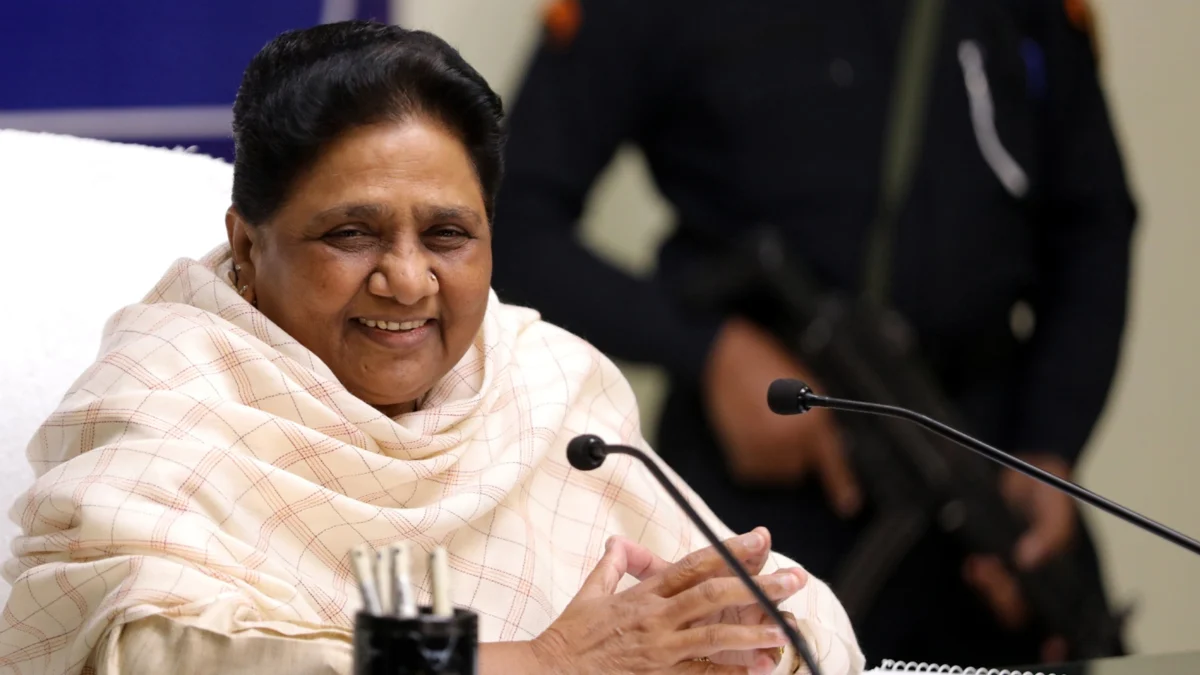
Lucknow, Sep 21, 2026 – In a dramatic pronouncement that has sent ripples through the political landscape of Uttar Pradesh and beyond, Bahujan Samaj Party (BSP) President Mayawati, 70, has declared her "antim faisla" (final decision): neither of her nephews, Akash Anand nor Ishan Anand, will hold any official party position or engage in active politics under the BSP banner. This decisive move, delivered with Mayawati’s characteristic finality, marks a significant turning point in the party’s long-running internal struggles and casts a long shadow over its future leadership.
The announcement comes amidst escalating "family issues" that have plagued the BSP for over two years, frequently seeing Mayawati oscillate between grooming and sidelining her young relatives. The latest decision is particularly striking as Akash Anand, previously touted as Mayawati’s political successor and the party’s national convener, had only recently been "completely freed" of all responsibilities, while Ishan Anand was simultaneously appointed as the party’s chief sector coordinator. This swift reversal underscores the deeply unpredictable nature of the BSP’s internal dynamics and Mayawati’s firm grip on its reins, even as the party grapples with declining electoral fortunes and an increasingly uncertain path forward.
Main Facts: A Succession Scramble Ends Abruptly
Mayawati’s "antim faisla" is more than just a family matter; it’s a political earthquake for the Bahujan Samaj Party. The veteran Dalit leader, who has steered the BSP for decades, effectively extinguished the political aspirations of both her nephews, Akash Anand and Ishan Anand, within the party structure.
Akash Anand, the son of Mayawati’s brother Anand Kumar, had been systematically introduced to the party’s top echelons, seemingly being groomed for a prominent leadership role. His rise was seen by many as Mayawati’s attempt to inject youth and dynamism into a party often criticized for its aging leadership and lack of a clear second-in-command. He was made the national coordinator, a position of considerable influence, and was frequently seen accompanying Mayawati at rallies and party events, often addressing youth gatherings and attempting to connect with a new generation of voters.
Ishan Anand, another nephew, had a more recent but equally significant elevation. Following Akash’s second temporary removal from his national coordinator post, Ishan was appointed as the chief sector coordinator, a crucial organizational role responsible for overseeing party activities in specific regions. This move had fueled speculation that Mayawati was testing Ishan as an alternative or supplementary successor, creating a subtle, albeit unacknowledged, competition between the two nephews.
The "antim faisla" eliminates both from the succession race, at least for now. Mayawati’s announcement leaves no ambiguity: neither will hold any party position, nor will they be involved in active political roles. This decision, conveyed without public explanation, reinforces Mayawati’s image as an unyielding leader who prioritizes party discipline and her own authority above all else. It also highlights the chronic lack of a clear, institutionalized succession plan within the BSP, a challenge that has become increasingly critical as Mayawati enters her eighth decade. The party, once a formidable force in Uttar Pradesh, now faces the daunting task of navigating its future without a designated next-generation leader, raising profound questions about its long-term viability and direction.
Chronology of Tumultuous Transitions
The current "antim faisla" is the culmination of a turbulent period marked by Mayawati’s indecisiveness and repeated attempts to manage the political futures of her nephews. This internal drama has been a consistent undercurrent in the BSP’s narrative since 2024, overshadowing its electoral performance and organizational efforts.
-
Pre-2024: The Rise of Akash Anand: For several years leading up to 2024, Akash Anand was strategically introduced to the party’s national stage. Mayawati, seemingly recognizing the need for a younger face and a potential heir, had gradually elevated him. He was appointed as the National Coordinator of the BSP, a significant position that allowed him to travel across states, address party workers, and participate in crucial decision-making processes. His public appearances alongside Mayawati, particularly during election campaigns, cemented his image as the designated successor. Party insiders and political analysts widely believed that Mayawati was grooming Akash to eventually take over the party’s leadership, especially given her own advancing age and the physical toll of rigorous campaigning. This period saw Akash attempting to connect with Dalit youth and articulate the party’s vision in a contemporary idiom, often focusing on social justice and economic empowerment.
-
Mid-2024: First Sidelining and Re-induction: The first major jolt to Akash’s trajectory came in mid-2024. Following a series of disappointing election results for the BSP, and possibly due to internal party feedback or Mayawati’s own assessment of his performance, Akash was removed from his prominent national coordinator role. The reasons provided were vague, often citing the need for him to "gain more experience" or focus on "party organizational work at a foundational level." However, this sidelining proved temporary. Within a few months, Mayawati, perhaps feeling the absence of a clear youth leader or bowing to pressure from her brother Anand Kumar, re-inducted Akash into his previous position. This initial episode set a precedent for the oscillating nature of Akash’s political career, signaling Mayawati’s deep internal conflict regarding succession.
-
Early 2025: Second Removal and Growing Uncertainty: The pattern repeated itself in early 2025. Following another electoral cycle where the BSP failed to make significant inroads, Akash Anand was once again relieved of his top party positions. This second removal was more definitive, with Mayawati publicly stating that Akash needed to "mature further" and "understand the intricacies of Dalit politics" more deeply before assuming such critical responsibilities. This move created palpable uncertainty within the party cadre. Questions arose about Mayawati’s long-term plans and whether she truly intended to pass on the baton to Akash. The frequent changes in his status undermined his authority and created confusion among party workers.
-
Mid-2026: Ishan Anand’s Brief Ascent and Akash’s "Complete Freedom": In a surprising twist in mid-2026, Mayawati introduced another nephew, Ishan Anand, into the leadership structure. While Akash was still nominally sidelined, Ishan was appointed as the party’s chief sector coordinator, a significant organizational role. This move was widely interpreted as Mayawati testing another family member for a leadership position, perhaps as a backup or an alternative to Akash. The internal dynamics became even more complex, with two nephews now potentially vying for influence. Concurrently, Mayawati declared Akash "completely freed" of all responsibilities, a phrase that suggested a more permanent disengagement than previous instances. This set the stage for the dramatic "antim faisla."
-
September 2026: The "Antim Faisla": The final decision, announced in September 2026, effectively draws a line under the past two years of uncertainty. By explicitly stating that neither Akash nor Ishan will hold any party position or engage in politics, Mayawati has, for the time being, closed the chapter on family succession. This decision, while seemingly definitive, leaves a significant void at the top of the party and raises more questions than answers about the BSP’s future leadership. The consistent pattern of elevation and demotion underscores Mayawati’s deep-seated distrust and her struggle to identify a successor who can both command respect and uphold the party’s foundational ideology.
Supporting Data: A Party in Decline and the Quest for Relevance
Mayawati’s "antim faisla" does not occur in a vacuum; it is set against a backdrop of the BSP’s significant and steady decline over the past decade. Once a formidable political force in Uttar Pradesh, capable of forming governments on its own, the party has seen its electoral base erode, its organizational structure weaken, and its relevance diminish in an increasingly polarized political landscape. The internal family drama only exacerbates these foundational challenges, highlighting a leadership crisis that transcends personal relationships.
Electoral Performance and Diminishing Returns:
The BSP’s electoral trajectory since its peak has been a cause for grave concern among its loyalists. In the 2007 Uttar Pradesh Assembly elections, the party secured a historic majority, forming a government with Mayawati as Chief Minister. However, subsequent elections have witnessed a sharp decline. In the 2012 Assembly elections, the party’s seat tally dropped significantly, and the trend continued in 2017 and the most recent 2022 Assembly elections, where its performance was abysmal, securing only a handful of seats and a drastically reduced vote share. Similarly, in Lok Sabha elections, after a strong showing in previous decades, the BSP struggled to maintain its presence, often failing to win a single seat or securing only a few, even in alliances. This consistent electoral slide points to a deeper disconnect with its traditional Dalit vote base and an inability to attract new segments of the electorate.
Mayawati’s Autocratic Leadership and Centralization of Power:
A defining characteristic of the BSP has been Mayawati’s highly centralized and autocratic leadership style. From the party’s inception, she has exercised absolute control, making all major decisions, often without extensive consultation. While this style brought discipline and prevented factionalism in the past, it has also stifled the emergence of a second rung of leadership. Senior leaders often feel unable to take initiatives without her explicit approval, leading to a lack of innovation and independent thought within the party. This centralization extends to financial matters and organizational appointments, leaving little room for dissent or alternative viewpoints. The repeated changes concerning her nephews exemplify this absolute authority – only Mayawati dictates who rises and who falls, often with little explanation. This leadership model, while effective in its prime, now appears to be a double-edged sword, hindering the party’s ability to adapt and evolve.
The Challenge of Dynastic Politics in India:
The BSP’s internal struggle over succession is not unique in the broader context of Indian politics, which is replete with examples of dynastic succession. From the Nehru-Gandhi family in the Indian National Congress to regional satraps like the Yadavs in the Samajwadi Party, the Badals in Punjab, or the Gandhis in the Congress, family-based leadership is a pervasive feature. However, the BSP’s situation is distinct. Unlike other parties where a clear heir often emerges and is gradually integrated into the leadership, Mayawati’s repeated dithering has created instability. Her inability to firmly establish a successor, particularly from within her family, highlights the unique challenges faced by a party built almost entirely around a single charismatic leader. The "antim faisla" suggests a rejection of dynastic succession, at least for now, which could be interpreted as either a principled stand or a failure to find a suitable candidate.
The Fading Charisma and the Search for a New Narrative:
Mayawati’s charisma, once a powerful magnet for Dalit votes, has arguably waned over time. Her increasingly reclusive public profile, combined with the party’s consistent electoral setbacks, has led to a perception of the BSP as a declining force. The party has struggled to articulate a compelling new narrative that resonates with younger voters and addresses contemporary socio-economic issues beyond its core identity politics. The "family issues" and succession uncertainties only compound this problem, diverting attention from ideological renewal and organizational revitalization. The absence of a clear youth leader like Akash Anand, who could potentially bridge this gap, leaves the party vulnerable to further erosion of its support base.
Organizational Weakness and Cadre Morale:
The constant churn in leadership roles, especially concerning figures like Akash Anand, has inevitably impacted cadre morale. Party workers, who rely on clear direction and stable leadership, are left confused and demotivated by inconsistent decisions. The lack of a robust, democratically functioning internal structure means that leadership changes are often abrupt and top-down, leaving little room for grassroots participation or feedback. This organizational weakness makes it difficult for the BSP to mobilize its traditional voters effectively, especially in an era where rival parties are investing heavily in ground-level outreach and sophisticated communication strategies. The "antim faisla" might bring temporary clarity but could also further demoralize a cadre already struggling with the party’s electoral misfortunes.
Official Responses: Silence, Speculation, and Scathing Critique
The immediate aftermath of Mayawati’s "antim faisla" has been characterized by a predictable mix of official silence from within the BSP, guarded commentary from political observers, and sharp criticism from rival parties. The absence of a direct, detailed explanation from Mayawati herself has fueled widespread speculation regarding her motivations and the party’s future direction.
BSP’s Evasive Stance:
True to its hierarchical and tightly controlled nature, the Bahujan Samaj Party has offered no elaborate public explanation for Mayawati’s decision. Senior party spokespersons, when pressed by the media, have issued carefully worded statements that reiterate Mayawati’s absolute authority and dismiss the internal family dynamics as irrelevant to the party’s mission. "Behenji’s decisions are final and always in the best interest of the Bahujan Samaj," stated a high-ranking BSP functionary, requesting anonymity. "There are no ‘family issues’ within the BSP; there is only dedication to the movement. This decision simply clarifies roles and ensures that the party’s focus remains on its foundational principles, not on individuals." Other spokespersons have echoed this sentiment, emphasizing unity and loyalty to Mayawati’s leadership. There has been no public statement from either Akash Anand or Ishan Anand, suggesting they are adhering to party discipline and Mayawati’s directive for silence. This lack of transparency, while characteristic of the BSP, only amplifies external speculation and internal unease.
Opposition’s Swift Condemnation:
Rival political parties were quick to seize upon Mayawati’s announcement, using it as an opportunity to lambaste the BSP’s internal democracy and question its future.
- Samajwadi Party (SP): The SP, the BSP’s traditional rival in Uttar Pradesh, launched a scathing attack. "This ‘antim faisla’ exposes the utter lack of internal democracy within the BSP," remarked an SP spokesperson. "Mayawatiji’s party is a private limited company where she is the sole proprietor. Today she elevates, tomorrow she sidelines. This instability proves that the BSP has no vision, no future, and is a spent force in UP politics." The SP suggested that the BSP’s internal turmoil would only benefit secular forces aligned against the ruling party.
- Bharatiya Janata Party (BJP): The ruling BJP also weighed in, albeit with a more calibrated tone. A state BJP leader commented, "The BSP’s internal matters are their own, but it reflects a deeper crisis of leadership and ideology. While other parties are focused on development and national interest, the BSP is caught in family squabbles. The people of Uttar Pradesh have moved past this kind of politics." The BJP subtly highlighted its own structured leadership and cadre-based approach as a contrast.
- Indian National Congress: The Congress party lamented the state of Dalit politics. "It is unfortunate to see a party that once championed the voice of the marginalized now struggling with such fundamental questions of leadership," stated a Congress leader. "This decision shows a failure to nurture new leadership and a desperate attempt to cling to power, even at the cost of the party’s future."
Political Analysts’ Interpretations:
Political analysts have offered a range of interpretations, mostly converging on the idea that the decision highlights Mayawati’s deep-seated distrust and her inability to envision a successor.
- Dr. Rakesh Singh, a Lucknow-based political scientist, observed, "This ‘antim faisla’ is quintessential Mayawati. She trusts no one implicitly, not even her own family, when it comes to the ultimate power. It’s a testament to her absolute control but also her greatest vulnerability. By sidelining both nephews, she has prevented any potential factionalism or challenges to her authority, but at the cost of leaving a huge leadership vacuum."
- Ms. Priya Sharma, a socio-political commentator, suggested, "Mayawati might be trying to send a message that the BSP is not a family enterprise in the same vein as other dynastic parties. However, the repeated grooming and then abrupt removals suggest deep confusion and a lack of clear strategy rather than a principled stand. It reflects her fear of losing control and the monumental challenge of finding someone who can fill her shoes."
- Some analysts speculate that Mayawati might be holding out for an external, non-family successor, or perhaps even herself, despite her age, for upcoming critical elections. The prevailing sentiment is that the decision, while seemingly decisive, only adds to the enigma surrounding the BSP’s post-Mayawati future.
Implications: A Void at the Helm and an Uncertain Future
Mayawati’s "antim faisla" carries profound implications for the Bahujan Samaj Party, for Dalit politics in India, and for the political landscape of Uttar Pradesh. It not only addresses the immediate "family issues" but also underscores a deeper existential crisis for a party that has historically been defined by its singular, towering leader.
For the Bahujan Samaj Party: A Leadership Vacuum and Organizational Instability:
The most immediate and significant implication is the creation of a glaring leadership vacuum at the top of the BSP. With both Akash and Ishan Anand explicitly barred from holding party positions, there is no clear second-in-command or designated successor to Mayawati. This absence of a generational shift or a robust leadership pipeline is a critical weakness for any political party, more so for one like the BSP, which has seen its electoral fortunes dwindle.
- Cadre Demoralization: The inconsistent messaging and abrupt reversals regarding the nephews’ roles will undoubtedly demoralize the party cadre. Workers who had invested hope in Akash as a youthful leader, or were beginning to look to Ishan, are now left without a clear direction or figure to rally behind. This could lead to apathy, internal dissent, or even defections to other parties that offer clearer career paths and a more stable leadership structure.
- Stagnation and Lack of Innovation: Without a clear successor or a team of empowered leaders, the BSP risks further stagnation. Mayawati’s autocratic style, while maintaining discipline, has historically stifled independent thought and initiative within the party. The absence of younger voices or alternative perspectives could make it harder for the BSP to adapt to changing political realities, connect with new voter demographics, or develop innovative strategies for resurgence.
- Electoral Challenges: In the short to medium term, the lack of a clear leadership succession will likely impact the BSP’s performance in upcoming elections (hypothetical state or national elections). A party without a visible second-tier leadership struggles to project strength, coherence, and a long-term vision to the electorate. Voters, particularly younger ones, might perceive the party as directionless and increasingly irrelevant.
For Mayawati’s Legacy: A Paradox of Control:
Mayawati’s decision, while asserting her absolute control, simultaneously presents a paradox for her legacy. On one hand, it reinforces her image as an iron-willed leader who prioritizes the party over personal or familial ties. On the other hand, it highlights her apparent inability or unwillingness to institutionalize a clear succession plan, a fundamental task for any long-serving leader. Her repeated changes of mind concerning her nephews suggest a deep-seated distrust or a failure to identify a suitable successor, even within her own family. This could lead to a legacy defined not just by her groundbreaking achievements for Dalit empowerment, but also by the struggle to ensure the party’s continuity beyond her lifetime.
For Dalit Politics: A Voice at Risk:
The BSP has historically been the most prominent political voice for Dalits in India, particularly in Uttar Pradesh. The current leadership crisis within the party therefore has significant implications for Dalit politics as a whole.
- Fragmentation of the Dalit Vote: Without a strong, unified BSP, the Dalit vote base, which Mayawati meticulously cultivated, could become further fragmented. Other parties, including the BJP, Congress, and regional outfits, have been actively trying to woo Dalit voters. A weakened BSP with an uncertain future might struggle to retain its core support, potentially diluting the collective political power of the Dalit community.
- Loss of Representation: The decline of the BSP could mean a reduction in the number of Dalit representatives in legislative bodies, and a weakening of a distinct Dalit political agenda. While other parties may have Dalit leaders, the BSP’s unique identity as a party of and for Dalits makes its decline particularly poignant.
- Search for New Leadership: The void created by Mayawati’s decision might compel the Dalit community to look for alternative leadership or platforms to articulate their demands and aspirations. This could lead to the emergence of new Dalit leaders or movements, or a greater alignment with broader national parties, but it also carries the risk of disunity and reduced influence.
For Uttar Pradesh Politics: Reshaping the Landscape:
Uttar Pradesh, India’s most populous state, has long been characterized by the interplay of caste-based politics. The BSP’s internal turmoil will undoubtedly reshape the state’s political dynamics.
- Advantage for Rivals: The BJP and Samajwadi Party stand to gain the most from the BSP’s internal instability. A weakened BSP means less competition for the crucial Dalit vote bank, which could be swayed by the BJP’s welfare schemes or the SP’s caste-based alliances.
- Fluid Political Alliances: The uncertainty surrounding the BSP’s future might make it a less attractive alliance partner for other parties in upcoming elections. This could further isolate the party or force it into disadvantageous alliances.
- Shifting Narratives: With the BSP struggling, the political narrative in UP might shift further away from core Dalit issues, towards other themes like development, nationalism, or broader social justice, as championed by other parties.
Long-Term Outlook: Is the "Final Decision" Truly Final?
Given Mayawati’s history of re-inducting Akash Anand after previous removals, there remains a lingering question: is this "antim faisla" truly final? Mayawati’s past actions suggest a degree of pragmatism and a willingness to reverse decisions if circumstances demand. However, the explicit barring of both nephews from any party position marks a more definitive stance than previous temporary sidelining.
For now, the BSP is left at a critical crossroads, grappling with the absence of a clear path forward. Mayawati’s "final decision" may have resolved the immediate family squabbles, but it has undeniably deepened the party’s long-term succession crisis, leaving the future of one of India’s most significant Dalit political movements shrouded in uncertainty. The coming years will reveal whether the party can navigate this void and rediscover its purpose, or if this "antim faisla" truly marks the beginning of the end of an era for the Bahujan Samaj Party.
