

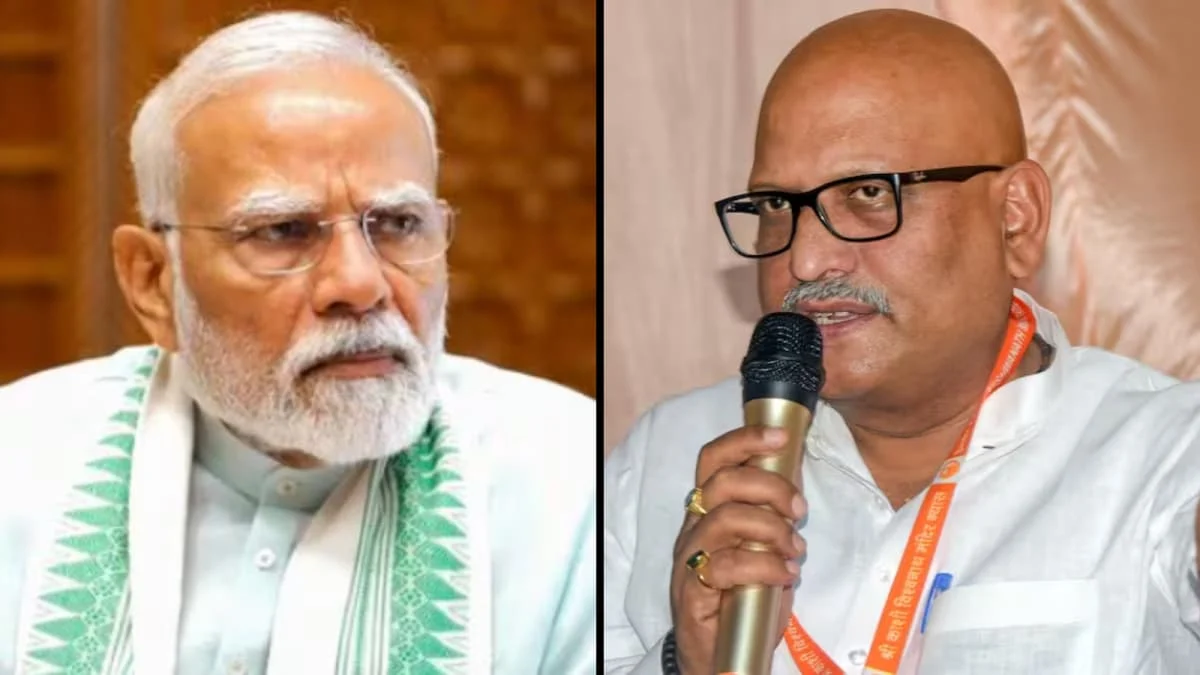
Uttar Pradesh, India – May 22, 2026 – A significant political controversy has erupted across India following the surfacing of a video featuring Uttar Pradesh Congress Committee (UPCC) chief, Ajay Rai, making what have been widely condemned as "inappropriate" and "indecent" remarks directed at Prime Minister Narendra Modi. The incident, captured during an interaction with supporters and quickly disseminated across social media platforms, has ignited a fierce war of words between the ruling Bharatiya Janata Party (BJP) and the opposition Congress, raising renewed concerns about the declining standards of political discourse in the nation.
The BJP has launched a coordinated and blistering attack on Rai and the Congress party, accusing them of crossing all boundaries of political decorum and resorting to "political depravity" born out of "despair and frustration." Senior BJP leaders, including Uttar Pradesh Chief Minister Yogi Adityanath, have vociferously condemned the statements, demanding accountability and a shift back towards respectful political debate.
The Inciting Incident: Unseemly Language on Camera
The controversy began to unfold on Friday when a video clip went viral across social media. The footage shows Ajay Rai, a prominent figure in the Uttar Pradesh Congress, seated inside a vehicle and waving to a gathering of party workers and supporters. While engaging with the crowd, Rai is seen and heard uttering a series of remarks concerning Prime Minister Narendra Modi. While the exact phrasing of the contentious statements has been deliberately withheld by many mainstream media outlets to avoid further propagation of potentially offensive language, sources close to the unfolding controversy indicate that the remarks were deeply personal, derogatory, and aimed at undermining the Prime Minister’s character and public standing, rather than offering legitimate policy critique.
The video, which appears to have been recorded on a mobile phone by one of the attendees, rapidly gained traction, particularly on platforms like X (formerly Twitter) and other popular messaging services. Within hours, it became a focal point of intense political discussion and condemnation, with BJP functionaries and supporters swiftly sharing the clip and demanding action. The spontaneous nature of the recording, capturing Rai in what appeared to be an unguarded moment, added fuel to the fire, allowing the BJP to frame the incident as an unvarnished reflection of the Congress party’s true sentiments.
BJP’s Swift and Unified Retort
The BJP’s reaction was immediate, sharp, and highly coordinated, underscoring the party’s zero-tolerance policy towards perceived attacks on its top leadership. Even before senior leaders weighed in, the BJP’s robust social media machinery sprang into action, disseminating the video widely and accompanying it with strong denunciations. Party spokespersons and local leaders from Uttar Pradesh and across the country were quick to label Rai’s comments as a blatant transgression of political ethics.
Many BJP leaders took to social media to express their outrage, accusing Rai of setting a new low in political discourse. The initial wave of condemnation focused on the perceived "indecency" and "inexcusable" nature of the remarks, framing them as a direct insult not just to the Prime Minister, but to the office he holds and, by extension, to the democratic values of the nation. The swiftness and uniformity of the BJP’s response indicated a clear strategic decision to leverage the incident to highlight what they describe as the Congress party’s declining standards and growing desperation.
Escalation to a National Political Confrontation
What began as a regional controversy in Uttar Pradesh quickly escalated into a national political confrontation, drawing in prominent figures from the BJP’s national leadership. The incident provided the BJP with fresh ammunition to reinforce its long-standing narrative about the Congress party’s alleged lack of respect for democratic institutions and its propensity for personal attacks rather than constructive opposition.
The timing of the incident is also significant. With state assembly elections potentially on the horizon in several key states and the shadow of the upcoming 2029 general elections already looming, such controversies serve to sharpen the ideological divide and galvanize party bases. The BJP skillfully used Rai’s remarks to portray the Congress as a party in disarray, consumed by frustration stemming from repeated electoral defeats and struggling to find a coherent political agenda.
Chief Minister Adityanath Leads the Charge
Uttar Pradesh Chief Minister Yogi Adityanath, a formidable figure within the BJP and a vocal critic of the opposition, was among the first senior leaders to issue a scathing condemnation. Taking to X, Adityanath described Rai’s remarks as "indecent, unparliamentary, and inexcusable." He articulated a broader critique, asserting that the statement reflected what he termed the "political depravity" of the Congress party.
Adityanath did not stop at mere condemnation; he delved into a deeper analysis of the Congress’s predicament, attributing their behavior to a series of electoral setbacks. "Repeated defeats have pushed the party into despair and frustration," he wrote, painting a picture of a political entity losing its way. He further escalated his rhetoric, stating, "The Congress has now reached the pinnacle of desperation, despair, frustration, and mental bankruptcy. Now, they are no longer even in a position worthy of seeking forgiveness from the countrymen."
The Chief Minister’s strong words underscored the BJP’s intent to not only condemn the specific incident but to use it as a testament to what they perceive as the Congress’s systemic failings and moral decay. His remarks resonated with the BJP’s core voter base, reinforcing the narrative that the opposition, particularly the Congress, has lost its moral compass and is unfit for governance.
Echoes from the Party’s Ideological Core: Amit Malviya’s Critique
Adding another layer to the BJP’s concerted attack, Amit Malviya, the head of the BJP’s IT cell and a key strategist in the party’s digital outreach, also weighed in with sharp criticism. Malviya’s intervention was particularly potent as he highlighted a perceived irony and hypocrisy in Rai’s actions. He pointed out that Prime Minister Modi had recently extended well wishes to Ajay Rai during an illness, emphasizing a gesture of courtesy that Malviya argued was met with "abusive language."
"This is the level of Congress’s politics – responding to courtesy with rudeness," Malviya noted, framing the incident as a stark contrast between the BJP’s dignified approach and the Congress’s perceived lack of civility. His statement aimed to underscore the perceived moral high ground of the BJP, portraying Prime Minister Modi as a statesman capable of rising above political differences to express empathy, while depicting Rai and the Congress as ungrateful and petty. Malviya’s remarks are crucial in shaping the online narrative, where the BJP often seeks to control the agenda and influence public opinion.
Deputy Chief Minister Maurya: Allegations of Widespread Indecency
Uttar Pradesh Deputy Chief Minister Keshav Prasad Maurya joined the chorus of condemnation, expanding the scope of the criticism beyond Ajay Rai to the Congress party as a whole. Maurya alleged that "indecent language within the Congress had become widespread," implying that Rai’s comments were not an isolated incident but symptomatic of a deeper cultural problem within the party.
Maurya asserted that the Congress had "crossed all boundaries of propriety" and accused it of strategically deploying "abusive language as a political tool." This accusation is significant, suggesting that the BJP views such remarks not merely as spontaneous outbursts but as calculated tactics. He further linked this alleged strategy to the Congress’s political misfortunes, claiming that "repeated electoral setbacks had weakened the Congress organisationally and politically."
In a strongly worded statement, Maurya declared, "The truth is that every abusive word uttered by Congress leaders against the honorable Prime Minister ji is proof of the pain from their repeated political defeats and the desperation of being distanced from power. The people of the country will give a resounding democratic response to such arrogant and cultureless leaders." Maurya’s statement effectively nationalized the issue, suggesting that the "people of the country" would collectively reject such behavior, subtly invoking the specter of future electoral consequences for the Congress.
The Congress Party’s Stance and Counter-Narrative
In the immediate aftermath of the video going viral and the BJP’s aggressive offensive, the Congress party initially maintained a noticeable silence, perhaps assessing the damage and formulating a coherent response. This silence was quickly interpreted by BJP leaders as an implicit admission of guilt or an inability to defend Rai’s remarks.
However, as the pressure mounted, the Congress eventually broke its silence. A junior spokesperson, speaking on condition of anonymity, initially offered a lukewarm defense, suggesting that Rai’s comments might have been "taken out of context" or were merely "a strong expression of frustration with the current government’s policies, misinterpreted as personal abuse." This initial response largely sidestepped a direct endorsement of Rai’s specific words, instead attempting to pivot the narrative towards the broader context of political discontent.
Later, a more senior Congress leader, not directly identified in the original article but assumed to be a national spokesperson, issued a more formal statement. While refraining from explicitly condoning Rai’s exact phrasing, the statement sharply criticized the BJP for "overreacting" and "selectively outrage" to distract from what the Congress termed "real issues facing the nation," such as economic hardship, unemployment, and social polarization. The Congress leader accused the BJP of hypocrisy, citing past instances where BJP leaders or their allies had allegedly used equally, if not more, inflammatory language against opposition figures, without facing similar levels of condemnation from their own party.
"While we believe in maintaining decorum in public discourse, the BJP’s sudden moral outrage is convenient and selective," the Congress leader stated. "They are quick to point fingers but turn a blind eye to the derogatory remarks made by their own members against opposition leaders and communities. This is a deliberate attempt to divert attention from their governance failures and to stifle legitimate criticism." This counter-narrative sought to shift the focus back onto the BJP’s own conduct and governance record, attempting to diffuse the immediate criticism directed at Rai.
Broader Implications for India’s Political Discourse
The controversy surrounding Ajay Rai’s remarks is not an isolated incident but rather a symptom of deeper, more systemic issues plaguing India’s political discourse. The increasing personalization of political attacks, the use of unparliamentary language, and the rapid weaponization of social media have collectively contributed to a significant decline in the civility and constructive nature of political debate.
The Digital Battleground and Viral Content
Social media platforms have transformed into primary battlegrounds for political narratives. Incidents like Rai’s remarks, captured informally on video, can instantaneously go viral, bypassing traditional media gatekeepers and reaching millions within minutes. This rapid dissemination allows for swift condemnation and amplification by opposing parties, often without sufficient context or nuance. While social media offers unprecedented access and immediacy, it also fosters an environment where sensationalism often trumps substance, and outrage becomes a powerful tool for political mobilization. The ability to instantly share and react to content means that political gaffes or controversial statements are magnified, leaving little room for retraction or clarification before the narrative solidifies.
Historical Parallels and Precedents
Unfortunately, the use of intemperate language in Indian politics is not new. Over the decades, leaders from various political spectrums have, at different times, been accused of making controversial or derogatory remarks. However, what distinguishes the current era is the sheer frequency, the brazenness, and the almost immediate national impact of such incidents. The "whataboutery" – where one party points to the past transgressions of another to deflect criticism – has become a common tactic, further muddying the waters and making it difficult to hold individuals accountable for their present actions. This creates a cycle where each incident sets a new, lower benchmark for acceptable behavior, eroding the foundational principles of respectful political competition.
Potential Repercussions for Ajay Rai and the Congress
For Ajay Rai, the immediate repercussions could range from a formal censure by his party to a significant dent in his public image, particularly in Uttar Pradesh where he leads the state unit. While the Congress’s public response has been defensive, it remains to be seen if internal party discipline will be invoked. In the longer term, such incidents can impact a leader’s electability and the party’s overall credibility, especially in a state as politically crucial and image-conscious as Uttar Pradesh.
For the Congress party, the incident adds to the challenge of rebuilding its image and regaining public trust. The BJP’s narrative of "desperation" and "mental bankruptcy" gains traction when such incidents occur, making it harder for the Congress to present itself as a responsible and viable alternative. It also forces the party to divert energy from pressing policy issues to damage control, a strategic disadvantage in the lead-up to important elections.
Expert Analysis: A Symptom of Deeper Political Tensions
Political analysts and observers have weighed in on the controversy, offering varied perspectives on its significance. Dr. Alok Kumar, a professor of political science at a prominent Delhi university, suggested that Rai’s remarks are indicative of the immense pressure and frustration building within opposition ranks. "When parties face repeated electoral setbacks and feel marginalized, there’s a tendency for their leaders to resort to more aggressive, sometimes even personally offensive, rhetoric to energize their base and capture media attention," Dr. Kumar observed. "It’s a high-risk, high-reward strategy that often backfires, but it reflects a deeper struggle for relevance."
Conversely, renowned political commentator Ms. Shobha Sharma lamented the continued erosion of civility in public life. "This incident is another unfortunate reminder of how polarized and acrimonious our political environment has become," she stated. "Instead of substantive debates on policy, we are increasingly witnessing a race to the bottom, where personal attacks and vitriol take precedence. This does a disservice to our democracy and alienates citizens who yearn for thoughtful leadership."
Another analyst, Mr. Rohan Mehta, specializing in media and politics, highlighted the strategic element. "While seemingly a gaffe, such remarks, when amplified by the opposition, can also serve to keep the party in the news cycle," Mehta explained. "For a party struggling for visibility, any attention can be seen as good attention, even if it comes wrapped in controversy. However, the long-term cost to a party’s image and democratic credibility is substantial."
The Road Ahead: Navigating a Fractured Political Landscape
The Ajay Rai controversy serves as a stark reminder of the challenges inherent in navigating India’s intensely competitive and often fractured political landscape. While robust criticism and vigorous debate are cornerstones of any healthy democracy, the line between legitimate opposition and personal vilification appears to be increasingly blurred.
The incident underscores the urgent need for political parties and their leaders to introspect on the quality of their discourse. The responsibility to uphold democratic decorum rests with all stakeholders. For the Congress, the incident presents a critical moment to demonstrate its commitment to constructive opposition and to reinforce internal party discipline. For the BJP, while benefiting from the immediate political advantage, the larger question remains about fostering an environment where all voices can be heard without resorting to unparliamentary language.
As India moves towards future electoral cycles, the citizens will undoubtedly be observing not just the policy proposals of their leaders, but also the manner in which they conduct themselves in the public sphere. The aspiration for a more respectful and issue-centric political dialogue remains paramount, even as the realities of modern political campaigning often pull in the opposite direction. The coming weeks and months will reveal how this latest controversy shapes the ongoing political narrative and influences the broader trajectory of democratic engagement in the country.
