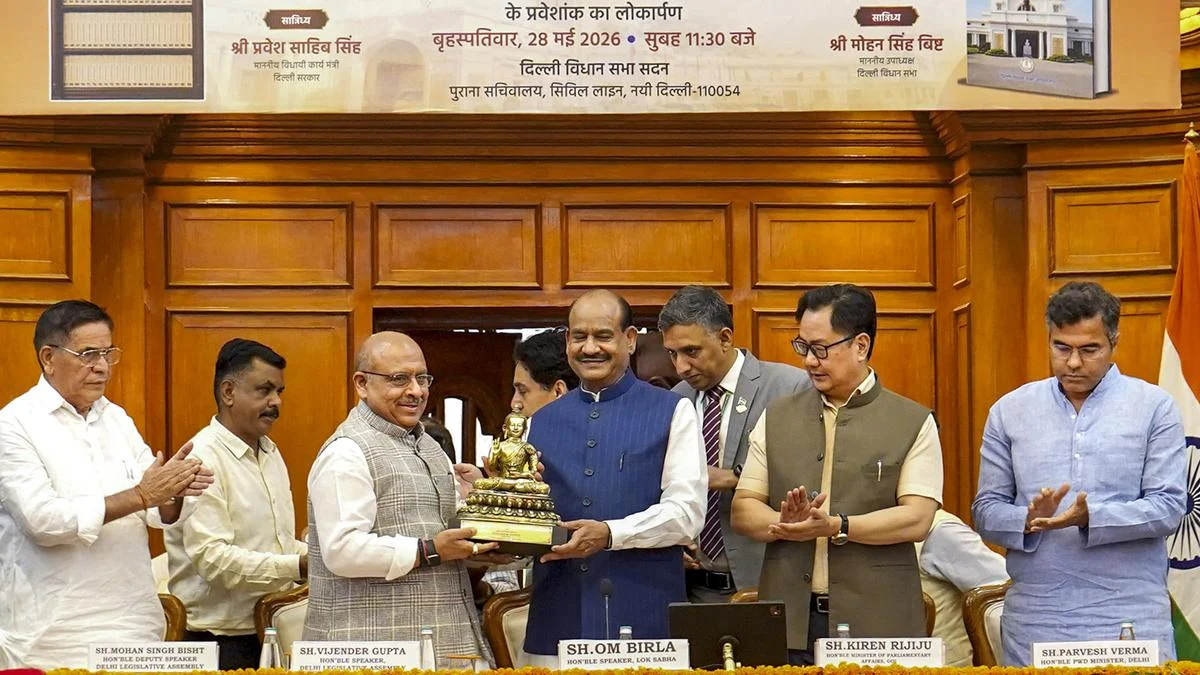
NEW DELHI — In a landmark event aimed at bridging the gap between India’s colonial legislative history and its modern democratic identity, Lok Sabha Speaker Om Birla presided over the ceremonial release of 89 comprehensive volumes documenting the proceedings of the Central Legislative Assembly from 1924 to 1930. The ceremony, held on May 28, 2026, at the historic Delhi Legislative Assembly, also marked the launch of ‘Vidhan Chetna,’ a new quarterly magazine intended to enhance legislative literacy and public engagement.
The publication of these archives is viewed by historians and constitutional experts as a monumental effort to preserve the "intellectual heritage" of India’s journey toward self-rule. Accompanied by high-ranking officials including Union Minister of Parliamentary Affairs and Minority Affairs Kiren Rijiju, Delhi Assembly Speaker Vijender Gupta, and Delhi Parliamentary Affairs Minister Parvesh Sahib Singh, Speaker Birla underscored the necessity of historical transparency in strengthening the foundations of the contemporary Republic.
I. Main Facts of the Launch Ceremony
The release of the 89 volumes represents one of the most significant archival projects undertaken by a state assembly in recent years. These volumes meticulously document a period of intense legislative activity during the British Raj—a time when Indian legislators began utilizing the floor of the House to challenge colonial authority through constitutional means.
Key Highlights:
- The Archives: 89 volumes covering the six-year span from 1924 to 1930.
- The Magazine: The inaugural issue of ‘Vidhan Chetna’ was unveiled, designed to serve as a bridge between the legislature and the citizenry.
- The Venue: The Delhi Legislative Assembly, which served as the actual seat of the Central Legislative Assembly before the completion of the Council House (now the Old Parliament House) in 1927.
- Objective: To provide a fact-based historical resource for researchers, students, and public representatives to understand the evolution of parliamentary debate in India.
Speaker Om Birla described the documents as a "guiding light," stating that they offer a window into the minds of the pioneers of Indian democracy who fought for the country’s dignity within the very halls where the ceremony took place.
II. Chronology: The Era of 1924–1930
To understand the significance of these 89 volumes, one must look at the turbulent and transformative years they chronicle. The period between 1924 and 1930 was a watershed moment for the Indian independence movement, shifting from purely external protest to "council entry."
1924–1925: The Rise of the Swarajists
Following the suspension of the Non-Cooperation Movement, leaders like Motilal Nehru and Chittaranjan Das formed the Swaraj Party. They sought to "wreck the government from within" by contesting elections and entering the Central Legislative Assembly. The volumes from these years detail the sophisticated legal and political arguments used by Indian members to obstruct oppressive colonial budgets.
1925: A Milestone in Speakership
In 1925, Vithalbhai Patel was elected as the first Indian President (Speaker) of the Central Legislative Assembly. His tenure is heavily documented in these volumes, showcasing his efforts to establish the independence of the Chair from the British executive—a precedent that Lok Sabha Speakers continue to follow today.
1928–1929: The Simon Commission and Public Safety Bill
The archives cover the intense debates surrounding the Simon Commission and the controversial Public Safety Bill. This period also includes the records of the assembly during the historic moment in April 1929, when revolutionaries Bhagat Singh and Batukeshwar Dutt threw "harmless" smoke bombs into the chamber to protest the Trade Disputes Bill and the Public Safety Bill, famously declaring they wanted "to make the deaf hear."
1930: The Call for Purna Swaraj
The chronology concludes as the Indian National Congress shifted toward the demand for complete independence (Purna Swaraj), leading to the mass resignation of many Indian legislators from the assembly to join the Salt Satyagraha.
III. Supporting Data and Archival Significance
The compilation of these 89 volumes was a Herculean task involving the digitization of brittle manuscripts, cross-referencing official colonial records, and ensuring the accuracy of translated debates.
Data Points:
- Volume Count: 89 individual books, categorized by legislative session and subject matter.
- Page Count: Estimated at over 45,000 pages of parliamentary transcripts.
- Content Diversity: Includes adjournment motions, budgetary questions, legislative amendments, and the "Presidential Rulings" of Vithalbhai Patel.
- Accessibility: The project aims to make these volumes available in both physical libraries and digital repositories for global academic access.
The Delhi Assembly, under the leadership of Speaker Vijender Gupta, spearheaded the curation. Gupta noted that the preservation of these records is not merely an act of storage but an act of "democratic restoration," ensuring that the rhetoric and logic of India’s founding fathers are not lost to time.
IV. Official Responses and Speeches
The event featured several high-profile addresses that touched upon the current state of Indian parliamentary democracy and the lessons to be drawn from the past.
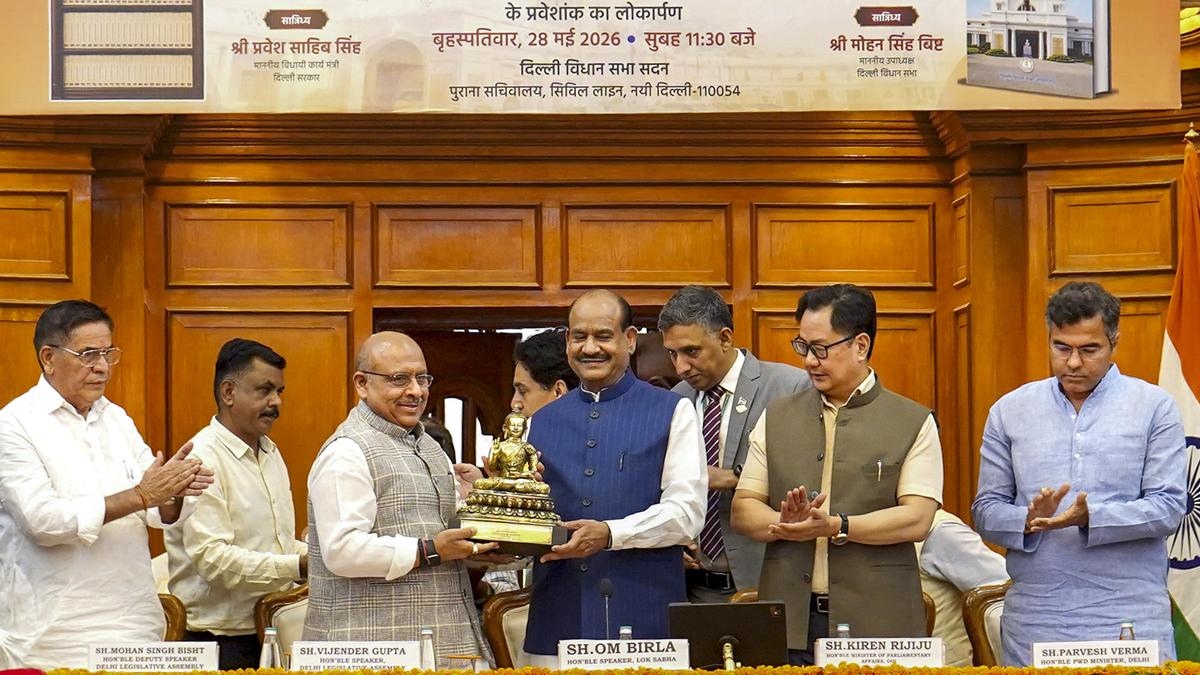
Om Birla, Lok Sabha Speaker
Speaker Birla focused on the "dignity of the house." He remarked, "Fact-based debates are the lifeblood of a democracy. When we look at these 89 volumes, we see a tradition of rigorous research and reasoned disagreement. Our ancestors did not just shout; they argued with facts. This is what strengthens constitutional institutions." He urged current public representatives to emulate the discipline found in the 1924-1930 records.
Kiren Rijiju, Union Minister
Minister Rijiju took a more cautionary tone, warning against the modern trend of using legislative chambers for "self-image building."
"There are elements today, both within and outside the country, that seek to undermine our progress by attacking the credibility of our constitutional bodies," Rijiju stated. He emphasized that respecting these institutions is a collective responsibility and that attacking them after being "rejected by the people" is a disservice to the nation. He praised the Delhi Assembly for its work in reinforcing the historical foundations of the Indian state.
Vijender Gupta, Delhi Assembly Speaker
As the host of the event, Gupta highlighted the local significance of the Delhi Assembly building. He noted that the "Old Secretariat" is a living monument of history and that the launch of ‘Vidhan Chetna’ would help the younger generation connect with the legislative process through a modern, accessible medium.
V. Implications for the Future of Indian Governance
The release of these archives and the launch of the new magazine carry several long-term implications for the Indian political and educational landscape.
1. Academic and Legal Research
For constitutional lawyers and historians, these volumes provide primary source material to track the evolution of Indian law. Many contemporary laws have their roots in the debates of the 1920s. Access to these records will allow for a deeper understanding of the "legislative intent" behind early Indian jurisprudence.
2. Strengthening Parliamentary Decorum
By highlighting a period where debate was characterized by intellectual depth—even under the constraints of colonial rule—the government and the Speaker’s office are setting a benchmark for current Members of Parliament (MPs) and Members of Legislative Assemblies (MLAs). The move is a subtle call to return to "substantive politics" over "disruptive politics."
3. Countering Misinformation
In an era of digital misinformation, the publication of "fact-based" historical volumes provides an objective record of India’s political evolution. This serves as a defense against the distortion of history for political ends.
4. Legislative Literacy through ‘Vidhan Chetna’
The quarterly magazine ‘Vidhan Chetna’ is expected to play a crucial role in "demystifying" the assembly. By explaining complex legislative procedures and profiling the work of various committees, the magazine aims to foster a more informed electorate, which is essential for a healthy democracy.
5. Institutional Pride
The collaboration between the Union government and the Delhi Assembly (represented by Birla and Rijiju alongside Gupta and Singh) signals a unified front in preserving national history, regardless of the complexities of modern federal politics. It reinforces the idea that while political parties may change, the institution of the legislature remains a permanent pillar of the state.
Conclusion
The unveiling of the 89 volumes of the Central Legislative Assembly proceedings is more than a bibliographic achievement; it is a reaffirmation of India’s commitment to its democratic roots. As Lok Sabha Speaker Om Birla noted, these volumes are not just "old papers" but are the "recorded heartbeat" of a nation striving for its soul. By making these records public, the Delhi Assembly has ensured that the voices of the past will continue to inform, challenge, and inspire the leaders of the future.
As India continues to assert its position on the global stage, the preservation of its parliamentary history serves as a reminder that its democracy is not a recent gift, but a hard-won legacy built on decades of sophisticated, intellectual, and courageous legislative struggle.