

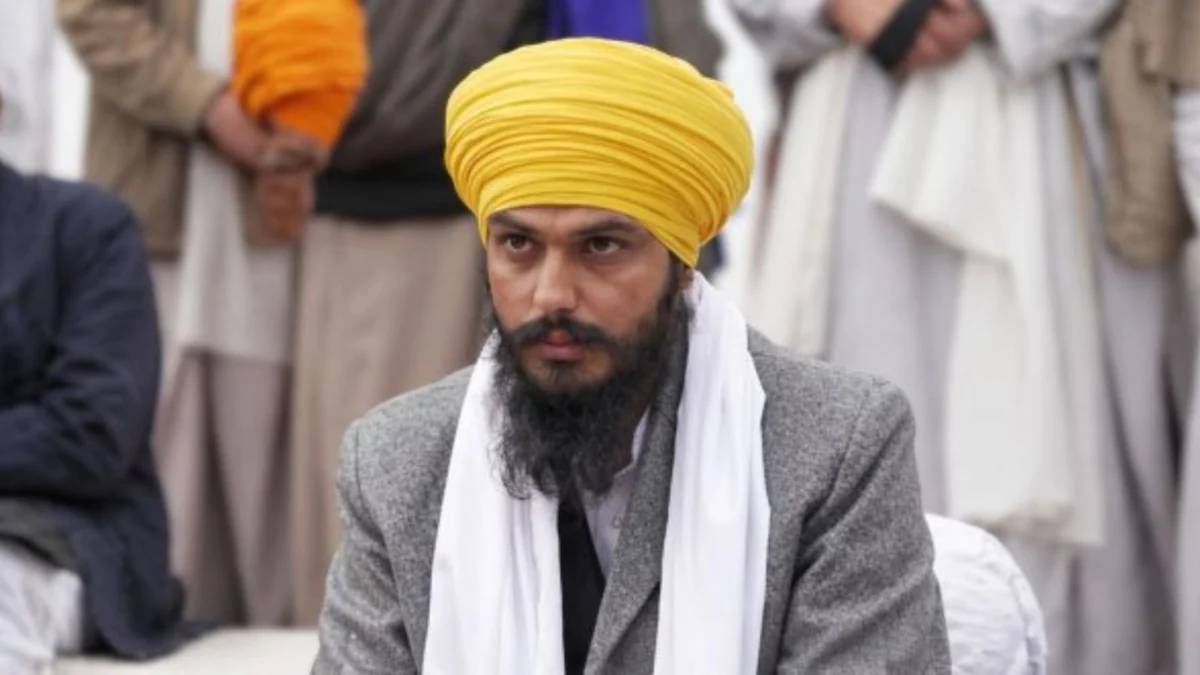
CHANDIGARH, Punjab – In a move that has sent ripples through Punjab’s political establishment, Niranjan Singh, a former Deputy Director of the Enforcement Directorate (ED) renowned for his unyielding stance against corruption, formally joined the Akali Dal (Waris Punjab De) on Wednesday. The party, currently spearheaded by the detained Khadoor Sahib MP Amritpal Singh, has been steadily attracting a diverse array of figures, signaling a concerted effort to redefine its public image and political agenda.
Singh’s defection is particularly significant given his long-standing reputation as a scrupulously apolitical and hard-nosed enforcement officer. His decision underscores a growing trend within Punjab, where the Waris Punjab De (WPD) movement, once primarily associated with radical rhetoric, appears to be strategically repositioning itself as a mainstream political entity. This shift is not isolated; it follows the high-profile entry of Manpreet Singh Ayali, a prominent three-time MLA and former stalwart of the Shiromani Akali Dal (SAD), who joined WPD in June.
The most intriguing aspect of these new affiliations is the explicit emphasis by these recent recruits on what the party isn’t about, actively working to shed the radical perceptions that have historically shadowed WPD and its leader, Amritpal Singh.
A Confluence of Dissatisfaction and Redefinition
The Waris Punjab De, initially gaining prominence through Amritpal Singh’s impassioned calls for a separate Sikh homeland, Khalistan, and his focus on Sikh religious revival, now finds itself at a critical juncture. With its leader in detention, the party appears to be undergoing a strategic transformation, seeking to broaden its appeal beyond its traditional base and address a wider spectrum of public grievances. This evolution is driven by a blend of disillusionment with established political parties and a perceived vacuum in effective governance.
Niranjan Singh, known for spearheading several high-profile investigations during his tenure at the ED, articulated his primary motivations for joining WPD as a response to the pervasive issues plaguing Punjab. "I am not a politician; I won’t contest any election," Singh clarified, dispelling immediate speculation about his electoral ambitions. "I have joined the party on four critical issues: the rampant drug problem, high-level corruption, the deteriorating law and order situation, and chronic unemployment." His pointed criticism of the current law and order scenario, citing the case of dismissed AIG Raj Jit Hundal, accused of drug trafficking, as emblematic of the "rot" within the system, highlights the deep-seated frustration driving his political foray.
The Constitutional Framework and National Unity
Perhaps the most striking aspect of WPD’s evolving narrative comes from its new entrants’ unequivocal embrace of national unity and constitutional principles. Niranjan Singh was resolute in his stance: "There can’t be any compromise on the unity or sovereignty of our country." When pressed on the Khalistan demands previously associated with Amritpal Singh, he dismissed them firmly: "What Khalistan? This is our homeland; we already have it. There is no question of another homeland." This clear articulation marks a significant departure from the more ambiguous positions sometimes perceived in the past.
Manpreet Singh Ayali, a veteran politician with over two decades in the Shiromani Akali Dal, affirmed that his decision to join WPD was contingent on the party’s commitment to operating strictly "within the framework of the Constitution." "I was very clear about it," he stated, underscoring the non-negotiable nature of this condition. Ayali’s move, given his deep roots within the traditional Akali establishment, signifies a major realignment and a tacit endorsement of WPD’s purported shift towards constitutionalism.
This emphasis on national integrity and constitutional adherence is a calculated strategy to broaden the party’s appeal, reassure a wary electorate, and perhaps, address the legal and political challenges faced by its detained leader. It suggests a pragmatic recognition that radical posturing may not translate into widespread political success in contemporary Punjab.
The Decline of the Old Guard and the Rise of a New Platform
For Manpreet Singh Ayali, WPD’s burgeoning popularity, particularly among the youth, is inextricably linked to the precipitous decline of the Shiromani Akali Dal (SAD). Ayali offered a scathing critique of his former party, asserting, "The SAD was formed over 100 years ago to represent the Panth. It combined politics with religion. But over time, it became a party of the Badals." This sentiment echoes a widespread perception in Punjab that the SAD, once the vanguard of Sikh politics, has become dynastic and disconnected from the aspirations of the common people.
Ayali reserved particular criticism for SAD chief Sukhbir Badal, accusing him of being adept at "vote management" but failing to grasp "Sikh sentiment." He pinpointed the beginning of SAD’s downfall to an event 11 years prior: the party’s controversial pardon of Dera Sacha Sauda chief Ram Rahim for impersonating Guru Gobind Singh. "It started a chain of events that culminated in sacrilege and the killing of two protesters," Ayali lamented, referring to the infamous Bargari sacrilege incidents and subsequent police firings that deeply scarred the Sikh psyche and significantly eroded SAD’s credibility.
Ayali, who was nominated by the Akal Takht – the highest temporal seat of Sikhism – to a panel tasked with recruiting members, claimed that their efforts brought 15 lakh young people into the party fold. This initiative, however, reportedly exacerbated his strained relationship with Sukhbir Badal, hinting at internal dissent within SAD that WPD is now capitalizing on.
WPD’s appeal to the youth, according to Ayali, stems from its presentation as a "new platform against drugs, corruption, and unemployment." These issues resonate deeply with Punjab’s younger generation, who feel disenfranchised and neglected by traditional political forces. The party’s ability to tap into this widespread disaffection is proving to be a potent political tool.
Embracing Inclusivity: "Sarbat Da Bhalla" and Diverse Leadership
Beyond constitutional adherence, WPD is actively working to project an image of inclusivity, drawing upon the core Sikh principle of "sarbat da bhalla" – the welfare of all. Ayali emphasized this philosophy, stating, "There is no discrimination in our mind against anyone. We will field Hindus and Muslims as well. If we form a government, we will have two deputy CMs, one Hindu and one Dalit." This promise of a diverse leadership structure, particularly the commitment to Hindu and Dalit Deputy Chief Ministers, is a bold statement designed to reassure non-Sikh communities and broaden the party’s electoral base significantly.
This conscious effort to broaden the party’s appeal is not a recent phenomenon. Anonymous retired bureaucrats have confirmed that senior WPD members have actively approached them for advice on making the outfit more inclusive. The shift in rhetoric was notably visible even before the 2024 Assembly elections, when Amritpal Singh’s father, Tarsem Singh, affectionately known as Bapuji, addressed public gatherings. Rather than invoking Khalistan, his speeches consistently focused on the devastating impact of drugs on Punjab’s youth, promising that his son would dedicate himself to eradicating this menace.
The Drug Scourge: A Central Plank
The drug crisis has emerged as one of WPD’s most prominent political platforms. At the politically significant Rakhar Puniya rally last month, the party made a concrete promise to release a white paper on the drug problem, signaling its commitment to transparency and decisive action. This issue has proven to be a powerful magnet for new recruits, including controversial former Punjab Police DSP Balwinder Singh, who recently switched from the BJP to WPD.
Balwinder Singh, who had previously joined the BJP with similar hopes, articulated his reasons for joining WPD: "I am a very secular man. I am joining the party in the hope that it will work to weed out drugs." He was also critical of his former party, stating, "It was with the same hope that I joined the BJP, but it cannot absolve itself of responsibility for securing the border against drug smuggling." This highlights a perception among some disillusioned figures that traditional parties have failed to adequately address the drug problem, leaving an opening for WPD to position itself as a serious contender on this critical issue.
Niranjan Singh echoed this sentiment, stating his disillusionment with traditional parties and even the Aam Aadmi Party (AAP) drove his decision. His focus on drugs, corruption, law and order, and employment reflects a pragmatic approach to governance, aiming to tackle fundamental issues that directly impact the lives of ordinary Punjabis.
Towards a Broader Political Programme: The Vision Document
Waris Punjab De is not merely relying on individual high-profile defections and revised rhetoric; it is actively working to craft a more comprehensive political programme. Manpreet Singh Ayali revealed that the party would soon announce a panel tasked with preparing a "vision document" for Punjab.
"We are taking advice from every community, be it the youth, businessmen, traders, and farmers, about Punjab’s problems and solutions," Ayali explained. "Ours is a consultative party; we will decide on the basis of what people tell us." This consultative approach, aiming to gather input from diverse stakeholders, seeks to portray WPD as a grassroots-driven, responsive political force, in stark contrast to the perceived top-down decision-making of established parties.
Regarding potential alliances, particularly with the BJP, the Akalis’ long-time ally, Ayali remained non-committal yet firm on core principles. "We won’t make any alliance for kursi (power), and we won’t take any decision that goes against the Panth. That is non-negotiable." This statement indicates a strategic balancing act: while seeking broader appeal, WPD intends to safeguard its core identity and avoid any political compromises that might alienate its foundational Panthic support.
Skepticism and the "Political Adventure"
Despite these concerted efforts to rebrand and broaden its appeal, not everyone is convinced of WPD’s transformation. Dr. Pramod Kumar, a prominent political observer, views WPD’s current trajectory with skepticism. Pointing to the specific candidates WPD has historically fielded, he suggests that the party’s new positioning may not be sufficient to fundamentally alter its political character.
"This is a political adventure in which a party founded on a radical Panthic agenda is trying to project a moderate image by bringing in non-Panthic faces," Dr. Kumar opined. "This experiment is unlikely to succeed." His assessment highlights the significant challenge WPD faces in reconciling its radical origins with its current attempts at moderation and inclusivity. The historical baggage and the lingering association with Khalistan rhetoric, particularly given Amritpal Singh’s detention, present a formidable hurdle to achieving widespread acceptance as a mainstream, constitutional party.
The success of this "political adventure" will ultimately hinge on WPD’s ability to consistently demonstrate its commitment to constitutional principles, national unity, and inclusive governance, while simultaneously addressing the deep-seated socio-economic issues that resonate with the Punjabi populace. The coming months, particularly with an eye on future electoral contests, will be crucial in determining whether Waris Punjab De can truly shed its past and emerge as a significant, redefined force in Punjab politics, or if it remains, in the eyes of some, merely a temporary experiment struggling to overcome its foundational identity.
