

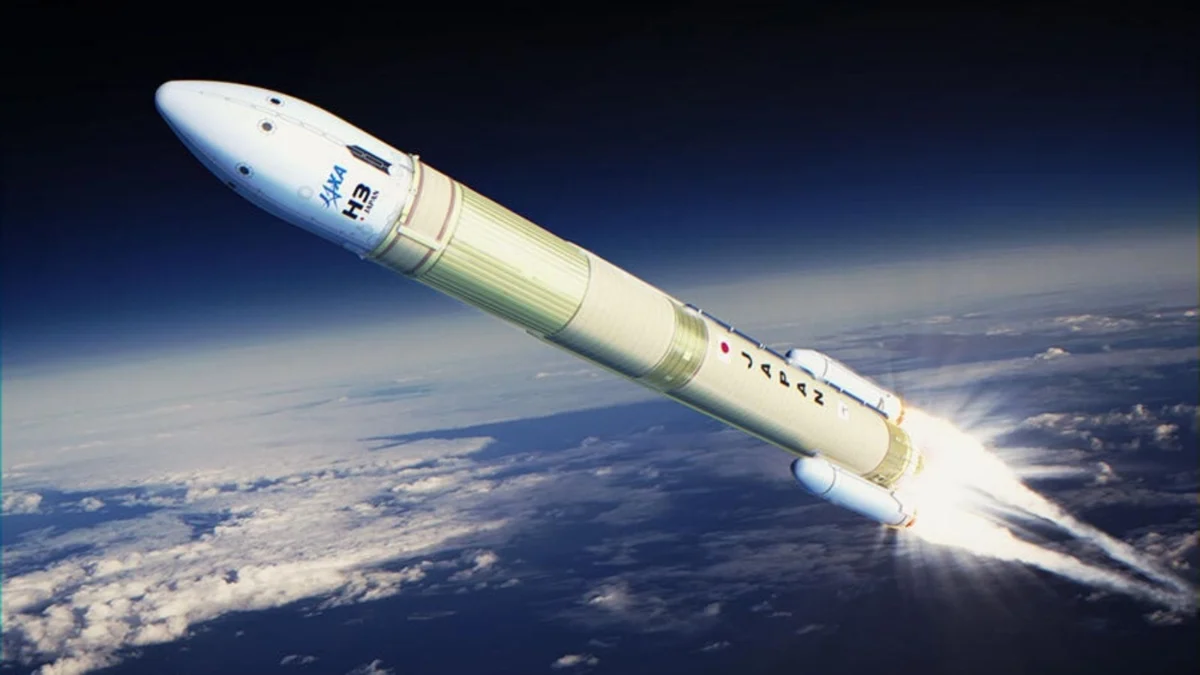
TANEGASHIMA, JAPAN — In a high-stakes display of engineering resilience and national ambition, the Japan Aerospace Exploration Agency (JAXA) successfully launched its flagship H3 launch vehicle on June 12, 2026. This mission, originating from the Tanegashima Space Centre, marks a definitive "return to flight" for Japan’s space program following a crushing mission failure in late 2025. By successfully deploying six distinct satellites into their targeted orbits, JAXA and its primary industrial partner, Mitsubishi Heavy Industries (MHI), have not only restored technical confidence in the platform but have also signaled Japan’s readiness to compete in an increasingly crowded global launch market.
The success of this mission is more than a routine orbital delivery; it is a critical validation of the corrective measures taken after the December 2025 disaster. With the H3 now operational in its most powerful configuration to date, Japan has solidified its path toward strategic autonomy in space, ensuring it remains a tier-one spacefaring nation capable of supporting government, scientific, and commercial interests.
Main Facts: A Flawless Execution in the Pacific
The launch occurred at precisely the scheduled window from the Yoshinobu Launch Complex. The H3 rocket, Japan’s successor to the venerable but expensive H-2A, performed a textbook ascent, shedding its solid rocket boosters and first stage before the upper stage took over to manage the complex task of multi-satellite deployment.
The Payload Manifest
The primary objective of the mission was the delivery of six satellites, representing a mix of scientific research, technological demonstration, and commercial application:
- PETREL and STARS-X: These were the first to be deployed, approximately 16 minutes into the flight. They focus on advanced orbital mechanics and potentially high-energy astrophysical observations.
- BRO-22: A commercial signals intelligence or maritime surveillance satellite, part of a growing constellation intended to monitor global shipping lanes.
- VERTECS: A sophisticated visible-light telescope designed for Earth observation or astronomical surveys.
- HORN-L and HORN-R: A pair of experimental satellites focused on communications and sensor testing.
JAXA confirmed that all six spacecraft reached their intended orbital parameters, a feat that requires precision timing and multiple re-ignitions of the second-stage engine—the very component that failed during the rocket’s previous outing.
Technical Milestone: The Three-Engine Configuration
A significant highlight of the June 12 launch was the debut of the H3 in its "Heavy" or three-engine configuration. While previous successful test flights utilized a two-engine setup, the addition of a third LE-9 engine to the first stage provides the thrust necessary to lift heavier payloads, such as large-scale telecommunications satellites or lunar cargo vessels. This configuration is essential for Japan’s future participation in the NASA-led Artemis program and its own deep-space exploration initiatives.
Chronology: The Turbulent Journey of the H3
To understand the weight of this success, one must look at the H3’s development history, which has been characterized by both groundbreaking innovation and heartbreaking setbacks.
2023: A False Start
The H3 project began with the goal of halving the cost of launches compared to the H-2A. However, the maiden flight in March 2023 ended in self-destruction. After a successful first-stage burn, the second-stage engine failed to ignite, forcing mission controllers to send a destruct command. This failure was a massive blow to JAXA, delaying the program by nearly a year.
2024–Early 2025: Building Momentum
Following the 2023 failure, JAXA engineers implemented rigorous changes to the ignition system. The rocket saw a string of five successful missions throughout 2024 and the first half of 2025. During this period, the H3 began to look like the reliable workhorse Japan had promised, carrying Earth-observation satellites and testing the modularity of its design.
December 2025: The Michibiki Disaster
The program hit a major "speed bump" in December 2025. The mission was intended to launch the Michibiki 5, a critical component of Japan’s Quasi-Zenith Satellite System (QZSS) for high-precision GPS. The flight failed when a damaged payload adapter—the structure that connects the satellite to the rocket—caused a chain reaction of mechanical issues. These issues interfered with the second stage’s ability to stabilize, preventing engine ignition and resulting in the loss of the expensive navigation satellite.
June 2026: The Return to Flight
The June 12 launch was the culmination of six months of intensive forensic engineering. JAXA and MHI redesigned the payload adapter and reinforced the structural integrity of the upper stage. The success of this most recent mission proves that the December 2025 failure was a mechanical anomaly rather than a fundamental design flaw in the H3 architecture.
Supporting Data: Technical Specifications and Market Positioning
The H3 is designed to be the "Swiss Army Knife" of rockets. It is a two-stage, liquid-fueled launch vehicle that uses liquid hydrogen and liquid oxygen.
The LE-9 Engine: A Feat of Engineering
The heart of the H3 is the LE-9 engine. Unlike the previous LE-7A, the LE-9 uses an expander bleed cycle, which is simpler and safer, though harder to manufacture at high thrust levels. The June 12 mission proved that clustering three of these engines is viable, providing a total thrust that rivals the world’s most powerful commercial rockets.
Cost-Effectiveness and Competition
One of the primary drivers for the H3 is cost. The H-2A cost roughly $100 million per launch, making it uncompetitive in a market dominated by SpaceX’s Falcon 9. The H3 aims to bring that cost down to approximately $50 million.
- Comparison: While the Falcon 9 remains cheaper due to reusability, the H3 offers a "bespoke" service for government and high-value commercial payloads that require specific orbital injections that ride-share missions cannot always provide.
- Payload Capacity: In its three-engine configuration, the H3 can loft over 6.5 metric tons to Geostationary Transfer Orbit (GTO), placing it in direct competition with Europe’s Ariane 6 and United Launch Alliance’s Vulcan Centaur.
Official Responses: Restoring National Pride
In the aftermath of the successful deployment, officials from across the Japanese aerospace sector expressed a mix of relief and renewed determination.
JAXA Statement:
In a press conference held at the Tanegashima Space Centre, a JAXA spokesperson stated: "Today’s success is a testament to the tireless work of our engineers and partners. We have addressed the issues from the December mission with transparency and rigor. The H3 is no longer just a prototype; it is Japan’s gateway to the stars."
Mitsubishi Heavy Industries (MHI):
A representative for MHI, the lead contractor, emphasized the commercial implications: "With the successful flight of the three-engine configuration, we are now ready to accept more diverse commercial contracts. We have proven that the H3 is a flexible, reliable, and powerful platform."
Government Support:
The Japanese government, which has recently increased its space budget to record levels, hailed the launch as a victory for national security. Prime Minister’s Office sources indicated that the H3 is "indispensable" for Japan’s ability to maintain its own satellite constellations without relying on foreign providers, particularly as geopolitical tensions in the Indo-Pacific region continue to rise.
Implications: The Future of Japan in the New Space Age
The success of the H3 has profound implications for the next decade of space exploration and global commerce.
1. Strategic Autonomy
For Japan, the H3 is a matter of national sovereignty. By having a domestic rocket capable of launching everything from spy satellites to lunar landers, Japan ensures it cannot be "locked out" of space by shifting political alliances or the commercial whims of foreign companies.
2. The Lunar Frontier and Artemis
Japan is a key partner in NASA’s Artemis program. The H3 is slated to launch the HTV-X, an advanced cargo ship designed to resupply the Lunar Gateway—a space station that will orbit the Moon. The success of the three-engine configuration is a prerequisite for these heavy-lift missions. Without a functioning H3, Japan’s contributions to human lunar exploration would be severely sidelined.
3. Commercial Market Penetration
The global satellite launch market is projected to be worth billions by 2030. Japan’s goal is to capture a significant share of this market by offering the H3 as a reliable alternative to American and European rockets. The successful deployment of six satellites at once demonstrates the "ride-share" capability that is highly sought after by private tech firms and emerging space nations.
4. Deep Space Exploration
Beyond the Moon, JAXA has plans for Martian moon exploration (the MMX mission) and other deep-space probes. The H3’s proven reliability will allow JAXA to greenlight these ambitious scientific endeavors with greater confidence, knowing that the "bus" to get them into space is stable.
Conclusion
The roar of the H3 engines over the Pacific on June 12, 2026, signaled the end of a period of uncertainty for Japan. By overcoming the mechanical failures of the past and successfully testing its most powerful iteration, the Japan Aerospace Exploration Agency has reaffirmed its status as a global leader in space technology. As the H3 settles into its role as the nation’s primary launch vehicle, the focus now shifts from "proving it works" to "making it work for the world." With the H-2A nearing retirement, the H3 has arrived just in time to carry Japan’s aspirations into the deep-space era.
