

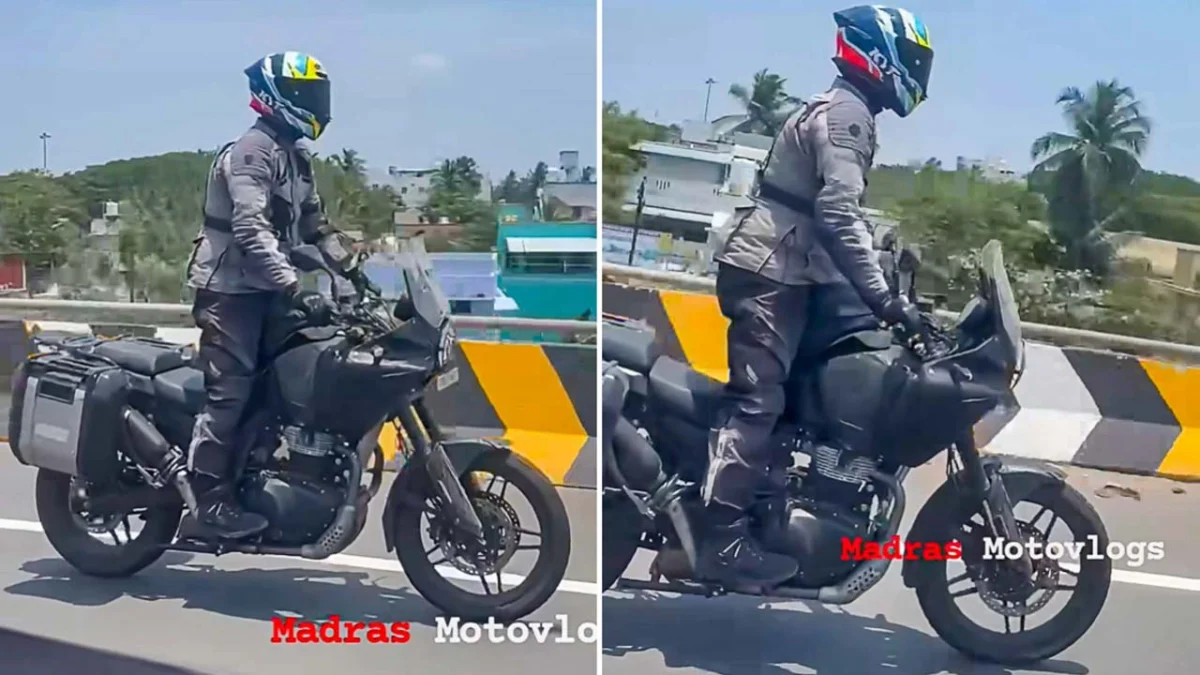
The global motorcycling landscape is currently witnessing a paradigm shift, led by the Chennai-based manufacturer Royal Enfield. Long celebrated for its retro-classic thumping singles, the company is now aggressively pivoting toward a more sophisticated, high-performance future. At the center of this transformation is the highly anticipated Royal Enfield Himalayan 750. Recently captured in a series of detailed spy photographs during real-world testing, the Himalayan 750 represents the pinnacle of Royal Enfield’s engineering evolution, aiming to bridge the gap between mid-weight accessibility and heavy-weight adventure performance.
Main Facts: A New Benchmark in Adventure Touring
The Royal Enfield Himalayan 750 is not merely an incremental update to the existing Himalayan 450; it is a fundamental reimagining of the brand’s adventure touring philosophy. The latest spy shots, which have sent ripples through the motorcycling community, provide the most comprehensive look yet at the motorcycle’s production-ready form, specifically focusing on its "saddling" ergonomics—the ability of a rider to stand comfortably on the footpegs while navigating technical off-road terrain.
Key highlights of the upcoming flagship include:
- Powertrain: A brand-new 750cc parallel-twin engine, evolved from the acclaimed 650cc platform found in the Interceptor and Continental GT.
- Suspension: Long-travel Upside Down (USD) front forks and a rear monoshock, both featuring high levels of adjustability, including a remote preload adjuster for the rear.
- Braking: A significant upgrade to a dual-disc setup at the front to manage the increased power and mass of the twin-cylinder machine.
- Technology: Integration of the "Tripper Dash," a circular TFT console featuring full-map navigation, smartphone connectivity, and various rider aids.
- Market Position: Designed to compete directly with global heavyweights such as the Honda XL750 Transalp, the Yamaha Ténéré 700, and the Suzuki V-Strom 800DE.
Chronology: The Road to 750cc
To understand the significance of the Himalayan 750, one must trace the lineage of Royal Enfield’s adventure aspirations.
2016 – The Birth of an Icon: Royal Enfield launched the original Himalayan 411. While it lacked outright power, its "LS410" long-stroke engine and rugged simplicity won over a global audience, proving that adventure riding didn’t require 100 horsepower.
2018 – The Twin-Cylinder Revolution: The introduction of the 650cc parallel-twin platform (Interceptor and Continental GT) proved that Royal Enfield could build world-class, vibration-free, and reliable multi-cylinder engines. Since then, enthusiasts have clamored for this engine to be placed in a Himalayan chassis.
2023 – The Sherpa 450: Royal Enfield introduced the Himalayan 450, its first liquid-cooled, high-revving DOHC engine. This was a bridge between the old-school 411 and the high-performance future.

2024-2025 – The 750cc Development: Following the success of the 450, internal reports and spy shots confirmed that the company was skipping a "Himalayan 650" in favor of a bored-out, more powerful 750cc platform to ensure the bike remained competitive in the European and North American markets.
November 2025 – EICMA Milan: Royal Enfield showcased a prototype/concept of the Himalayan 750, signaling that the project was nearing the final stages of validation.
Current Status: The motorcycle is undergoing rigorous road testing in India and Europe, with a commercial launch expected at EICMA 2026, followed by a phased global rollout.
Supporting Data: Technical Analysis and Ergonomic Revelations
The most recent spy shots have offered a deep dive into the "saddling" ergonomics of the Himalayan 750. In adventure motorcycling, saddling is a critical maneuver where the rider stands on the pegs to lower the center of gravity and use their legs as secondary shock absorbers over rough terrain.
Ergonomic Geometry
Observation of the test rider—who appears to be of slightly above-average height—suggests that Royal Enfield has mastered the rider triangle. The footpegs are positioned in a slightly rear-set orientation. This is a strategic choice; it allows for a sporty feel during high-speed highway cruising while providing a stable platform for standing. The handlebar is positioned high and wide, ensuring the rider does not have to stoop or overreach while standing, which significantly reduces fatigue during long-distance "Trans-Himalayan" style expeditions.
The 750cc Powerplant
While official specifications remain under wraps, industry analysts and leaked data suggest the following performance metrics:
- Estimated Power: 55 PS to 60 PS.
- Estimated Torque: 60 Nm to 65 Nm.
- Engine Character: Unlike the 650cc twin which is tuned for a linear, "easy-going" delivery, the 750cc unit is expected to have a meatier mid-range to handle the additional weight of luggage and a pillion, as well as the aerodynamic drag of a larger ADV fairing.
Hardware and Components
The Himalayan 750 will be the most technologically advanced Royal Enfield to date. The inclusion of a remote dial for rear suspension adjustment is a major "quality of life" feature, allowing riders to stiffen or soften the ride on the fly as they transition from smooth tarmac to rocky trails.

Furthermore, the braking system has been overhauled. Given that the bike is expected to weigh in the vicinity of 210-220 kg (kerb), the dual-disc front setup is a necessary safety and performance requirement. The wheels seen in the latest shots include both alloy and wire-spoke variants, suggesting that Royal Enfield will offer multiple trims: a road-biased tourer and a hardcore off-road "Rally" edition.
Official Responses and Market Strategy
Royal Enfield’s leadership has been vocal about their "18 launches in 5 years" strategy. Siddhartha Lal, Managing Director of Eicher Motors (Royal Enfield’s parent company), has frequently hinted that the 750cc platform is the "next big frontier" for the brand.
While the company has not officially commented on the specific technical details of the leaked spy shots, internal sources suggest that the 750cc engine is designed to be a "global engine," meeting stringent Euro 5+ and upcoming Euro 6 emission norms. This reflects the company’s shift from being an Indian manufacturer that exports, to a global manufacturer that happens to be headquartered in India.
The strategy for the Himalayan 750 is clear: Value-Driven Performance. By positioning the 750cc twin at a price point likely to undercut the European and Japanese competition by 20-30%, Royal Enfield aims to capture the "middle-weight plus" segment.
Implications: A New Era for the Mid-Weight Segment
The arrival of the Himalayan 750 carries significant implications for the motorcycle industry and the consumer alike.
1. Disrupting the Middle-Weight Status Quo
For years, the 700cc-800cc adventure segment has been dominated by premium brands with high entry costs. The Himalayan 750 could democratize this segment, offering "large-capacity" twin-cylinder touring capabilities to a much wider demographic. This "Robin Hood" approach—stealing market share from the elites to give to the masses—has been the cornerstone of RE’s success with the 650 twins.
2. Brand Perception Shift
The Himalayan 750 will act as a "halo" product. It moves Royal Enfield away from the "leisurely cruiser" image and firmly into the "performance enthusiast" category. If the 750cc engine proves to be as reliable as the 650cc unit, it will solidify Royal Enfield’s reputation for engineering excellence.

3. The "One Bike" Solution
For many riders, the 450cc single is slightly underpowered for long-distance highway hauling, while 1000cc+ ADVs are too heavy and expensive for daily use. The 750cc parallel-twin sits in the "Goldilocks" zone—powerful enough for 150 km/h highway cruising and agile enough for technical trails.
4. Expansion of the 750 Platform
The Himalayan is just the beginning. The 750cc engine will undoubtedly find its way into a "Super Interceptor," a "Continental GT 750" (as seen in other spy shots), and potentially a 750cc Cruiser. This modularity will allow Royal Enfield to scale its production and offer a diverse portfolio based on a single, robust engine architecture.
Conclusion
The latest spy shots of the Royal Enfield Himalayan 750 reveal a motorcycle that is mature, ergonomically sound, and mechanically ambitious. By focusing on the nuances of saddling ergonomics and high-end suspension componentry, Royal Enfield is signaling that it understands the needs of the serious adventure rider.
As the motorcycling world looks toward EICMA 2026, the Himalayan 750 stands as a testament to how far the brand has come. It is no longer just about nostalgia; it is about competing at the highest level of global motorcycling. For the enthusiasts waiting to stand on those pegs and head toward the horizon, the wait for the 750cc twin appears to be nearing a spectacular end.
